
What if the most straightforward solution for your eyesight is actually the one being overlooked in favour of more complex alternatives? If you’ve spent any time researching single vision lenses Essex, you’ve likely encountered a confusing maze of clinical terms like myopia, hyperopia, and astigmatism. It’s perfectly natural to feel a little overwhelmed by the jargon or to worry that you might be paying for lens extras that your lifestyle doesn’t actually require. At our Rayleigh and Benfleet centres, we believe that clarity shouldn’t just apply to your vision; it should apply to your understanding of your eye care too.
We understand the frustration of juggling two pairs of glasses. This expert guide is designed to demystify your prescription and provide you with the confidence to choose the right materials for your specific needs. We’ll compare single vision options against multifocal alternatives and explore how the latest 2024 consumer regulations on pricing transparency ensure you receive honest, professional advice. By the end of this guide, you’ll have a clear roadmap for your next visit to a trusted local optician, helping you achieve the perfect balance of comfort and visual excellence.
Key Takeaways
- Understand the fundamental differences between single vision and multifocal lenses to determine which focal power best suits your daily routine.
- Discover why choosing single vision lenses Essex can provide you with the widest, most distortion-free field of peripheral vision for tasks like driving or reading.
- Learn how to customise your eyewear with high-index materials and anti-reflective coatings to ensure your glasses are both lightweight and safe for night-time use.
- Debunk common myths regarding eye strain and find out when it’s most beneficial to wear your corrective lenses throughout the day.
- Recognise the value of independent optical care and how a comprehensive eye examination leads to a more precise, personalised prescription.
Understanding Single Vision Lenses: The Foundation of Corrective Eyewear
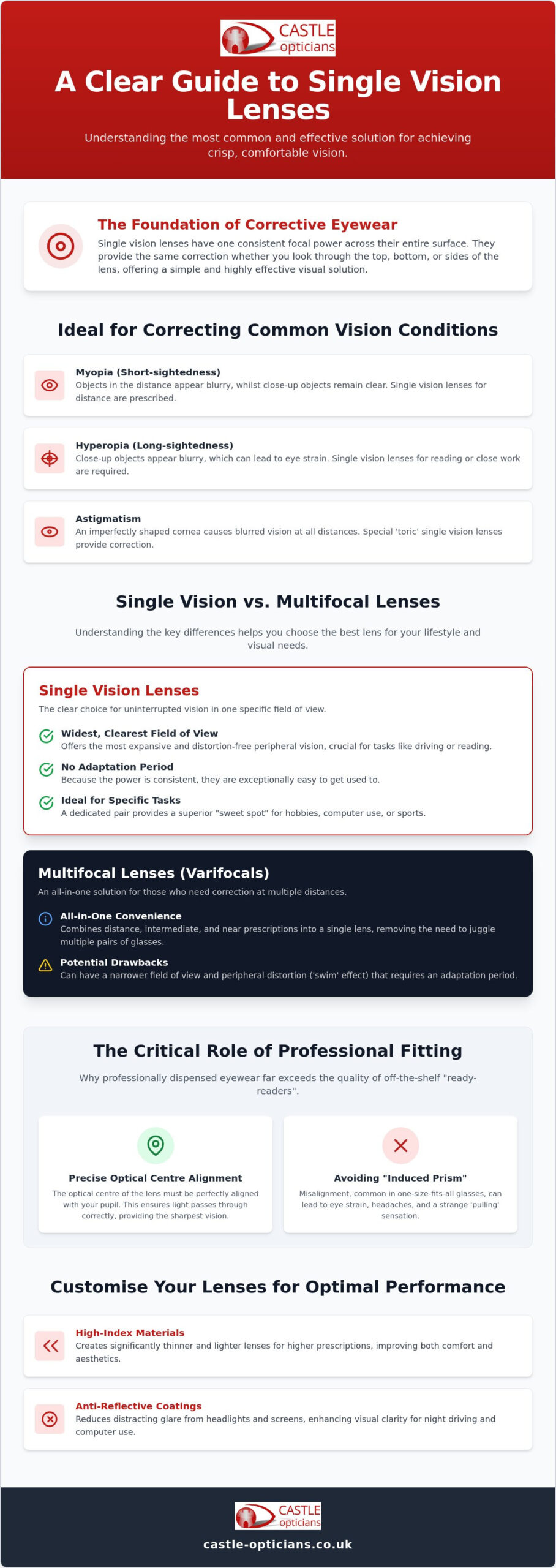
A Corrective lens with a single vision profile remains the most frequently prescribed solution in modern optometry. These lenses feature one consistent focal power across their entire surface, meaning the correction remains identical whether you are looking through the top, bottom, or outer edges. They are the primary choice for individuals experiencing myopia (short-sightedness), hyperopia (long-sightedness), or astigmatism. While they appear simple, the technology behind them has advanced significantly to provide sharper, more natural vision than ever before.
When you choose single vision lenses Essex residents often find that the real difference in quality lies in the precision of the fitting. A critical component of a successful prescription is the alignment of the optical centre. This is the specific point on the lens where light passes through without being diverted. If this centre isn’t perfectly aligned with your pupil, you may experience “induced prism,” which often leads to eye strain, headaches, or a strange pulling sensation. This level of detail is why professionally dispensed eyewear far exceeds the quality of “ready-readers” found in local pharmacies. Those off-the-shelf options assume both eyes are identical and that your pupils are a standard distance apart; in reality, most people require a more bespoke approach to achieve true visual comfort.
Distance Vision vs. Reading Lenses
Single vision lenses are typically categorised by the specific task they support. Distance lenses are designed for activities where you need to see clearly beyond arm’s reach, such as driving along the A13 or watching a film. Conversely, reading lenses are specialised for close-up tasks like scrolling through a smartphone or reading a book. As we reach our 40s, the eye’s natural lens becomes less flexible, a process called presbyopia. This is often the stage where someone who has never needed glasses before might require their first pair of single vision reading lenses to maintain clarity during daily tasks.
Correcting Astigmatism with Single Vision
Astigmatism occurs when the cornea or lens is shaped more like a rugby ball than a football. This irregularity causes light to focus on two different points at the back of the eye, resulting in blurred vision at all distances. To correct this, we use a “toric” lens. Unlike a standard spherical lens, a toric lens has different powers in different meridians. Precise alignment is vital. If the lens is off by even a few degrees on its “axis,” your vision will feel distorted. This is particularly noticeable during night driving, where uncorrected astigmatism causes lights to “streak,” or during prolonged screen use where text appears to have a ghosted edge. Taking the necessary time to ensure these measurements are exact provides a level of comfort that mass-market alternatives often miss.
Single Vision vs. Bifocals and Varifocals: A Comparison
Choosing the right eyewear involves understanding how different lens types impact your daily life. Single vision lenses feature a single prescription across the entire lens surface. In contrast, bifocals have two distinct sections, and varifocals provide a gradual transition between multiple focal points. For many seeking single vision lenses Essex, the primary draw is the expansive, distortion-free field of view. Because there are no “power zones” to navigate, your peripheral vision remains sharp and consistent. This makes them exceptionally easy to use with no adaptation period required.
Aesthetically, single vision lenses are indistinguishable from high-end fashion eyewear since they lack the visible dividing line found in traditional bifocals. They also represent the most cost-effective entry point into prescription glasses. However, as we reach our 40s, we hit what we call the “Presbyopia Pivot.” This is when the eye’s internal lens loses its zoom ability, making it harder to switch focus from the dashboard to a map or from a computer screen to a printed document.
When to Stick with Single Vision
Even if you use varifocals for general wear, there are times when a dedicated pair of single vision lenses is superior. For intensive close-up hobbies like needlework, model making, or painting, a single vision reading pair provides a much larger “sweet spot” for fine detail. Similarly, dedicated computer glasses can reduce neck strain by offering a wide, clear view of the monitor without needing to tilt your head. Younger patients, whose eyes still focus naturally at all distances, will almost always find single vision lenses Essex to be the perfect solution.
The Limitations of Single Vision as We Age
The most common frustration for those over 45 is the “on-and-off” dance. You might find yourself constantly removing your distance glasses to read a text message or peering over the top of your reading glasses to see across the room. This inconvenience is why many eventually choose to book an eye test to discuss a more versatile solution. Whilst single vision can’t “do it all” once presbyopia sets in, our team can help you decide if a transition to varifocals or a second dedicated pair is the most comfortable path forward for your lifestyle.
Can You Wear Single Vision Glasses All the Time?
A frequent concern we hear at our practices is whether wearing glasses all day will “weaken” the eyes or make them “lazy”. We want to reassure you that this is a complete myth. Corrective lenses don’t change the physical structure of your eye; they simply ensure that light focuses correctly on your retina. By wearing your glasses, you aren’t making your eyes weaker. You’re simply allowing your brain to process a sharp, clear image without the constant, exhausting effort of squinting.
For many people using single vision lenses Essex, all-day wear is actually the most comfortable and practical option. If you’re short-sighted, your glasses are essential for seeing clearly across a room or identifying road signs. However, if you use your distance glasses for hours of close-up work, you might notice some digital eye strain. This happens because your eyes have to work harder to focus through a distance prescription at a near range. In these instances, we often suggest “occupational” lenses specifically designed for office workers in Rayleigh and Benfleet who spend significant time at a desk.
Safety remains a paramount consideration for all-day wearers. In the UK, legal vision standards for driving require you to be able to read a car number plate from a distance of 20 metres. If you require single vision lenses to meet this standard, wearing them whilst driving isn’t just a matter of comfort; it’s a legal obligation. For general daily life, if you find that your vision is clearer and your eyes feel more relaxed with your glasses on, there’s no clinical reason to take them off.
Managing Eye Strain in a Digital World
Single vision “computer glasses” are different from standard reading glasses. They’re specifically calibrated for the intermediate distance of a monitor, which is usually slightly further away than a book. To support your visual health, we recommend the 20-20-20 rule: every 20 minutes, look at something 20 feet away for at least 20 seconds. This simple habit helps the focusing muscles inside your eyes to relax, reducing the likelihood of the headaches and neck pain often associated with prolonged screen use.
The Impact of Frame Choice on All-Day Comfort
The weight and fit of your eyewear are just as important as the lenses themselves. If a frame is poorly fitted, even the most advanced lenses will feel uncomfortable by mid-afternoon. We prioritise a personal fitting service to ensure the weight is distributed evenly across the bridge of your nose and behind your ears. You can explore our wide range of spectacles Essex residents trust to find a style that provides both the aesthetic you want and the all-day comfort you need. High-index lens materials can also be used to keep your glasses slim and lightweight, regardless of your prescription strength.
Advanced Materials and Coatings: Customising Your Lenses
Selecting the right prescription is only half of the journey toward perfect vision. For those choosing single vision lenses Essex, the customisation options available today allow us to tailor your eyewear to your exact lifestyle. Modern lens technology isn’t just about correcting sight; it’s about protecting your eyes and ensuring your glasses are as comfortable and durable as possible. Whether you’re navigating unlit country lanes at night or spending hours in front of a monitor, the right coatings and materials make a significant difference. If you want a broader framework for making these decisions, our ultimate checklist for choosing prescription eyewear Essex residents can rely on walks you through every stage of the process, from frame selection to lens technology.
Anti-reflective (AR) coatings are perhaps the most vital addition for local drivers. On unlit Essex roads, the glare from oncoming LED headlights can be blinding and dangerous. An AR coating allows more light to pass through the lens whilst reducing distracting reflections, providing much clearer vision during night-time commutes. Similarly, scratch-resistant treatments are essential for protecting your investment, ensuring that daily wear and tear doesn’t compromise the clarity of your view. We also frequently discuss blue light filters with our patients; whilst their impact on eye health is still being studied, many users find they help reduce the “harshness” of digital screens during long working days.
Thin and Light: The Beauty of High-Index Lenses
If you have a stronger prescription, you might worry about the thickness of your lenses. Standard 1.5 index plastic can become heavy and protrude from the frame, often called the “coke bottle” effect. High-index materials, such as 1.6, 1.67, or 1.74, are denser and can bend light more efficiently, allowing the lens to be significantly thinner and lighter. We often recommend “aspheric” designs for these prescriptions. These lenses have a flatter curvature, which not only looks more attractive in the frame but also reduces the magnification effect that can make your eyes look larger or smaller to others. This ensures your eyewear remains a stylish accessory rather than a clinical necessity.
The Importance of UV and Glare Protection
Protecting your eyes from invisible threats is a cornerstone of long-term care. UV protection is vital for preventing conditions like cataracts and macular degeneration, which is why we integrate this into our eye health check Essex protocols. For those who spend time outdoors, polarised single vision lenses are a revelation. They block the horizontal glare reflecting off wet roads or water, providing a level of visual comfort that standard sunglasses cannot match. If you prefer a single solution for all environments, photochromic lenses (often known as Transitions) darken automatically in sunlight and return to clear indoors, offering seamless protection throughout the day.
If you’re unsure which combination of materials and coatings will best serve your daily routine, you can contact our independent team for personalised advice tailored to your specific prescription.
Why Independent Care in Essex Leads to Better Vision
Choosing where to have your eyes tested is just as important as the prescription itself. Whilst many high-street chains operate on a high-volume model, often resulting in a 20-minute “conveyor belt” experience, independent practices prioritise a more methodical approach. A comprehensive eye test in Essex at an independent clinic allows the time necessary to explore the nuances of your visual health. This unhurried environment ensures that when we prescribe single vision lenses Essex residents receive a solution that accounts for their specific work environment, hobbies, and digital habits.
Unlike large corporate retailers, independent opticians aren’t restricted to a single “house brand” of lenses. We have the freedom to source from a vast array of global manufacturers, such as Carl Zeiss or Essilor. This means if you need a specific high-index material to thin down a strong prescription, or a particular anti-reflective coating for night driving on rural roads, we can find the exact match for your requirements. We don’t believe in forcing a one-size-fits-all product when a more bespoke alternative would provide superior clarity. For a deeper understanding of how frame selection and lens technology work together, our comprehensive reference guide to quality spectacles in Essex explores how to balance clinical precision with personal style.
Precision Measurements: The Independent Advantage
The success of your eyewear depends heavily on the dispensing process. Beyond the prescription numbers, we take precise measurements of your pupillary distance (PD) and vertex distance. This is the gap between the back of the lens and the surface of your eye. If these are even slightly inaccurate, the optical centre of the lens won’t align with your pupil. This often leads to the blurry vision or persistent headaches associated with “off-the-shelf” or poorly fitted glasses. Our branches in South Essex utilise advanced diagnostic technology to ensure these measurements are bespoke to your facial structure and chosen frame.
A Community-Focused Approach to Optometry
There is a distinct reassurance in building a long-term relationship with a local professional. By supporting independent businesses in Rayleigh, Benfleet, and Canvey Island, you ensure that you’ll see the same friendly, familiar faces at every visit. We take pride in knowing our patients’ histories and visual preferences, providing a level of personal consideration that corporate entities simply cannot replicate. If you’re ready to experience a more thorough and attentive level of care, you can book your appointment at Castle Opticians today and take the first step toward clearer, more comfortable vision.
Take the Next Step Toward Clearer Vision
Choosing the right eyewear is a personal journey that extends far beyond simply picking a frame. We’ve explored how single vision lenses Essex provide an expansive, distortion-free field of view and how advanced coatings can protect your eyes from night-time glare and digital strain. Whether you’re a young professional in Rayleigh or a long-term resident of Benfleet, the precision of your lens fit is what determines your daily comfort and visual clarity.
Castle Opticians has been serving the Essex community since 1989, offering a level of personalised care that only an independent specialist can provide. Our qualified local experts are here to guide you through our wide selection of designer frames and precision lenses, ensuring your prescription is tailored exactly to your lifestyle. We take the time to get every measurement right, prioritising your long-term ocular health over a quick sale.
Book Your Comprehensive Eye Test at Castle Opticians Today to experience the difference that dedicated, community-focused eye care makes. We look forward to welcoming you into our practice and helping you see the world with renewed clarity and confidence.
Frequently Asked Questions
What is the difference between single-vision and bifocal lenses?
Single-vision lenses have a single focal power across the entire surface, providing a uniform correction for either distance or reading. In contrast, bifocals are divided into two distinct sections, with the top portion for distance and a visible segment at the bottom for near tasks. Because single vision lenses Essex provide one consistent power, they offer a wider, more natural field of view without the visible dividing line found in traditional bifocals.
Are single vision lenses cheaper than varifocals?
Single vision lenses are almost always the most budget-friendly option when compared to varifocals or bifocals. The manufacturing process is less complex because the lens only needs to provide one focal power rather than a gradual transition between multiple distances. Whilst specific costs depend on your chosen materials and coatings, they represent a more affordable entry point for high-quality, professional eyewear.
Can I use single vision distance glasses for reading?
Distance glasses aren’t suitable for reading if you’re experiencing the natural age-related loss of near focus known as presbyopia. If you’re short-sighted, your distance lenses are specifically designed to help you see objects far away. Attempting to read a book or use a smartphone through a distance prescription can lead to significant eye strain and headaches, as your eyes must work much harder to focus on near objects through that correction.
Do I need a special prescription for single vision lenses?
You don’t require a “special” prescription, but your optician will specify whether your correction is intended for “distance,” “near,” or “intermediate” use. A standard comprehensive eye examination provides all the necessary details. From these results, our qualified team can dispense lenses tailored to your specific visual needs, whether you’re looking for dedicated driving glasses or a pair for intensive computer work.
How long does it take to get used to new single vision glasses?
Most people adapt to new single vision lenses within a few hours, though it can take a couple of days if your prescription has changed significantly. Unlike varifocals, there’s no “learning curve” for where to look through the lens. We recommend wearing your new glasses consistently for the first few days to allow your brain to settle into the new image, especially if you’ve moved to a different lens material or frame style.
Can single vision lenses correct astigmatism?
Single vision lenses are highly effective at correcting astigmatism through the use of “toric” designs. These lenses are shaped to compensate for the irregular curvature of your eye, ensuring light focuses precisely on the retina. Our independent team takes extra care with the “axis” measurement of your prescription to ensure the correction is perfectly aligned within your frames for the sharpest possible vision.
What are high-index single vision lenses?
High-index lenses are made from denser materials that bend light more efficiently than standard plastic. This allows the lens to be significantly thinner and lighter, even for those with stronger prescriptions. They’re an excellent choice for those who want to avoid the “coke bottle” effect, as they sit more neatly within fashionable frames. Choosing these high-index single vision lenses Essex residents often find their glasses are much more comfortable for all-day wear.
Should I get a blue light coating on my single vision lenses?
A blue light coating is a personal choice that many find beneficial if they spend long hours in front of digital monitors or smartphones. Whilst clinical research into long-term eye health benefits is ongoing, many patients report that the coating reduces the “harshness” of screens and helps manage visual fatigue. It’s a popular customisation for office workers in Rayleigh and Benfleet who want to improve their visual comfort during the working day.