
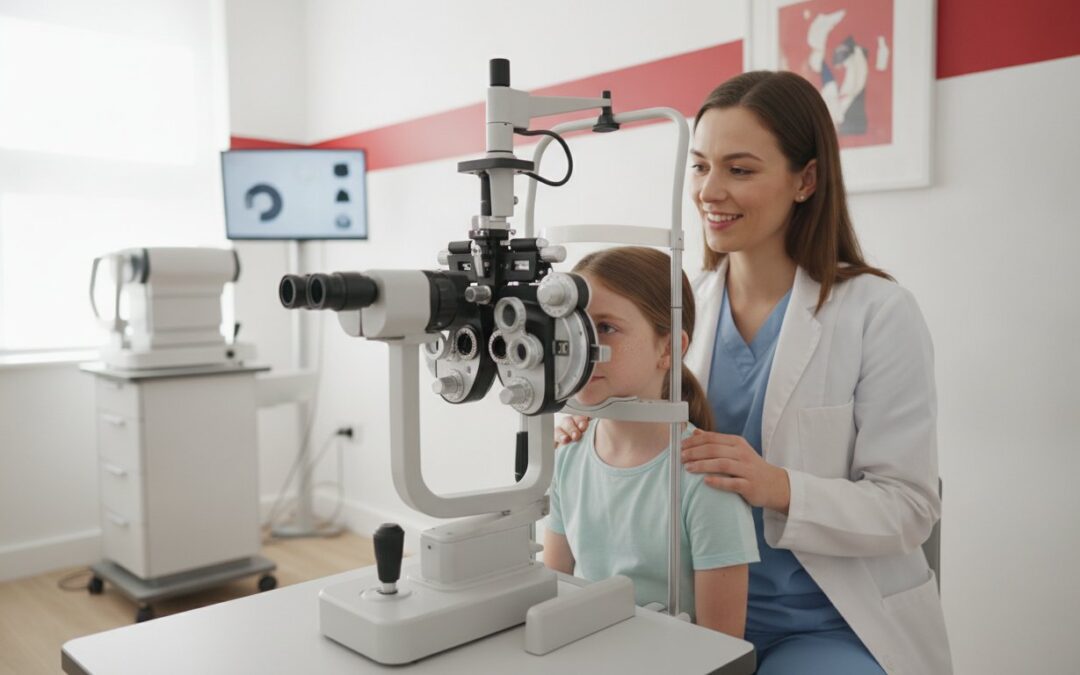
Did you know that an estimated 1 in 5 school children in the UK currently lives with an undetected eye problem? It’s a startling figure, especially when you consider that 80% of a child’s learning is visual. You might feel a sense of relief when your child passes their initial check in class, but understanding the limitations of a school vision screening vs comprehensive eye exam is essential for their academic success. While these screenings are a helpful starting point, they’re often basic checks designed to catch only the most obvious issues rather than providing a full picture of your child’s ocular health.
We understand that checking NHS eligibility and worrying about undiagnosed learning difficulties can feel overwhelming. You want the certainty that your child can see clearly and comfortably whilst they study. In this guide, we’ll explain why a basic screening is only a safety net and how a professional eye exam serves as a vital foundation for their wellbeing. You’ll discover the depth of testing required to spot conditions like amblyopia, or lazy eye, and learn how to access the expert, personalised care your family deserves at our Rayleigh or South Benfleet practices.
Key Takeaways
- Understand why a school screening is only a preliminary “pass/fail” check and how a clinical exam provides a full assessment of your child’s eye health.
- Explore the significant differences between a school vision screening vs comprehensive eye exam, from the advanced equipment used to the specialist qualifications of the examiner.
- Learn why factors like inconsistent lighting and busy school environments can cause undiagnosed vision problems to be missed during classroom checks.
- Identify the physical and behavioural red flags, such as frequent headaches or losing their place whilst reading, that suggest your child needs more than a basic screening.
- Discover how to access thorough, NHS-funded eye tests for children at an independent local practice in Rayleigh or South Benfleet.
School Vision Screening vs Comprehensive Eye Exam: The Vital Difference
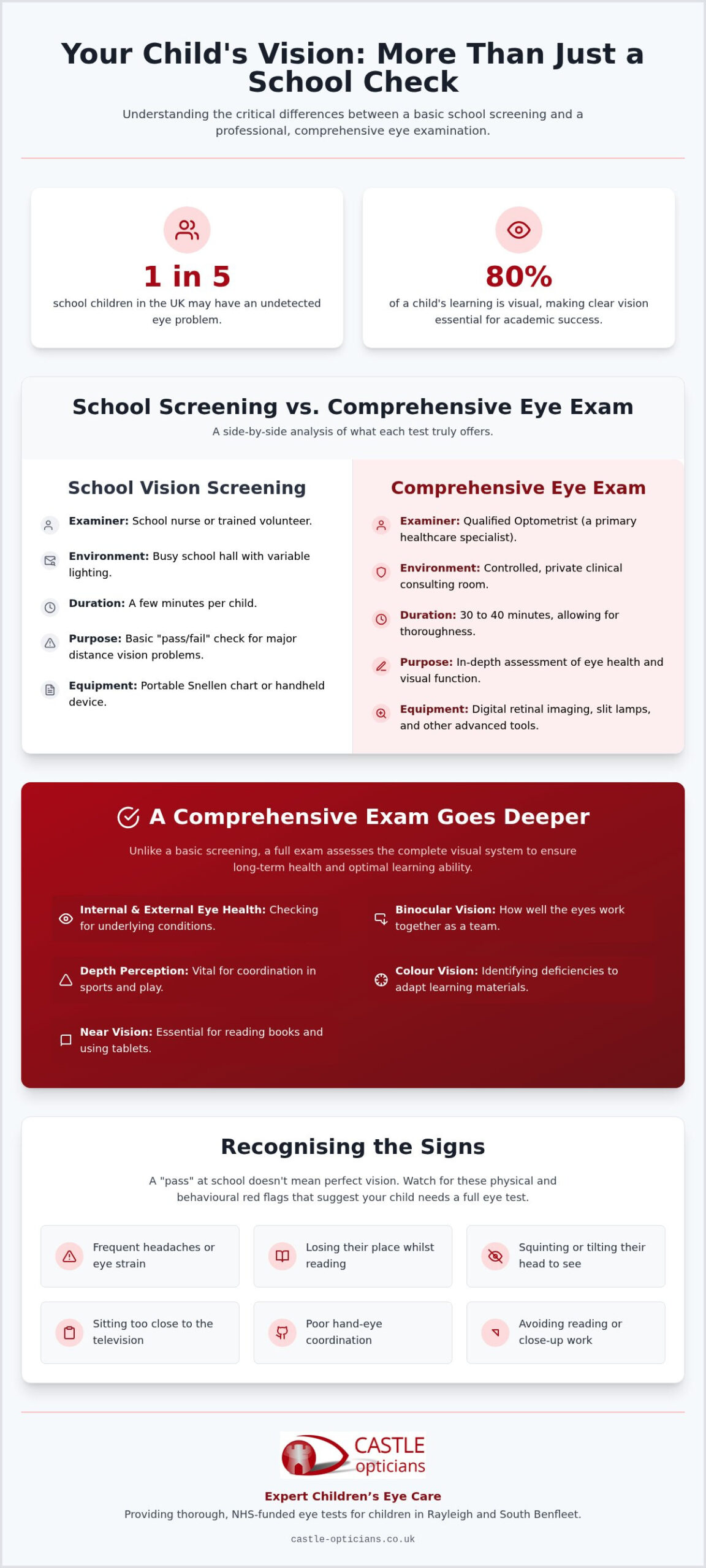
In the UK, most children undergo a vision screening during their Reception year, typically between the ages of four and five. This service is a valuable public health tool designed to identify significant problems that could hinder a child’s early development. However, many parents mistakenly believe this classroom check is an exhaustive medical assessment. Understanding the distinction between a school vision screening vs comprehensive eye exam is the first step in protecting your child’s long-term sight. A school screening is essentially a “pass or fail” exercise. If a child can read a certain line on a portable chart, they pass. This doesn’t necessarily mean their eyes are healthy; it simply means they meet a minimum standard for distance vision on that specific day.
The Purpose of School Vision Screenings
The primary goal of these screenings is to catch major, sight-threatening conditions like amblyopia, commonly known as “lazy eye,” or severe short-sightedness. Because these checks are often performed by school nurses or trained lay screeners rather than optometrists, they focus almost exclusively on distance visual acuity. They are designed to be quick and cost-effective, acting as a basic safety net for the general population. While this catches some children who might otherwise slip through the cracks, it misses many subtle issues that impact learning. These include eye teaming difficulties or problems with near-focusing, which are vital for classroom work. In England, these screenings are recommended but not mandatory in every local authority, meaning some children may miss out entirely if they don’t visit an optician.
What a Comprehensive Eye Exam Delivers
In contrast, a comprehensive eye exam is a deep dive into the biological health and functional ability of the eyes. Conducted by a qualified optometrist in a controlled clinical environment, this goes far beyond reading letters on a wall. It includes a detailed assessment of both the internal and external structures of the eye, ensuring there are no underlying health concerns. This level of care is what we prioritise at our independent practices in Rayleigh and South Benfleet, where we take the time to understand each child’s specific needs.
During a full clinical exam, we also test for several factors that screenings overlook:
- Binocular vision: Checking how well the eyes work together as a team to prevent double vision or strain.
- Depth perception: The ability to judge distances accurately, which is essential for sports and coordination.
- Colour vision: Identifying potential deficiencies early so teachers can adapt learning materials.
- Near vision: This is critical for reading books and using tablets, yet it’s rarely tested in a school hall.
A pass at school doesn’t guarantee perfect vision. It only suggests your child isn’t struggling with the most obvious distance issues. For true peace of mind, a clinical assessment is the only way to ensure their sight and health are fully protected for the school years ahead.
Comparing the Depth of Testing: A Side-by-Side Analysis
When evaluating a school vision screening vs comprehensive eye exam, the most striking difference lies in the precision of the tools used. In a school hall, a screener typically relies on a portable Snellen chart or a simple handheld device. These are excellent for a quick check, but they cannot provide the granular data needed to diagnose complex issues. In our clinical consulting rooms, we use advanced technology like digital retinal imaging and specialised slit lamps. These tools allow us to look beneath the surface of the eye, identifying health markers that a simple wall chart simply cannot detect.
The qualifications of the person conducting the test are equally important. A school screening is often performed by a school nurse or a trained volunteer who follows a specific protocol. Whilst they are dedicated professionals, they lack the years of clinical training required to interpret subtle physiological changes. An optometrist is a primary healthcare specialist. We spend significantly more time with each child, often 30 to 40 minutes, compared to the few minutes allocated during a school check. This unhurried approach allows us to distinguish between “sight,” which is the basic clarity of an image, and “vision,” which is how the brain processes and interprets that information.
Testing Distance vs. Near Vision
Most school screenings focus almost exclusively on distance visual acuity, essentially checking if a child can see the whiteboard. However, a child’s school day involves a constant shift between looking at the front of the room and focusing on a book or tablet just 30 to 40 centimetres away. A child can have “20/20” distance sight but still struggle with significant near-vision strain. This leads to fatigue, avoidance of reading, and frustration. Our clinical exams specifically test the eyes’ ability to focus at close range, ensuring that reading and writing are comfortable and sustainable throughout the day.
Eye Muscle Coordination and Tracking
Vision is a team effort between the eyes and the brain. Health organisations like the CDC emphasise that parents must distinguish between vision screenings and eye exams because screenings rarely assess how the eyes work together. If the eye muscles don’t coordinate perfectly, a child may experience “jumping” text or double vision. This is often missed amongst peers in a busy school environment. We check for latent squints and tracking abilities to ensure your child can follow a line of text smoothly without losing their place. If you have concerns about your child’s concentration, booking a comprehensive eye examination at our Rayleigh or Benfleet centre can provide the clarity you need.
Why School Screenings Often Miss Undiagnosed Vision Problems
It’s a common scenario: a parent receives a letter saying their child passed the school check, so they assume all is well. However, the debate of school vision screening vs comprehensive eye exam often boils down to where and how the test happens. School halls are multi-purpose spaces, not clinical environments. Lighting levels vary wildly from one end of a room to the other; a simple glare on a portable chart can easily skew a child’s results. More importantly, children are incredibly resourceful. They often subconsciously compensate for poor sight by squinting or even memorising the letters they hear their classmates recite whilst waiting in line. This leads to a “false sense of security” for parents, whilst underlying issues continue to develop unnoticed.
The Limitations of the Snellen Chart
The traditional Snellen chart, which uses rows of letters that get smaller, has been a staple of eye care for over 150 years. Whilst it’s a useful tool for measuring distance acuity, it’s remarkably limited. It tells us nothing about how a child’s brain processes images or the physical health of their eyes. Professional bodies like the AOA suggest that a comprehensive eye and vision examination is necessary because it allows us to inspect the retina and optic nerve. These are the parts of the eye that can reveal early signs of health conditions that a simple letter chart could never uncover. Modern optometry requires sophisticated diagnostic technology to ensure a child’s eyes are truly healthy, not just capable of reading a specific line of text.
Environmental Factors and Distractions
Contrast the bustling atmosphere of a school corridor with the quiet, focused setting of our Rayleigh practice. In a school, a child is often surrounded by noise, peers, and time pressure. These distractions can cause a child to lose focus, leading to an inaccurate result. In a professional clinical setting, we provide personalised attention in an unhurried environment. This calm atmosphere is essential for getting an accurate prescription, especially for younger children who may find it hard to concentrate. We take the time to ensure they are comfortable and engaged, which is something a quick school screening simply cannot offer. This personal touch, combined with clinical expertise, ensures that no detail is overlooked in your child’s care.
Recognising the Signs: When to Book a Full Eye Test in Essex
Parents are often the first to notice when a child is struggling, even if a school check hasn’t raised any red flags. Whilst we have explored the technical gaps in a school vision screening vs comprehensive eye exam, your daily observations at home are a vital piece of the puzzle. Children rarely complain about their sight because they don’t have a point of comparison; they simply assume everyone sees the world the same way they do. This is why being alert to subtle physical and behavioural cues is so important for their development.
Physical signs like frequent squinting, tilting the head to one side, or excessive eye rubbing are common indicators that a child’s eyes are working too hard. You might also notice they suffer from headaches, particularly towards the end of a school day. Behaviourally, keep an eye out for children who sit unusually close to the television or lose their place whilst reading. If a child frequently skips lines or uses a finger to track words long after their peers have stopped, it may suggest a coordination issue that a basic screening would likely miss. Academically, a sudden lack of interest in reading or falling behind in class can often be traced back to undiagnosed vision strain rather than a lack of ability.
NHS Eye Tests for Children
Many parents are pleasantly surprised to learn that children’s eye tests in South Benfleet and Rayleigh are fully funded by the NHS. There is no cost to you for the clinical examination itself. Our role as independent opticians is to provide a thorough, unhurried assessment that puts your child at ease. If our optometrist determines that your child requires spectacles, you will also receive an NHS voucher. This voucher helps towards the cost of frames and lenses, ensuring that essential eye care remains accessible for every family in our community.
The Recommended Frequency of Exams
Developing eyes can change with remarkable speed, especially during growth spurts. A child’s vision may be perfect in September but require correction by the following spring. For this reason, we typically recommend an annual check-up for school-aged children. Integrating a visit to the optician into your “back to school” routine is an excellent way to ensure they start each academic year with the best possible foundation for learning. It provides peace of mind that their sight is keeping pace with their physical growth. If you’ve noticed any of the signs mentioned above, we invite you to book a comprehensive eye examination with our friendly team to ensure your child’s vision is fully supported.
Expert Children’s Eye Care at Castle Opticians
At Castle Opticians, we believe every child deserves a clear and bright future. Our approach to paediatric eye care is built on being a trusted local expert for families across South Essex. We understand that a clinical environment can sometimes feel intimidating for little ones, so we have designed our experience to be as warm and welcoming as possible. Unlike the rapid pace of a classroom check, we offer an unhurried, friendly consultation where your child is the centre of attention. This patient rhythm allows us to get the most accurate results whilst ensuring your child feels completely at ease. Choosing between a school vision screening vs comprehensive eye exam is about more than just checking sight; it’s about finding a partner in your child’s long-term health.
As an independent group serving our community since 1989, we pride ourselves on building long-term relationships with our patients. You aren’t just another number in a corporate high-street chain; you’re a member of our local community. This independence gives us the freedom to spend more time with each child, explaining every step of the process in a way they can understand. If your child does require correction, we offer a wide selection of durable and stylish frames. We know that children need spectacles that can keep up with their active lives, which is why we source high-quality lenses and frames that kids actually feel proud to wear.
Personalised Care in Rayleigh and South Benfleet
Seeing the same friendly faces at every visit provides a sense of continuity that is especially beneficial for younger children. Our teams in Rayleigh and South Benfleet are committed to delivering a comprehensive eye test in Essex that looks at the whole picture of ocular health. We don’t just stop at the basics. We use our clinical expertise to ensure your child’s eyes are developing exactly as they should. When you weigh up a school vision screening vs comprehensive eye exam, the real difference is found in this personalised, professional attention that prioritises your child’s individual needs.
Booking Your Child’s Appointment
Arranging a visit is straightforward and stress-free. You can book an appointment at either our Rayleigh or South Benfleet branches by giving our friendly reception team a call. For your first visit, it’s helpful to bring along any previous optical records or a simple list of any behaviours you’ve noticed at home. We recommend allowing about 40 minutes for the full assessment. This ensures we have plenty of time for thorough testing and, if needed, a relaxed frame selection process. Our final reassurance to you is simple: we are here to help your child see their best, every single day. We look forward to welcoming your family soon.
Give Your Child a Clear Path to Success
Understanding the vital differences in a school vision screening vs comprehensive eye exam allows you to make the best choice for your child’s development. While a classroom check serves as a basic safety net, it cannot replace the depth of a clinical assessment that looks at internal health and functional vision. Our independent local experts have been supporting families in South Essex since 1989, offering the unhurried, personalised care that ensures every detail is captured.
All children are eligible for NHS-funded eye tests, so there is no cost for this essential professional care at our Rayleigh or South Benfleet branches. Whether you’ve spotted a few red flags or just want to ensure they are ready for the new term, our friendly team is here to help. Book a comprehensive children’s eye test at Castle Opticians today to protect your child’s sight and support their learning journey. We look forward to welcoming you and your family into our practice soon.
Frequently Asked Questions
Is a school vision screening the same as an eye test?
No, a school vision screening is not the same as a clinical eye test. A screening is a basic pass or fail check designed to spot obvious distance vision problems. In contrast, the choice between a school vision screening vs comprehensive eye exam involves a full health assessment of the internal and external eye. It uses advanced technology to check for things like eye muscle coordination and retinal health, which a simple classroom check can easily overlook.
Does my child need an eye test if they passed the school screening?
Yes, your child should still have a full assessment even if they passed their school check. When comparing a school vision screening vs comprehensive eye exam, it’s important to remember that screenings focus mainly on distance vision. They often miss issues with near vision, tracking, and focusing, which are essential for reading. A clinical pass doesn’t guarantee perfect ocular health; it only means they met a minimum threshold on that specific day.
At what age should a child have their first full eye exam?
It is recommended that every child has their first full eye examination by the age of four, ideally before they start Reception. This allows an optometrist to identify and treat any underlying issues, such as a lazy eye, before they impact a child’s early education. Early detection is vital because many vision problems are much easier to correct whilst the visual system is still developing in younger children.
Are children’s eye tests free on the NHS in Essex?
Yes, eye tests are free under the NHS for all children under sixteen, as well as for those aged sixteen to eighteen who remain in full-time education. At our Rayleigh and South Benfleet branches, we provide these comprehensive assessments at no cost to the parent. If your child requires spectacles, you will also receive an NHS optical voucher to help with the cost of their frames and lenses.
How long does a comprehensive children’s eye exam take?
A thorough clinical examination typically takes between 30 and 40 minutes. This unhurried pace is essential for making younger children feel comfortable and for conducting a wide range of tests. We take the time to assess eye health, coordination, and focus, ensuring a far more detailed result than the few minutes allocated during a basic school check. This allows us to provide personalised care tailored to your child’s needs.
What happens if my child cannot read letters yet?
Don’t worry if your child hasn’t mastered their alphabet yet; we can still perform a complete exam. Optometrists use specialised charts featuring pictures or shapes instead of letters. We also use objective testing methods, such as shining a gentle light into the eye, to determine a prescription without the child needing to say a word. These techniques ensure we get accurate results regardless of your child’s reading ability or age.
Can a school screening detect colour blindness or lazy eye?
Whilst school screenings aim to catch significant cases of lazy eye (amblyopia), they frequently miss more subtle instances. They also rarely include tests for colour vision deficiencies. A clinical exam is much more reliable for these diagnoses. We use specific tests, such as Ishihara plates for colour and detailed muscle checks for lazy eye, ensuring these conditions are identified early so that appropriate support can be put in place.
How often should my child visit the optician?
Most children should visit the optician for an annual check-up. Because a child’s eyes develop rapidly during growth spurts, their prescription can change significantly in just twelve months. Regular yearly visits ensure that any shifts in vision are caught early, keeping their sight clear for schoolwork and play. Your optometrist will advise if your child needs to be seen more frequently based on their specific eye health and development.