
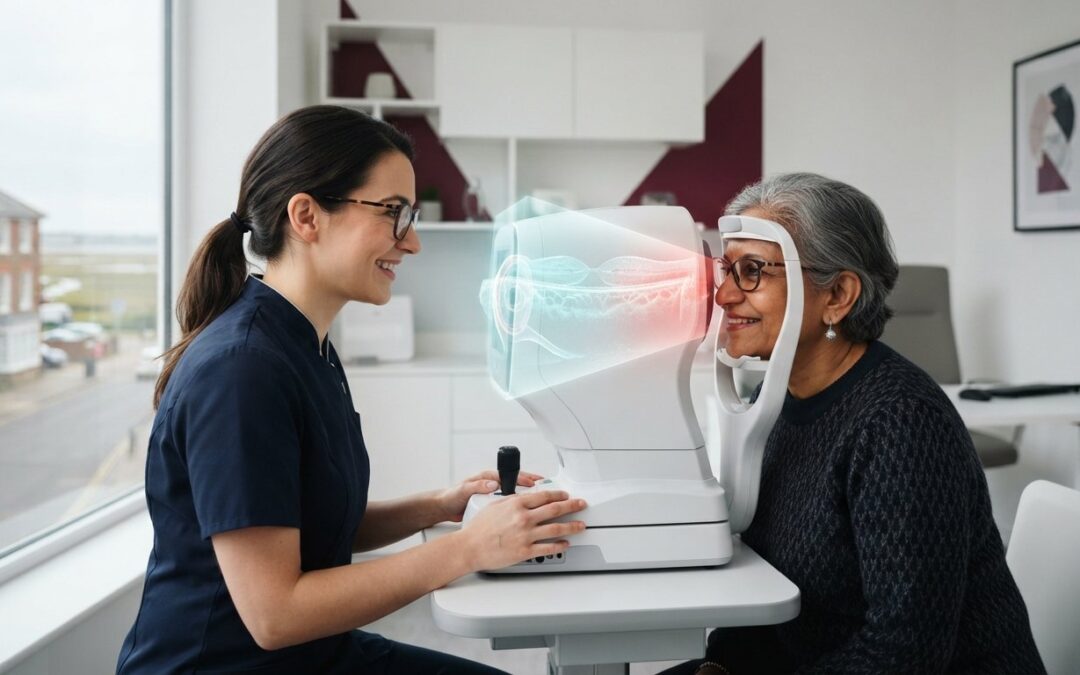
What if you could spot a sight-threatening eye condition years before experiencing a single symptom? Most of us assume that clear vision means healthy eyes, but reading letters off a chart only inspects the surface. That is where ocular coherence tomography changes the standard of care. Using gentle light rather than physical contact, this completely painless 3D scan captures microscopic cross-sections beneath the retina, functioning like a clinical time machine for your ocular wellbeing.
It is natural to worry about silent conditions or feel apprehensive about unfamiliar clinical procedures. In this guide, you will discover how OCT technology provides a life-changing 3D view of your eye health and why this advanced scan is essential for early disease detection. We will walk through exactly how the imaging works, what sets it apart from a routine eye test, and how our independent team in Rayleigh and South Benfleet ensures your sight remains thoroughly protected.
Key Takeaways
- Understand how ocular coherence tomography creates high-resolution 3D cross-sections of the eye to uncover early indicators of retinal conditions.
- Learn why standard retinal photography only captures the surface layer, whilst an advanced scan reveals all ten microscopic layers beneath.
- Discover the critical differences between an everyday eye test and an in-depth structural assessment of your optic nerve.
- Find out who benefits most from regular screening and what to expect during this completely contact-free, comfortable procedure.
- See how an unhurried consultation with an independent team in Rayleigh or South Benfleet provides ongoing peace of mind through personalised care.
What is Ocular Coherence Tomography (OCT)?
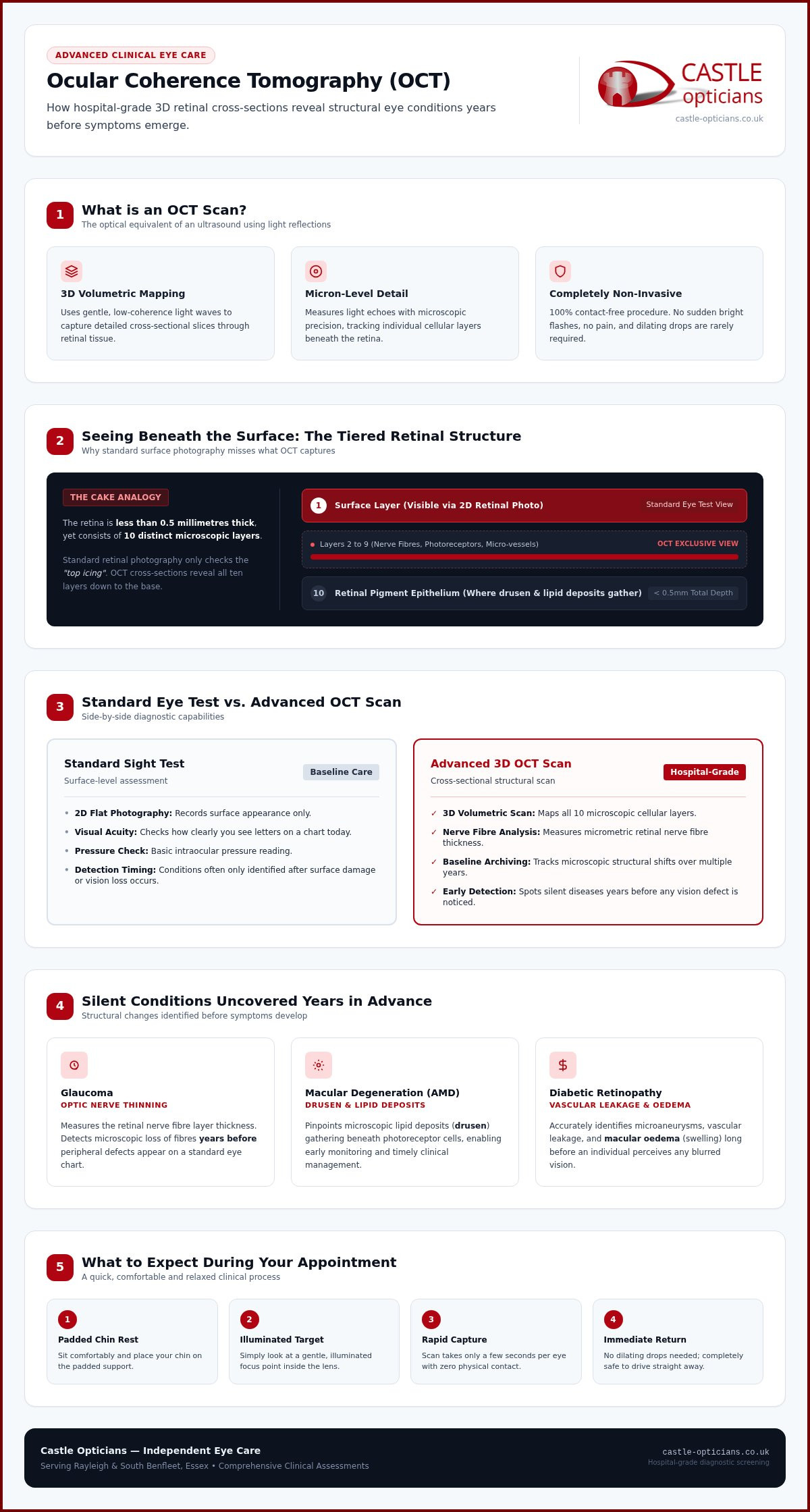
At its core, ocular coherence tomography is a specialised, non-invasive imaging test that uses low-coherence light waves to produce high-definition, cross-sectional pictures of your retina. In simple terms, OCT acts as the optical equivalent of an ultrasound, using light reflections rather than sound waves to map structural layers. While standard retinal photography only captures a two-dimensional portrait of the surface, this scan penetrates deep into ocular tissue. As detailed in the scientific overview of Optical Coherence Tomography (OCT), measuring light echoes achieves microscopic detail measured in microns, revealing structural changes that would otherwise stay hidden beneath the surface of the eye.
The Evolution of the Eye Examination
Sight care has transformed dramatically over the last thirty years. What used to be a simple check to update your spectacle prescription is now an essential window into long-term ocular health. Eye tests have shifted from basic visual acuity tests to thorough ocular health screenings. Rather than just checking how well you see today, modern diagnostics protect how well you will see tomorrow. That is why Castle Opticians prioritises hospital-grade diagnostic technology for local residents, delivering advanced clinical assessments right here in Rayleigh and South Benfleet.
Is an OCT Scan Invasive or Painful?
If clinical equipment makes you feel slightly apprehensive, you can put your worries aside. An OCT scan is completely painless and entirely non-contact; nothing touches your eye during the assessment. You simply sit in a relaxed position, rest your chin on a padded support, and look at an illuminated target. The imaging capture takes only a few seconds per eye without sudden, dazzling bursts of light. Because dilating eye drops are rarely needed for this test, you avoid temporary blurred vision and can safely drive straight after your appointment.
The Science of the Scan: Seeing Beneath the Surface
To understand the clinical power of ocular coherence tomography, consider the anatomy of the retina. Though less than half a millimetre thick, this delicate structure consists of ten distinct microscopic layers, each carrying out vital tasks in processing light into vision. Standard digital retinal photography only photographs the surface, much like admiring the top icing on a tiered cake without knowing what lies underneath. Light waves map the thickness of the retina to micron-level accuracy, giving our optometrists an unobstructed, high-resolution cross-section through every single layer. This reveals cellular changes long before they disturb your sight.
Detecting Glaucoma and Macular Health
Glaucoma often develops silently, progressively damaging the optic nerve fibres without causing obvious symptoms in its early stages. By measuring the retinal nerve fibre layer thickness, an OCT scan spots subtle thinning years before vision defects appear on a chart. Similarly, the scan identifies early Age-Related Macular Degeneration (AMD) by highlighting tiny lipid deposits called drusen that gather beneath the photoreceptor cells. As the American Academy of Ophthalmology explains the OCT exam, this diagnostic precision helps clinicians monitor disease progression and initiate timely management. Choosing a Comprehensive Eye Health Check in Essex ensures these delicate structures are methodically evaluated rather than overlooked.
Diabetic Retinopathy and Vascular Health
Systemic conditions like diabetes leave clear footprints across retinal blood vessels. OCT imaging accurately pinpoints early microaneurysms, vascular leakage, and macular oedema (swelling) long before an individual notices blurred or distorted eyesight. Establishing a baseline scan allows our clinical team to compare subtle structural shifts over several years, distinguishing healthy stability from early disease activity.
If you have diabetes or a family history of retinal conditions, booking an unhurried assessment with Castle Opticians gives you the peace of mind that comes from knowing your eyes are monitored with genuine clinical care.
Standard Eye Test vs. OCT: Why the Upgrade Matters
A standard eye test remains the foundation of good visual care, checking your prescription, examining surface structures, and measuring intraocular pressure. However, evaluating visual sharpness does not reveal structural shifts developing out of sight. While conventional retinal cameras capture a flat, two-dimensional snapshot of the surface, ocular coherence tomography generates a true 3D volumetric map of your eye’s internal architecture. Because it detects unseen changes beneath the visible retina, Castle Opticians recommends OCT as the gold standard for preventative ocular care.
What a Standard Digital Camera Misses
Two-dimensional imaging provides valuable surface documentation, but it leaves critical blind spots when pathology lurks underneath. A standard retinal photograph cannot determine the exact depth or vertical spread of microscopic irregularities. Key diagnostic gaps include:
- Subsurface fluid accumulation: Flat photos cannot measure subtle elevations or fluid pockets caused by central serous retinopathy or early macular swelling.
- Pre-symptomatic nerve fibre loss: Glaucoma frequently erodes the structural layers around the optic disc before any visible paleness or cupping appears on the surface.
- Underlying macular disruption: Early deposits and microscopic thinning occur in deeper strata where surface illumination simply reflects away.
The Value of a Digital Health Record
Beyond capturing immediate detail, the true strength of an OCT assessment lies in long-term comparison. Rather than treating each visit as an isolated snapshot, we securely store your volumetric scans to build an ongoing digital health record. At your subsequent visits, the scanning software aligns current scans against your baseline down to exact micrometer coordinates.
This tracking embodies our Trusted Local Expert philosophy. By following your unique ocular behaviour year after year, your optometrist in Rayleigh or South Benfleet identifies tiny variances that a routine chart test would inevitably miss. You gain reassurance knowing that subtle changes are observed, understood, and managed by a dedicated independent team who knows your eyes personally.
Who Should Have an OCT Scan and What to Expect?
While an advanced 3D scan provides reassurance for anyone wanting a comprehensive view of their vision, certain individuals face elevated risks of asymptomatic retinal conditions. Clinical guidelines strongly recommend ocular coherence tomography every two years for individuals aged 40 and over, as cellular changes accelerate with age. Prioritising an in-depth scan is especially vital if you belong to any of these high-risk categories:
- Family medical history: Immediate relatives diagnosed with glaucoma or age-related macular degeneration carry inherited genetic markers for accelerated optic nerve or macular thinning.
- Cardiovascular and vascular issues: High blood pressure, systemic vascular disease, and elevated cholesterol directly alter retinal microcirculation.
- Diabetes: Even with stable blood sugar readings, diabetic patients remain susceptible to sudden microvascular leakage and retinal swelling.
- High myopia: Significant short-sightedness physically elongates the eyeball, thinning the peripheral retina and predisposing tissue to tears or macular holes.
The Patient Journey at Castle Opticians
Experiencing an unhurried, comfortable examination sits at the heart of our community-focused approach. Here is what happens during your appointment:
- Step 1: Welcoming arrival: You are greeted warmly at our Rayleigh or South Benfleet practice, where our team takes time to discuss your current vision and daily visual demands.
- Step 2: Simple positioning: You sit comfortably in front of the OCT scanner, resting your chin on a cushioned support, exactly as you would for a conventional digital photograph.
- Step 3: Rapid image capture: You fix your gaze on a central illuminated target. The machine scans your eye in just seconds using gentle light, without physical contact or sharp bursts of brightness.
Understanding Your Results
Rather than sending you home with vague conclusions, our optometrist pulls up the cross-sectional 3D images on screen right beside you. We explain the structural integrity of your retina using clear, intuitive colour-coded thickness maps that distinguish robust tissue from areas that require monitoring. We then outline transparent next steps, whether that simply means scheduling your next routine review or coordinating a direct medical referral. To safeguard your vision with thorough, personalised care, book an eye test with Castle Opticians today.
Expert Eye Care in South Essex: Booking Your Scan
Selecting where to have an eye examination should never feel like passing through an impersonal conveyor belt. Large corporate optical chains often treat advanced diagnostics as an optional, rushed upsell at the till. Castle Opticians approaches sight care from a completely different perspective. Rather than an afterthought, ocular coherence tomography forms an integral cornerstone of our clinical assessment. Since 1989, our independent practice has prioritised unhurried consultations that give you ample time to ask questions, explore findings, and genuinely understand your health.
Our Local Practices in Rayleigh and Benfleet
Conveniently located in Rayleigh and South Benfleet, our welcoming practices combine warm community hospitality with the latest hospital-grade diagnostic instrumentation. Stepping into our clinics means being treated by familiar professionals who take the time to know your personal medical history. You can readily arrange both private and NHS-enhanced sight tests with us, tailoring the examination to your specific lifestyle and visual needs. Exploring a Comprehensive Eye Test Essex shows you just how detailed and personal modern optical care can be.
Investing in Your Future Vision
Protecting your sight is one of the most worthwhile long-term investments you can make. The practical value is undeniable: a thorough, proactive scan today can prevent years of irreversible sight deterioration tomorrow. We firmly believe that advanced diagnostic precision should remain fully accessible to all our South Essex neighbours, without unnecessary clinical barriers or impersonal treatment.
Your eyesight shapes every meaningful moment in daily life. Whether you need an updated prescription, new frames, or simply complete reassurance regarding your retinal health, the Castle Opticians family is here to look after you with the attentive care you deserve.
Take the Next Step Toward Lifelong Eye Health
Preserving clear, healthy sight goes far beyond updating your lenses; it requires looking deep beneath the surface before subtle issues arise. Incorporating ocular coherence tomography into your routine care transforms early detection from guesswork into microscopic precision. As independent eye care specialists since 1989, Castle Opticians brings this advanced 3D diagnostic technology directly to your doorstep across our welcoming Rayleigh and South Benfleet practices.
Every consultation is unhurried and personal. Rather than a rushed appointment, you gain dedicated time with a Trusted Local Expert who takes pride in monitoring your vision year after year. Taking a proactive step today safeguards the moments that matter most tomorrow. Book your advanced OCT eye test at Castle Opticians today and enjoy lasting peace of mind about your visual health.
Frequently Asked Questions
Is an OCT scan included in a standard NHS eye test?
No, an OCT scan is not funded under a routine NHS eye test. The standard NHS sight test focuses on assessing visual acuity and basic ocular health, checking your prescription and surface structures. Because ocular coherence tomography represents an advanced diagnostic screening using specialised hospital-grade imaging, it is offered as an enhanced supplementary check alongside your standard private or NHS examination.
How much does an OCT scan cost at Castle Opticians?
Because diagnostic fees depend on whether the scan is combined with a private eye examination or added to an NHS-funded appointment, we invite you to speak directly with our team for exact current options. Contact our Rayleigh or South Benfleet practice, where our friendly staff will happily clarify the appointment details and answer any questions before you visit.
How long does the OCT procedure take during my appointment?
The imaging capture itself takes only a few seconds per eye. You simply look at an internal target while the camera sweeps harmless light waves across your retina. We set aside ample time during your appointment so our optometrist can thoroughly inspect the high-resolution slices, review the findings directly with you, and answer any questions without rushing.
Can an OCT scan detect a brain tumour or other health issues?
Yes, an OCT scan can uncover subtle signs of serious underlying health conditions. By providing micrometer-accurate measurements of the optic nerve head, the scan reveals papilloedema, which is optic disc swelling caused by raised intracranial pressure from tumours or neurological inflammation. It can also detect early microvascular strain linked to diabetes and systemic cardiovascular disease.
Do I need an OCT scan if I have no symptoms of eye disease?
Yes, booking a scan when you have perfect vision is actually the most beneficial time to do so. Many serious conditions, including open-angle glaucoma and dry age-related macular degeneration, develop painlessly beneath the surface without initial sight changes. Undergoing an early scan establishes a healthy baseline, allowing us to spot microscopic changes years before noticeable symptoms develop.
What is the difference between retinal photography and an OCT scan?
Retinal photography captures a flat, two-dimensional colour picture of the retina’s surface, comparable to looking at the outside of a building. In contrast, an OCT scan functions like an optical ultrasound, penetrating into the tissue. It generates an interactive 3D volumetric map detailing all ten individual layers, highlighting fluid pockets, thinning, or lesions concealed beneath the visible surface.
Will the OCT scan results be explained to me on the day?
Yes, our optometrists review your diagnostic images with you during the same consultation. You will sit together in front of the screen to examine intuitive colour-coded maps showing tissue thickness and structural integrity. We clearly explain what the scans reveal, confirm whether your structures look healthy, and discuss any recommendations for ongoing monitoring.
How often should I have an OCT scan performed?
For most healthy adults over 40, having a scan every two years alongside a routine eye test provides optimal preventative monitoring. If you live with diabetes, manage ocular hypertension, or have a family history of glaucoma or macular degeneration, our clinical team in Rayleigh, Benfleet, or nearby Canvey Island may recommend an annual scan to track your ocular health more closely.