

Imagine sitting down to read the morning paper, only to notice that the straight lines of text have started to wave or distort unexpectedly. It’s a subtle change that often brings a sudden wave of anxiety whilst you wonder if a standard high-street eye test is truly enough to protect your sight. If you’ve been searching for a comprehensive macular degeneration test essex, you’re likely looking for more than just a new pair of glasses; you’re looking for the peace of mind that comes from a thorough, clinical assessment of your retinal health.
We understand that the distinction between a routine check-up and a specialist health screening can feel confusing, particularly when you’re worried about conditions like Age-Related Macular Degeneration (AMD). In this guide, we’ll show you how advanced screening at our Rayleigh and Benfleet practices can safeguard your central vision and provide the answers you need. You’ll learn the critical differences between wet and dry AMD, why we prioritise technology like OCT scans for early detection, and how our status as a trusted local expert ensures your eye health is managed with the patience and detail it deserves.
Key Takeaways
- Learn how Age-Related Macular Degeneration (AMD) impacts your central vision and why early detection is vital for maintaining your independence.
- Discover how state-of-the-art OCT technology allows our clinicians to look beneath the surface of the retina for signs of change that standard tests might miss.
- Understand the differences between NHS and private screenings when booking your macular degeneration test essex to ensure you receive the most thorough care possible.
- Identify the specific “warning signs” and risk factors, such as distorted lines or family history, that mean it’s time to schedule a specialist health check.
- Find out why an independent consultation in Rayleigh or South Benfleet offers a more personalised, unhurried experience compared to high-street chains.
Understanding Age-Related Macular Degeneration (AMD)
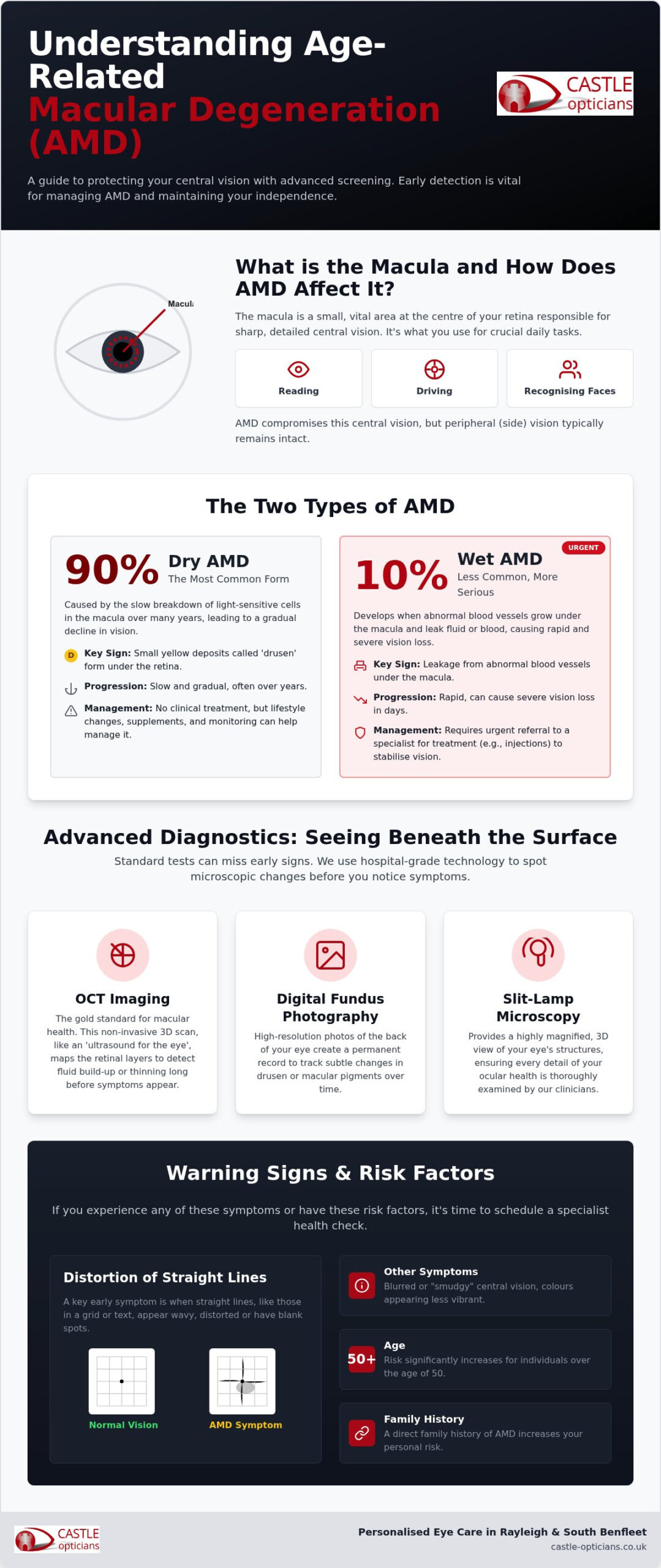
The macula is a small but vital area located at the centre of your retina. It’s responsible for the sharp, detailed vision you use every day for tasks like reading, driving, and recognising the faces of friends and family. When age-related macular degeneration (AMD) begins to develop, this central clarity is compromised, though your peripheral vision usually remains intact. Because the condition doesn’t cause total blindness, many people don’t realise the severity of the impact until their independence is threatened. Booking a macular degeneration test essex at our Rayleigh or South Benfleet practices allows us to assess this delicate area with the clinical precision it requires.
Early detection is the most effective way to manage the condition. Whilst there isn’t a way to reverse existing damage, identifying changes early allows for lifestyle adjustments and clinical monitoring that can significantly slow progression. We focus on providing a thorough assessment that goes beyond a standard sight test, ensuring you have a clear picture of your retinal health.
The Difference Between Wet and Dry AMD
Dry AMD is the most common form, accounting for roughly 90% of cases. It occurs when light-sensitive cells amongst the macula slowly break down over many years. This leads to a gradual decline in vision, often starting with a need for brighter light when reading. There’s currently no clinical treatment for dry AMD, but we can recommend specific supplements and monitoring tools to help you manage it.
Wet AMD is less common, affecting about 10% of people with the condition, but it’s far more serious. It develops when abnormal blood vessels grow under the macula and leak fluid or blood. This causes rapid and severe vision loss, sometimes over just a few days. If we suspect wet AMD during your macular degeneration test essex, we’ll arrange an urgent referral to a hospital specialist, as prompt treatment with injections can often stabilise the vision and prevent further deterioration.
How AMD Progresses Over Time
In the early stages, an optometrist might see small yellow deposits called drusen behind the eye. You won’t usually notice these yourself, and your vision may still feel perfectly normal. However, as drusen grow in size or number, the risk of transitioning to late-stage AMD increases. You might begin to notice that colours seem less vibrant or that your vision feels “smudgy” or blurred in the centre. Monitoring these changes in clarity and colour is a key part of our long-term care for the local Essex community.
Advanced Diagnostic Technology at Castle Opticians
At Castle Opticians, we believe that providing a truly thorough macular degeneration test essex requires more than just a basic eye chart. Our independent status allows us to invest in hospital-grade equipment that offers a deeper look at your eye health. This clinical focus is particularly important when monitoring the macula, as many changes occur beneath the surface where they aren’t visible during a standard inspection. By using advanced 3D imaging, we can spot the earliest markers of change, giving us the best possible chance to protect your central vision.
The Power of OCT Imaging in Essex
Optical Coherence Tomography (OCT) has become the gold standard for assessing macular health. You can think of it as an ultrasound for the eye, but instead of sound waves, it uses light to map the different layers of the retina. OCT is a non-invasive imaging test that uses light waves to take cross-section pictures of your retina. This allows our optometrists to identify microscopic fluid build-up or thinning before any physical symptoms ever appear. Because early detection is so critical, we recommend an OCT scan for all patients over the age of 50 during their visit to our Rayleigh or Benfleet practices.
Alongside OCT, we utilise digital fundus photography to capture high-resolution images of the back of your eye. These photos are invaluable for tracking subtle changes in macular pigments or the appearance of drusen over several years. During your clinical examination, we also use a slit-lamp microscope. This allows for a highly magnified, three-dimensional view of the eye’s structures, ensuring that every aspect of your eye health is carefully considered. Understanding the Symptoms and risk factors for AMD is a great starting point, but these advanced tools provide the definitive data needed for true peace of mind.
Visual Acuity and Amsler Grid Testing
Whilst high-tech scans are essential, we also rely on functional tests to see how your vision performs in daily life. The Amsler grid is a simple yet powerful tool used to detect distortion, such as straight lines appearing wavy or central areas looking blank. If you’ve noticed these changes, it’s a sign that you should book a comprehensive eye test with our team. We also take the time to refine your prescription lenses, ensuring you maintain the best possible functional sight for reading and driving, even if early macular changes are present. This patient-led approach ensures that your care is always tailored to your specific needs and lifestyle.
NHS vs Private Macular Screening in Essex
Deciding between an NHS-funded eye examination and a private macular degeneration test essex often comes down to the level of detail you require for your peace of mind. For many residents in Rayleigh and South Benfleet, the NHS provides a vital baseline for monitoring general ocular health. However, when specific concerns about the macula arise, a more specialised health check is often the most prudent path. We believe in being transparent about what each service offers, ensuring you can make an informed choice for your vision.
At Castle Opticians, we bridge the gap between routine care and specialist hospital referrals. Whether you’re visiting us for a standard check-up or a deep-dive clinical screening, our goal is to provide a clear, unhurried assessment of your sight. Our independent status means we aren’t bound by the high-volume targets of corporate chains, allowing us to focus entirely on the individual needs of our patients.
When is an NHS Eye Test Sufficient?
Many individuals are entitled to free NHS eye tests, including those aged 60 and over, or people with a close family history of glaucoma. These routine examinations are highly effective for updating your prescription for lenses and checking for common conditions. During a standard NHS check, our optometrists look for signs of general visual health and basic retinal changes. It’s a reliable way to maintain your eye health on a regular basis. For a full breakdown of what these sessions include, you can explore our guide on the comprehensive eye test Essex.
The Advantages of Independent Private Care
Whilst the NHS provides an essential service, basic screenings can sometimes be limited when managing complex macular health concerns. Opting for a private eye health check Essex at our practice offers several clinical advantages. We prioritise longer appointment times, which allows for a methodical and patient consultation. This extra time is vital for discussing your symptoms in detail and performing a more thorough analysis of your retinal layers.
Private care also ensures you have access to Advanced diagnostic tests for macular degeneration, such as OCT imaging, as a standard part of the examination. For our NHS patients, we offer these advanced scans for a small additional charge, ensuring that high-level technology is accessible to everyone in the South Essex community. This continuity of care, seeing the same local expert each time you visit, builds a detailed history of your eye health that is invaluable for spotting subtle changes over many years.
When to Book a Macular Health Check: Symptoms and Risk Factors
Recognising the subtle shifts in your vision is the first step toward protecting your long-term independence. Whilst some changes in sight are a natural part of getting older, certain markers suggest that your macula requires professional attention. If you’ve been searching for a macular degeneration test essex, it’s often because you’ve noticed a frustrating lack of clarity that isn’t solved by simply cleaning your glasses. Early intervention is the most powerful tool we have, so understanding what to look for can make a significant difference to your clinical outcome.
Key Symptoms You Should Never Ignore
The most distinctive warning sign of macular change is metamorphopsia, where straight lines appear wavy, bent, or distorted. When you’re at home, you might notice that the edge of a door frame or the lines on a crossword puzzle seem to dip in the centre. Other common symptoms include:
- Central Blind Spots: Finding a dark or “empty” patch in the middle of your field of vision, making it hard to see the person directly in front of you.
- Low-Light Struggles: Noticing that you need much brighter lamps for reading or needlework than you did previously.
- Fading Colours: Colours may appear less vibrant or “washed out” compared to how they used to look.
If you experience a sudden onset of these symptoms, particularly wavy lines, you should contact us immediately. This can sometimes indicate the transition to wet AMD, which requires urgent clinical referral.
Are You at High Risk?
Age remains the primary risk factor, and we strongly recommend that those over 60 schedule an annual eye health check Essex. Genetics also play a significant role; if you have a family history of AMD, your risk profile is higher. Beyond what we’re born with, lifestyle choices impact retinal health. Smoking is the most significant modifiable risk factor, as it can double the likelihood of developing the condition.
Nutrition is another vital area of focus. Research suggests that a diet rich in Lutein and Zeaxanthin, found in leafy greens like kale and spinach, helps protect the macula from oxidative stress. We also advise on UV protection, as long-term exposure to sunlight can accelerate retinal damage. Our team in Rayleigh and South Benfleet can help you select specialised lenses with high-quality UV filters to support your vision. For our at-risk patients, we organise bespoke monitoring plans to ensure any changes are caught at the earliest possible stage. If you’re concerned about your risk factors, you can book your macular health screening with our friendly team today.
Personalised Eye Care in Rayleigh and South Benfleet
Since 1989, Castle Opticians has stood as an independent pillar of the South Essex community. We’ve always believed that eye care should be as much about people as it is about clinical excellence. When you visit our Rayleigh or South Benfleet branches for a macular degeneration test essex, you won’t find the rushed, “one-size-fits-all” atmosphere often associated with high-street corporate chains. Instead, we offer a welcoming environment where our clinicians take the time to listen to your concerns and explain your results with quiet confidence and clarity.
Our commitment to unhurried, professional care means your consultation is a thorough process designed to provide total peace of mind. We combine warm hospitality with clinical authority, ensuring you feel both respected and looked after from the moment you walk through our doors. Whether you’re a long-standing patient or visiting us for the first time, our goal is to build a lasting relationship based on trust and exceptional service.
Your Local Path to Specialist Referral
If our screening identifies changes that require further investigation, we don’t simply hand you a letter and leave you to manage the next steps alone. We maintain strong clinical links with the Mid and South Essex NHS Foundation Trust, ensuring that any necessary referrals to local diagnostic hubs or ophthalmology services are handled swiftly and accurately. Our team understands that the prospect of an AMD diagnosis can be a source of significant anxiety, and we’re here to support you through that journey.
Whilst you wait for hospital appointments, we provide essential continuity of care. We manage your functional vision and offer advice on specialised lenses or lighting that can help you maintain your daily activities. Being a trusted local expert means we’re always available to answer your questions, acting as a reliable bridge between your routine eye health check and specialist hospital treatment.
Booking Your Appointment Today
Protecting your central vision starts with a simple conversation. You can find our practices in the heart of Rayleigh and South Benfleet, where our friendly teams are ready to help you organise your next visit. When preparing for your macular degeneration test essex, we recommend bringing your current spectacles and a list of any medications you’re taking, as this helps us build a complete picture of your visual health.
Our independent status gives us the freedom to prioritise your well-being above all else. We take pride in being a seasoned professional voice in the local fabric of Essex, providing the personal attention and high standards of care you deserve. If you’ve noticed changes in your sight or simply want the reassurance of a specialist health check, we invite you to experience our community-centred approach to eye health.
Protecting Your Vision for the Years Ahead
Maintaining your sight is one of the most important things you can do to preserve your independence and quality of life. The key to managing conditions like AMD lies in early detection and the use of precise clinical technology. By choosing a specialist macular degeneration test essex at our practice, you ensure that your eye health is monitored using hospital-grade OCT scans and the attentive eye of an independent professional.
Since 1989, Castle Opticians has provided the South Essex community with a standard of care that prioritises thoroughness over speed. Whether you visit us in Rayleigh or South Benfleet, you’ll receive a warm welcome and a consultation that is never rushed. We take pride in our role as your trusted local experts, bridging the gap between routine checks and specialist hospital referrals with quiet confidence.
Don’t wait for your vision to change before taking action. Book your expert macular health check at Castle Opticians today and enjoy the peace of mind that comes from a truly comprehensive examination. We look forward to looking after you and your sight for many years to come.
Frequently Asked Questions
How long does a macular degeneration test take at your Essex practices?
A comprehensive macular degeneration test essex typically takes between 30 and 45 minutes. Because we’re an independent practice, we don’t rush our appointments. This extra time allows our optometrists in Rayleigh or South Benfleet to conduct a methodical examination and discuss any findings with you in detail. We believe that a patient and thorough consultation is the best way to ensure your central vision is properly protected and your questions are fully answered.
Will I need eye drops for my macular screening appointment?
During your screening, our optometrist may use dilating eye drops to widen your pupils. This allows for a much clearer, unobstructed view of the retina and macula at the back of your eye. Whilst the drops are painless, they will make your vision temporarily blurry and your eyes more sensitive to light for a few hours. We recommend bringing sunglasses to your appointment and avoiding driving until your vision has returned to its normal state.
Can an optician detect macular degeneration during a normal eye test?
Yes, an optometrist can often spot early markers of macular change during a standard eye test by looking for yellow deposits called drusen. However, a basic check only assesses the surface of the retina. To see the deeper layers where the earliest signs of damage occur, we recommend a more detailed macular degeneration test essex using OCT technology. This advanced imaging provides a far more definitive assessment than a routine sight test alone can offer.
Is macular degeneration testing available on the NHS in Rayleigh?
Yes, residents in Rayleigh and South Benfleet can access macular screening as part of their NHS-funded eye test if they are eligible. Whilst the standard NHS check covers a basic retinal assessment, advanced diagnostic tools like OCT imaging are not typically included. At Castle Opticians, we offer these hospital-grade scans to our NHS patients for a small additional charge, ensuring that everyone in our local community has access to the highest standard of clinical care.
What is the difference between an eye test and an OCT scan?
A standard eye test primarily focuses on your visual acuity and the external health of your eyes to determine your prescription for lenses. In contrast, an OCT scan is a non-invasive 3D imaging test that acts like an ultrasound for the eye. It uses light waves to take cross-section pictures of your retina, allowing us to see beneath the surface. This technology is essential for identifying microscopic fluid build-up or thinning associated with macular degeneration.
What should I do if I notice wavy lines in my central vision?
You should book an urgent appointment with our team in Rayleigh or South Benfleet immediately. Noticing wavy or distorted lines is a key symptom of “wet” macular degeneration, which can cause rapid vision loss if left untreated. We’ll perform a priority assessment and, if necessary, coordinate a direct referral to a hospital specialist within the Mid and South Essex NHS Foundation Trust. Acting quickly is the most effective way to stabilise your vision and prevent further damage.
Are there any treatments available if you find signs of AMD?
Whilst there is currently no cure for “dry” AMD, we can recommend specialised lenses and nutritional supplements to help manage your vision. If we detect signs of “wet” AMD, which involves leaking blood vessels, medical treatments like anti-VEGF injections are available at local hospital clinics. These injections are highly effective at slowing the progression of the condition and can often stabilise or even improve your sight. We manage your care and support you throughout this referral process.
How often should I have my macular health checked if I am over 60?
We strongly recommend that patients over the age of 60 have their macular health checked at least once a year. Regular annual screenings at our Rayleigh or South Benfleet branches allow us to create a detailed history of your retinal health. This makes it much easier to spot subtle changes that might otherwise go unnoticed. If you have a family history of AMD or other risk factors, our optometrists may suggest more frequent clinical monitoring plans.