
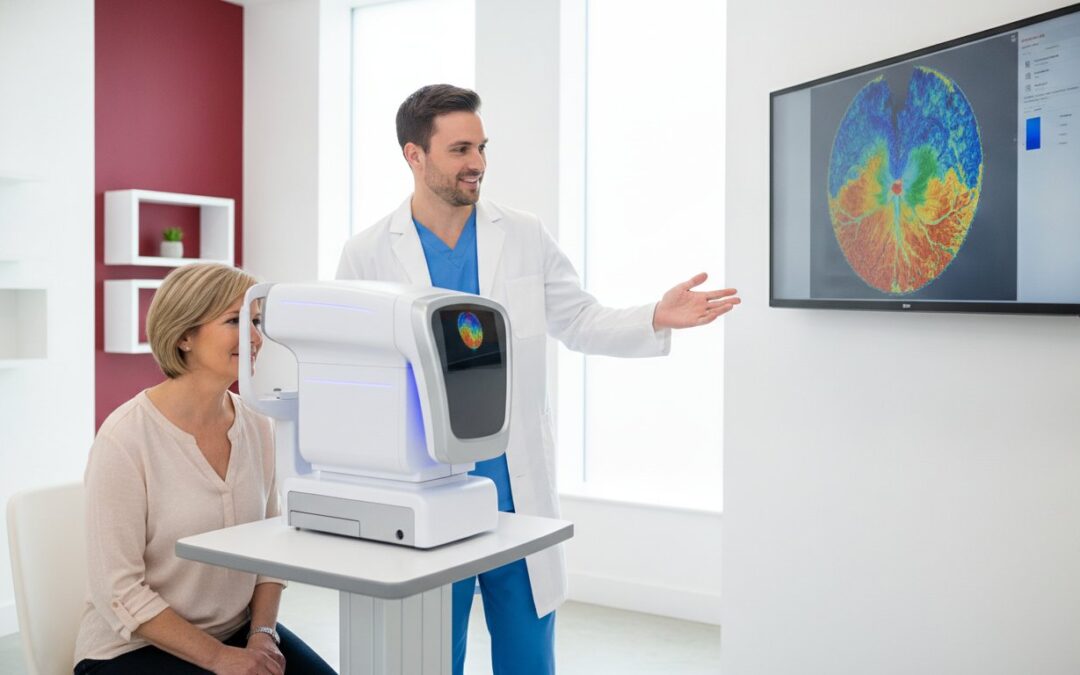
What if your optician could see not just the surface of your eye, but deep beneath it, where the earliest signs of disease often hide in silence? For many of our neighbours in Essex, a routine eye test feels familiar, yet the introduction of advanced 3D imaging can sometimes cause a bit of confusion. You might find yourself wondering what is an oct scan and how it actually differs from the standard digital photographs you have seen before.
It is perfectly natural to feel a sense of uncertainty when it comes to your eye health. You want to be sure that your vision is protected by the best possible technology, whilst also receiving the warm, personalised care that an independent practice provides. We understand that you value thoroughness over a rushed appointment, and we believe that clarity is the best cure for anxiety.
In this guide, we will explain how this clinical breakthrough allows us to map your eye in incredible detail. You will learn exactly what to expect during your visit to our Rayleigh or South Benfleet centres, and why this painless, non-invasive scan is now the gold standard for maintaining your long-term wellbeing and peace of mind.
Key Takeaways
- Understand what is an oct scan and how this advanced technology captures detailed, 3D cross-sectional images of your retina.
- Learn why a 3D scan provides a far more comprehensive view of your eye health than a standard 2D photograph.
- Discover the specific conditions, such as glaucoma and AMD, that can be detected much earlier with this state-of-the-art equipment.
- Find out what happens during your appointment and why the procedure is quick, painless, and non-invasive for every patient.
- See how our independent team in Rayleigh and South Benfleet uses these detailed results to provide unhurried, personalised care.
What is an OCT Scan? Defining Modern Eye Diagnostics
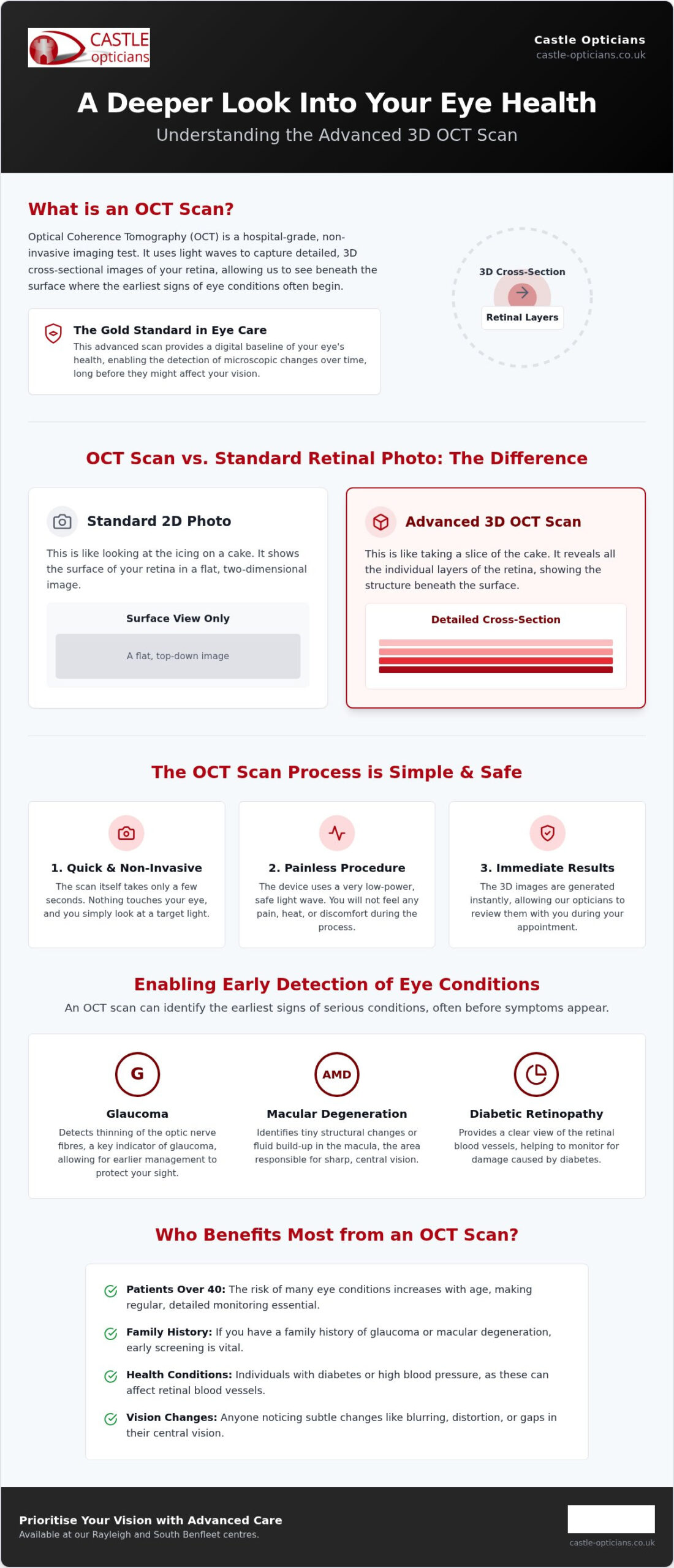
If you’ve ever wondered what is an oct scan, think of it as a significant leap forward in how we protect your vision. Optical Coherence Tomography (OCT) is a non-invasive imaging test that has transformed modern eye diagnostics. Unlike traditional methods that only show the surface, an OCT scan uses light waves to capture incredibly detailed, cross-sectional pictures of your retina. It’s a clinical breakthrough that allows us to see what lies beneath the surface.
By mapping the back of the eye in three dimensions, we can see each of the retina’s distinctive layers. This level of detail is vital because most eye conditions begin in the deeper structures where the naked eye cannot reach. Not long ago, this sophisticated technology was found only in specialist eye hospitals. Today, we’re proud to bring this hospital-grade equipment to our local Rayleigh and South Benfleet communities. This ensures you receive the highest standard of care without needing a hospital referral.
The Purpose of an OCT Examination
The primary goal of an OCT scan is to provide a complete picture of your ocular health. It’s not just about your current vision; it’s about your future. By establishing a digital baseline of your eye’s internal structure, we can compare future scans to detect even the most microscopic changes over time. These tiny alterations are often the first indicators of conditions like glaucoma or macular degeneration. Whilst a standard sight test is excellent for checking your prescription, an OCT examination goes much further. It offers a thorough assessment that provides true peace of mind by identifying issues long before they affect your sight.
Who Should Consider an OCT Scan?
While anyone can benefit from a deeper look at their eye health, certain groups find it particularly valuable. Many of our visitors ask what is an oct scan and whether they actually need one during their routine check-up. We typically recommend it for patients over the age of 40, as the risk of certain eye conditions naturally increases with time. If you have a family history of glaucoma or macular degeneration, early monitoring is essential. Additionally, individuals living with diabetes or high blood pressure should consider regular scans. These systemic conditions can impact the delicate blood vessels in the retina. If you’ve noticed any subtle changes in your central vision, such as blurring or distortion, a scan helps us identify the cause quickly and accurately.
The Science of 3D Eye Imaging: How OCT Works
To understand the mechanics of modern eye care, it helps to compare the technology to something familiar. If you’ve ever wondered what is an oct scan, think of it as an ultrasound that uses light instead of sound. Whilst a traditional ultrasound sends sound waves into the body to create an image, OCT uses advanced light waves to achieve the same goal with far greater precision. By measuring how these light waves reflect off the different structures at the back of your eye, the scanner maps the thickness of your retina in micron-level detail.
A helpful way to visualise this is the “cake slice” analogy. A standard retinal photograph is like looking at the icing on a cake; it shows us the surface colour and texture, which is useful but limited. An OCT scan is like taking a thin, digital slice out of that cake. It reveals every individual layer of the retina, allowing our opticians to see the “sponge” and “filling” where health issues often begin. The technology is incredibly fast, capturing thousands of data points in just a few seconds to build a complete 3D model of your eye.
Visualising the Retinal Layers
The Science of 3D Eye Imaging relies on a principle called low-coherence interferometry. This process creates a topographical map of the eye’s interior, effectively building a digital landscape of your vision. We pay particular attention to the macula, the small area responsible for your sharpest central vision, and the optic nerve head. By seeing these structures in three dimensions, we can spot tiny elevations, fluid build-up, or thinning of the nerve fibres. These are the early warning signs that a traditional flat photo would simply miss, giving us a head start on protecting your sight.
Why Light Waves are Safe for Your Eyes
Safety is a common concern for many patients, but you can rest assured that this procedure is entirely gentle. There’s no radiation involved, unlike an X-ray or some other medical scans. The device uses a low-powered, near-infrared light that is invisible to the human eye and completely painless. You won’t feel any heat or discomfort during the process. Because the technology is non-contact, nothing ever touches your eye, making it a calm and straightforward way to get a hospital-grade assessment in a comfortable local setting. If you’re due for a check-up, you can book your eye test at our Rayleigh or South Benfleet practice to experience this advanced care for yourself.
OCT Scan vs. Digital Retinal Photography: The Difference
Many visitors to our practices in Rayleigh and South Benfleet are already familiar with digital retinal photography. This technology captures a high-resolution image of the back of the eye, which is certainly a valuable tool for any optician. However, it’s often confused with more advanced imaging. When patients ask what is an oct scan, they’re usually looking for the distinction between a simple 2D photo and a 3D structural analysis. Think of digital photography as a map of a city; it shows the streets and landmarks clearly. An OCT scan, by contrast, is like a 3D building plan that lets us see every floor, room, and structural support in detail.
By using both technologies, we can provide a truly comprehensive eye test in Essex. Photography gives us the “landscape” view, whilst the scan allows us to peer into the foundations. This dual approach is essential because many sight-threatening conditions develop silently beneath the surface. They often remain invisible to standard photography until they reach an advanced stage. Our independent status allows us to take the time needed to use both tools, ensuring nothing is missed during your consultation.
The Limitations of Standard Photography
Standard retinal photography is limited to capturing the top layer of the retina. It’s essentially a record of what the eye looks like on the surface at a specific moment in time. Because it only provides a two-dimensional view, it cannot measure the thickness of the delicate nerve fibres or the volume of the macula. It’s vital to understand that a photo shows appearance, not necessarily internal function. The surface might look perfectly healthy even if fluid is starting to accumulate or nerve fibres are thinning deep within the eye’s complex anatomy.
The Superiority of 3D Mapping
In contrast, 3D mapping offers a level of precision that was once only available in specialist hospital settings. It allows our team to track changes over time with micron-level accuracy, which is far more precise than the naked eye could ever be. This is particularly vital for detecting fluid or swelling between the retinal layers, a hallmark of conditions like wet Age-Related Macular Degeneration (AMD). By identifying these microscopic shifts early, we can often facilitate treatment before any permanent vision loss occurs. We believe this depth of insight is the only way to truly safeguard your long-term vision and provide the peace of mind you deserve.
What to Expect During Your OCT Appointment and What it Detects
When you visit us for your appointment, you’ll find the process is as comfortable as it is thorough. If you’ve been wondering what is an oct scan in a practical sense, the experience is entirely non-invasive and straightforward. You’ll be asked to sit at the scanner and rest your chin on a padded support to keep your head still. All you need to do is focus on a small target light inside the machine. The scanner then uses its light-based technology to map your eye, and the process is usually completed in less than a minute per eye.
One of the most significant benefits of this technology is that the high-resolution images are available immediately. There’s no waiting for lab results or external processing. Your eye health check in Essex will involve a dedicated, unhurried discussion where your optician will show you these images on a screen. We believe in being transparent and helpful, so we’ll walk you through exactly what the scans show, ensuring you leave our Rayleigh or South Benfleet practice with total clarity about your eye health.
Key Conditions Detected by OCT
The level of detail provided by an OCT scan allows us to identify several serious conditions in their earliest stages. For glaucoma, we use the scan to measure the thickness of the optic nerve fibre layer; thinning here is often the first sign of the disease, appearing long before you notice any vision loss. When screening for Age-Related Macular Degeneration (AMD), we look for tiny deposits called drusen or signs of fluid leaks. The technology is also vital for patients with diabetes, as it monitors for swelling, known as macular oedema, which can affect central vision. We also use it to detect vitreous detachment and macular holes, providing a level of diagnostic certainty that protects your long-term wellbeing.
Preparing for Your Scan
You don’t need any special preparation before your visit. Unlike some older diagnostic methods, modern OCT machines rarely require the use of dilation drops, meaning your vision won’t be blurred afterwards and you can usually drive yourself home. It’s always helpful to bring any current spectacles you use to the appointment, as this assists us in tailoring the assessment to your specific needs. Our team is here to make the experience as relaxed as possible, so please feel free to ask any questions during the process. If you haven’t had your eyes checked recently, you can book an appointment with our friendly team today.
Prioritising Your Vision with an OCT Scan at Castle Opticians
Choosing where to go for your eye care is a deeply personal decision. At Castle Opticians, we believe that understanding what is an oct scan is only the first step; the second is having a trusted professional who takes the time to discuss those results with you. As an independent group, we aren’t bound by the corporate targets that often limit your time in the consulting room. This independence means we can offer longer appointment times, ensuring we can review your 3D scans together in a relaxed and unhurried environment. It’s about providing the personal attention you deserve.
We view these advanced scans as a vital investment in your future sight, rather than just a one-off test. Every time you visit us, we store your images in a secure digital archive. This allows us to compare your eye health year-on-year with incredible precision. By looking at these historical records, we can spot subtle trends or microscopic changes that might otherwise go unnoticed. This level of continuity is a cornerstone of our care, providing a detailed health history that protects your vision as you age.
Independent Care in Rayleigh and South Benfleet
Since 1989, we’ve been a proud and active part of the South Essex community. Our commitment to Rayleigh and South Benfleet goes beyond just providing eye tests; it’s about building long-term relationships with our neighbours. When you visit our practices, you’ll often see the same friendly faces who know your history and care about your wellbeing. Being an independent entity gives us the freedom to invest in the latest clinical technology, like the OCT scanner, because we believe our local community deserves the very best diagnostic tools available.
Booking Your Advanced Eye Test
Booking your next appointment is a simple and straightforward process. Whether you’re eligible for an NHS test or are booking a private consultation, you can easily request an OCT scan as an add-on to your examination. We highly recommend this for anyone wanting the most thorough assessment of their eye health. After your clinical consultation, why not take a moment to browse our curated collection of spectacle frames in Rayleigh? Our team is always on hand to help you find a style that suits you perfectly, ensuring you look as good as you see. Ultimately, your vision is precious, and we take the time to look after it properly.
Protecting Your Sight with Advanced Clarity
Understanding what is an oct scan helps you appreciate the incredible level of detail now available during a routine check-up. This technology moves beyond the surface view of traditional photography, offering a 3D structural analysis that identifies microscopic changes deep within the retina. By detecting issues like fluid build-up or nerve thinning at the earliest possible stage, we can take proactive steps to safeguard your vision.
At Castle Opticians, our status as an independent, family-run practice allows us to invest in this state-of-the-art 3D OCT technology for our local community. We’re highly rated for our patient care in Rayleigh and Benfleet because we take the time to listen and explain your results without any rush. It’s about more than just a prescription; it’s about providing a lifetime of healthy sight through attentive, expert care.
Book your comprehensive eye test with an OCT scan at Castle Opticians today. We look forward to welcoming you to our practice and giving you the peace of mind you deserve.
Frequently Asked Questions
Is an OCT scan painful?
An OCT scan is entirely painless and non-invasive. You won’t feel any discomfort because nothing actually touches your eye during the procedure. It uses light waves rather than physical contact or sound, making it a very gentle experience for our patients in Rayleigh and South Benfleet. You simply sit at the machine and look at a target light for a few seconds. It’s a calm, straightforward process that provides incredible detail without any stress.
How much does an OCT scan cost in the UK?
In the UK, this advanced imaging is typically offered as an optional add-on to your standard eye examination. Whilst industry prices vary based on the specific technology used, it’s best to contact our team directly to discuss our current professional fees for private and NHS-funded tests. Investing in this technology allows our independent practice to provide a much higher level of diagnostic care than a basic sight test alone could ever offer.
Do I need an OCT scan if my vision feels fine?
Yes, because many serious eye conditions don’t have obvious symptoms in their early stages. When people ask what is an oct scan, they often discover it’s the best way to spot microscopic changes before their vision is affected. Conditions like glaucoma or macular degeneration can develop silently. By the time you notice a change in your sight, damage may have already occurred. Regular scans provide a vital safety net for your long-term health.
How long does the OCT procedure take?
The actual scanning process is remarkably fast, usually taking less than one minute per eye. However, at Castle Opticians, we believe in a methodical and patient approach. Whilst the machine captures data in seconds, we dedicate extra time during your consultation to review the 3D images with you. This unhurried pace ensures you fully understand your results and have plenty of opportunity to ask our experts any questions about your ocular health or spectacles.
Can an OCT scan detect a brain tumour?
An OCT scan is not a brain scan, but it can identify signs of pressure on the brain. By looking at the optic nerve head, we can detect swelling known as papilledema. This can sometimes be caused by a brain tumour or other serious neurological issues. Whilst the scan primarily focuses on the eye, the health of the optic nerve is a vital window into your broader systemic wellbeing and can prompt life-saving referrals when necessary.
Is an OCT scan covered by the NHS?
OCT scans are not routinely available as part of a standard NHS sight test on the high street. They are generally used in hospital eye clinics for monitoring specific diagnosed conditions. At our independent practices in South Essex, we offer this as an advanced clinical option to enhance your standard eye test. This allows us to provide hospital-grade diagnostic technology to our local Rayleigh and Benfleet neighbours in a much more convenient, community setting.
What is the difference between OCT and a visual field test?
These two tests look at different aspects of your eye health. An OCT scan is a structural test that takes high-resolution 3D images of the retinal layers. A visual field test is a functional test that measures your peripheral vision by asking you to respond to flashing lights. Whilst an OCT scan shows us what the eye looks like internally, the visual field test shows us how well your vision is actually working in practice.
How often should I have an OCT scan?
Most healthy adults benefit from having a scan every two years as part of their routine eye test. This allows us to build a digital history of your eye health and spot subtle trends over time. If you have a family history of glaucoma, or if you live with diabetes, we might recommend more frequent scans every 12 months. Our team will always provide personalised advice based on your specific needs and individual risk factors.