
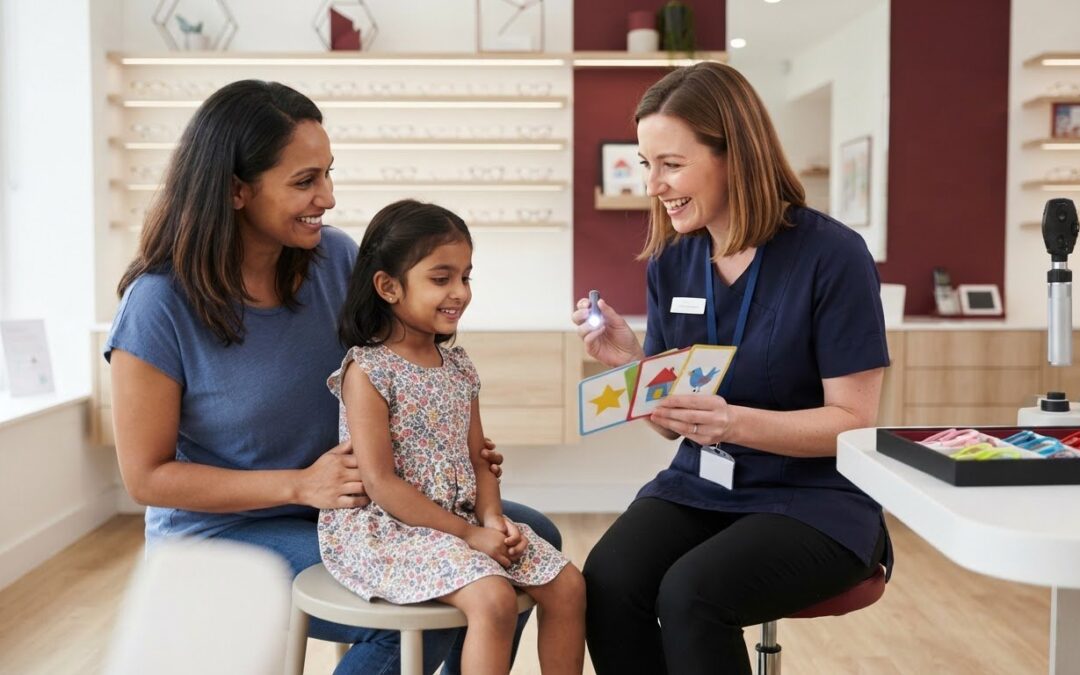
An eye test for preschoolers isn’t a test your child needs to pass. It’s an assessment adapted to what they can manage, and they don’t need to read or explain exactly what they see. Young children may show a vision difficulty through behaviour, such as sitting close to screens, squinting or tilting their head. These signs can be easy to mistake for ordinary preschool habits.
If you’re unsure when to arrange an eye test, or feel anxious about how your child will cope, you’re not alone. This guide explains which changes are worth discussing with an optometrist, when a preschooler may benefit from an examination, and what an age-appropriate appointment may involve. The aim is to help you feel informed and prepared.
You’ll also learn how a full eye examination differs from vision screening, and how to help your child feel more at ease. Tests can be adapted to a young child’s age and may use pictures, shapes or lights, so knowing the alphabet isn’t required. We’ll also explain how to ask for local professional advice in Rayleigh, South Benfleet and the surrounding area, including Canvey Island.
Key Takeaways
- An eye test for preschoolers is an opportunity to understand their vision, not a pass-or-fail task.
- Keep a note of repeated behaviours that concern you, including when they happen, so you can describe them to an optometrist.
- A young child’s appointment can be adapted to their age. Ask the practice what to expect when arranging it.
- Help your child feel more comfortable by explaining the visit simply and choosing a time when they’re rested.
- Check NHS eligibility and confirm that your chosen local practice can see preschool-aged children before arranging an appointment.
Eye test for preschoolers: when is it worth arranging one?
Preschoolers may not recognise a change in their vision, let alone have the words to explain it. An eye test is a professional assessment of how a child sees and how their eyes are working. It isn’t a pass-or-fail task, and a child doesn’t need to know the alphabet to take part. A broad overview of a standard eye examination explains some of the different checks that may be used, including options for children who can’t read letters.
There’s no single age or interval that suits every child. In the UK, the UK National Screening Committee recommends vision screening for children aged 4 to 5 to identify possible problems, but screening is not the same as a full eye examination. In England, screening provision varies by local authority. Children under 16 are entitled to NHS-funded eye tests, but parents should check how to arrange one locally and whether a practice can see a preschool-aged child.
Is there a standard age for a preschool eye test?
Timing can depend on what you’ve noticed, your child’s development, family history and any advice from a health professional. If you have a concern, you don’t need to wait until your child starts school or reaches a particular birthday before raising it with an optometrist. Describe what you’ve observed and ask what type of assessment may be suitable. If you’re asking about a routine appointment, check that the practice sees children of your child’s age.
Why can a preschooler have a vision problem without saying so?
A young child may assume everyone sees the way they do. They might adapt without telling you, or lack the words to describe blur, difficulty focusing or differences between their eyes. Repeated squinting, closing one eye, holding objects unusually close or difficulty tracking things visually are useful observations to share. On their own, though, they don’t establish what is causing the behaviour.
A sign is a reason to ask a question, not a diagnosis. An optometrist can assess your child’s vision and advise whether further attention is needed. Noticing a behaviour doesn’t mean there’s necessarily a problem, but noting when it happens can make your conversation more useful. For example, record whether it occurs during close-up activities, outdoor play or when your child is tired.
Routine concerns can usually be discussed with an optometrist or your child’s GP. Seek prompt advice if your child has a sudden change in vision, significant eye pain or an eye injury. If you’re unsure how urgently to act, contact NHS 111 or a GP for guidance rather than waiting for a routine appointment.
What happens during an eye test for preschoolers?
An eye test for preschoolers is tailored to the child, rather than following a single fixed routine. The optometrist will choose suitable ways to assess their vision and eye health, taking their age, communication and comfort into account. The appointment may begin with a conversation with you, so the practitioner can understand the reason for the visit and any relevant background.
You may be asked about your child’s general health and development, family history or behaviours you’ve noticed. Share specific examples, such as what was happening when you noticed a concern and how often it occurs. This helps the optometrist understand what you’re seeing at home and decide which checks may be helpful. The NHS guidance on eye tests for children also explains why children’s vision matters and how checks may be arranged.
How can an optometrist assess a child who cannot read?
Reading letters isn’t essential. Depending on the child and the assessment, the optometrist may use pictures or symbols, ask them to match shapes, or observe how they respond to simple instructions. Some checks may involve looking at or following something. The exact methods and order vary, so don’t assume your child will be asked to complete every check or use a particular chart or instrument.
If you’d like to know what to expect at a specific practice, ask when you enquire about an appointment. You can mention your child’s age and ask how the practice adapts appointments for young children. That gives the team a chance to explain its approach without promising a particular method or outcome.
What if my preschooler is shy or won’t cooperate?
Children’s confidence and attention vary, and an unfamiliar room or person can make a child hesitant. The practitioner may adjust how they explain a check, offer time to settle or try a different approach where possible. You can help by sharing what usually reassures your child, but there’s no need to put pressure on them to perform.
If your child finds part of the appointment difficult, that doesn’t mean they can’t be assessed at another time. The optometrist can explain what they were able to check and whether further advice or another appointment would be appropriate. If you’re considering a local appointment, you can ask Castle Opticians about eye tests in Rayleigh or South Benfleet and confirm whether they can see a preschool-aged child.
Which preschool behaviours may justify an eye-care conversation?
Children don’t always tell you that something looks unclear. They may not realise their experience differs from anyone else’s, or may not have the words to describe it. So a lack of complaint doesn’t confirm that their vision is normal. Changes you notice are useful clues to discuss, not evidence of a particular eye condition.
Pay attention to patterns during ordinary activities. Does your child lose their place while looking at a picture book, seem to have trouble following a moving toy, or regularly turn their head to look at something? You might also notice them closing one eye, repeatedly rubbing their eyes, avoiding close-up play or appearing uncomfortable in bright light. These behaviours can have several explanations, but if they happen often, it’s reasonable to ask an optometrist for advice.
What changes in behaviour should parents mention?
Give the optometrist a clear picture rather than trying to interpret what the behaviour means. Note what happens, how often and in which situations. For example, does your child struggle to follow a ball during play, or only seem distracted when they’re tired? Mention any noticeable change in how they engage with books, toys or objects around them.
Tiredness, concentration, mood and the setting can all affect a child’s behaviour. One difficult afternoon doesn’t necessarily point to a vision concern. A repeated pattern, or a change that persists across different activities, is more useful context for a professional conversation. You don’t need to work out the cause yourself.
When should parents seek prompt professional advice?
Longstanding questions can be raised with an optometrist or your child’s GP. A sudden change, symptoms that are getting worse, or anything that causes you serious concern calls for prompt advice rather than waiting for a routine appointment. Contact your GP or NHS 111 for guidance on the appropriate next step. If your child has an eye injury, seek urgent medical advice.
Keep your description simple and factual: what changed, when you first noticed it, and whether it has happened again. That information can help a health professional decide how quickly your child should be seen and whether an eye test for preschoolers is appropriate. A behaviour alone can’t diagnose an eye condition, but it can be a helpful reason to ask.
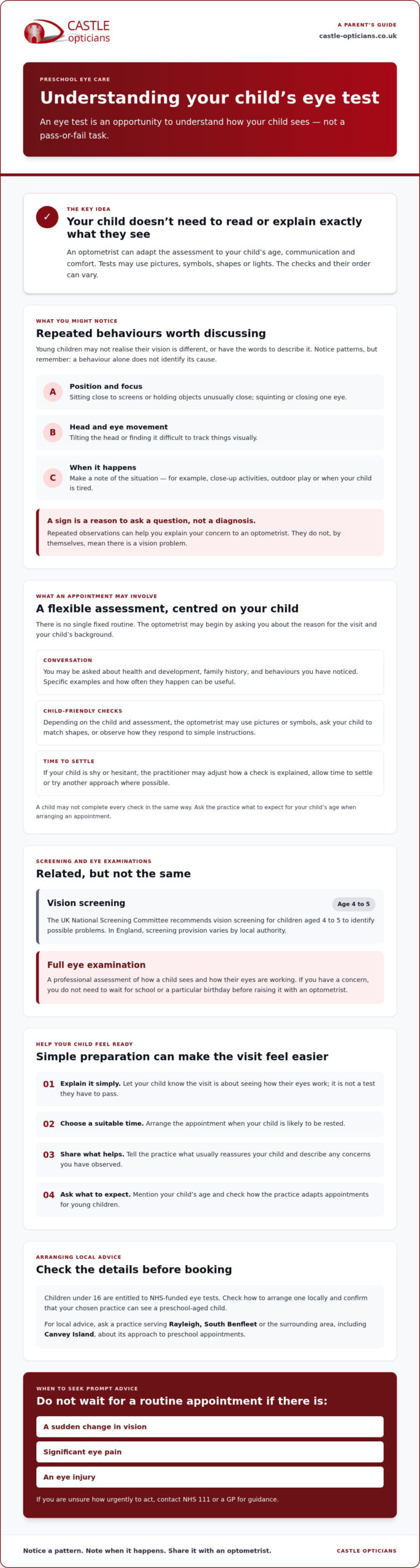
How to prepare your preschooler for an eye test
A little preparation can make an unfamiliar appointment feel more manageable. Keep the explanation simple and positive: you might say, “We’re going to meet someone who’ll check how your eyes are working.” Avoid promising that the visit will be fun or that everything will be fine. Instead, explain that the practitioner will guide them and that they can ask you questions.
Use this short checklist to get ready:
- Choose a suitable time. If you can, pick an appointment that fits your child’s usual routine and when they’re likely to be rested.
- Bring their glasses. If your child already wears glasses, take them along. Bring previous prescription details or other eye-health records if you have them.
- Make a few notes. Write down what you’ve noticed, how often it happens and when you first became aware of it.
- Share relevant background. Tell the optometrist about your child’s health and development, and any family history of eye conditions that may be relevant.
- Check the arrangements. Ask the practice whether it needs particular records and confirm any appointment details in advance.
What should parents bring or tell the optometrist?
Specific examples can be more helpful than a general feeling that something seems different. For instance, note whether a behaviour happens during picture books, outdoor play or other activities, and whether it’s new or has been present for some time. You don’t need to decide what it means. Your observations help the optometrist understand your concern and consider what checks may be appropriate.
How can you help your child feel comfortable?
Keep your tone calm and familiar. Let your child know they can stay with you and that the practitioner will explain what to do. A favourite small toy may offer comfort, if appropriate. Try not to practise answers with them or describe the appointment as a test they need to get right. The eye test for preschoolers is an assessment, not a performance.
Children may respond differently on the day, so allow for a little uncertainty. If your child is tired or shy, tell the practitioner; they can explain the next steps and what may be possible during the appointment. If you’re preparing to arrange a local visit, contact Castle Opticians to ask about eye tests for preschool-aged children at its Rayleigh or South Benfleet practices.
Finding preschool eye-test advice in Rayleigh and South Benfleet
For a routine question about your child’s vision, an optometrist can advise whether an eye examination is appropriate. A GP may be a helpful first contact if you’re unsure where to turn or have concerns about your child’s general health. If symptoms are sudden, worsening or worrying, seek prompt advice from a health professional rather than waiting for a routine appointment.
In England, children under 16 are entitled to free NHS-funded eye tests. However, you’ll still need to check how to arrange one and whether a local practice can examine a preschool-aged child. Availability and booking arrangements can vary, so confirm these directly instead of assuming every optician offers appointments for young children. If you live in Canvey Island, you can also ask a practice in Rayleigh or South Benfleet about its arrangements for preschool appointments.
What should you ask when contacting a local optician?
A quick enquiry can clarify the next step. Ask whether the practice sees children of your child’s age, what appointment options are available and what information to bring. You can also ask how NHS eligibility applies to your circumstances and whether there are any booking requirements. For broader background, Castle Opticians’ guide to a comprehensive eye test in Essex may also be useful.
How can a familiar local practice support your next step?
Castle Opticians is an independent optician group with practices in Rayleigh and South Benfleet. It offers NHS and private eye examinations, but check directly whether the practice you contact currently sees preschool-aged children. When you enquire, mention your child’s age and briefly explain what you’ve noticed. That gives the team useful context and helps them advise you about suitable appointment options.
If you’re looking specifically for local information, the guide to a children’s eye test in South Benfleet may be relevant. A local appointment can also give you the opportunity to discuss your observations with an eye-care professional and ask what to do next. Families in Canvey Island can contact either the Rayleigh or South Benfleet practice to check which arrangements may suit them.
If you’re in Rayleigh, South Benfleet or Canvey Island, contact Castle Opticians to ask whether a preschool appointment is available and what arrangements may apply. You don’t need to have worked out what a behaviour means before making an enquiry. Simply explain your concern and ask for guidance.
Take a calm next step for your child’s vision
Your preschooler may not be able to explain what they see, so repeated behaviours or changes in how they engage with everyday activities can be useful to discuss with an optometrist. They aren’t a diagnosis, and an eye test is an assessment adapted to the child, not something they need to pass. A little preparation and a clear description of your concerns can help you feel more ready for an appointment.
If you’re considering an eye test for preschoolers, check that the practice can see a child of your child’s age and ask about current NHS eligibility and booking arrangements. Castle Opticians is an independent optician group operating since 1989, with practices in Rayleigh and South Benfleet. It offers NHS and private eye examinations; contact the practice to confirm whether a preschool appointment is available. Families in Canvey Island can also ask the Rayleigh or South Benfleet practice about appointment options.
Contact Castle Opticians to ask about an eye test for your preschooler and share what you’ve noticed. Asking for advice is a positive, practical first step, and you don’t need to have all the answers before you get in touch.
Frequently Asked Questions
When should a preschooler have an eye test?
There isn’t one age that suits every child. The UK National Screening Committee recommends vision screening for children aged 4 to 5, but screening isn’t the same as a full eye examination. In England, screening provision varies by local authority. If you’ve noticed a concern, or have questions about your child’s development or family eye-health history, speak to an optometrist or GP rather than waiting for school.
Can a three-year-old have an eye test if they cannot read?
Yes. Reading letters isn’t necessary for an optometrist to assess a young child’s vision. Depending on the child and the practice, checks may use pictures, symbols, matching or simple responses. The exact approach depends on the practitioner’s assessment, so ask the practice what to expect and confirm that it can see a child of your child’s age before arranging an appointment.
What happens at an eye test for preschoolers?
An eye test for preschoolers is an individual assessment, not a pass-or-fail exercise. The optometrist may ask you about your child’s health, development, family eye-health history and anything you’ve noticed. They’ll choose suitable checks for your child; the methods and order can vary, and not every child will complete the same checks. You can share concerns or ask questions during the appointment.
How can I tell if my preschooler needs an eye test?
Repeated squinting, closing one eye, holding objects close or seeming to struggle to follow things visually are examples worth mentioning to an optometrist. You might notice them during play, looking at picture books or other everyday activities. These behaviours don’t prove there’s an eye condition, and tiredness or concentration can also affect them. Note what happens, how often and in which situations.
Is a child’s eye test free on the NHS in England?
Yes. Children under 16 are entitled to free NHS-funded eye tests in England. This entitlement doesn’t confirm that every practice offers appointments for preschool-aged children, so check with the optician before booking and ask about current arrangements. If you’re unsure how to arrange a test, your GP or a local optician may be able to advise on an appropriate next step.
What if my preschooler will not cooperate during an eye test?
Tell the optometrist if your child is shy, tired or finding it hard to take part. The practitioner may adapt how they explain a check or allow time for your child to settle, where possible. A difficult appointment doesn’t mean your child can’t be assessed another time. The optometrist can explain what they were able to check and whether further advice or another appointment is appropriate.
Should I arrange an eye test if my preschooler has no symptoms?
No obvious symptoms don’t guarantee that a child’s vision is normal, as preschoolers may not recognise or describe a difference. You can ask an optometrist about routine checks and what may be suitable for your child, particularly if you have questions about development or family eye-health history. In Rayleigh, South Benfleet or Canvey Island, check local arrangements and confirm the practice sees preschool-aged children.