
The most stylish frame in the world is little more than a fashion accessory if the lenses inside aren’t tailored to your specific visual environment. It’s completely natural to feel a sense of confusion when faced with technical jargon like high-index or varifocal. Most people just want to avoid the discomfort of heavy spectacles or the worry that they’re overpaying for unnecessary extras. After all, your vision is personal, and your eyewear should reflect that.
We believe that choosing your eyewear should be a reassuring and personal experience rather than a technical hurdle. This guide provides the expert clinical guidance you need to select the perfect lenses for your lifestyle and frame choice. With the average adult now spending over seven hours a day on digital devices, finding the right balance of clarity and protection is more important than ever. You’ll discover how modern thinning technologies and durable coatings provide clearer vision at all distances whilst keeping your glasses light and aesthetically pleasing. We will explore the latest advancements in digital surfacing to ensure you find a solution that fits your daily needs perfectly.
Key Takeaways
- Learn how modern polymers have replaced heavy glass to create lightweight, impact-resistant eyewear that remains comfortable all day.
- Identify whether single vision, bifocal, or varifocal lenses are the best match for your daily activities and specific vision requirements.
- Understand lens index numbers to ensure your finished spectacles are thin, light, and aesthetically pleasing, regardless of your prescription strength.
- Discover why high-quality lens coatings are vital performance features that protect your investment and significantly reduce digital eye strain.
- Explore the benefits of personalised dispensing and thorough clinical examinations at a trusted independent practice for a truly tailored fit.
Understanding Modern Spectacle Lenses: More Than Just Vision Correction
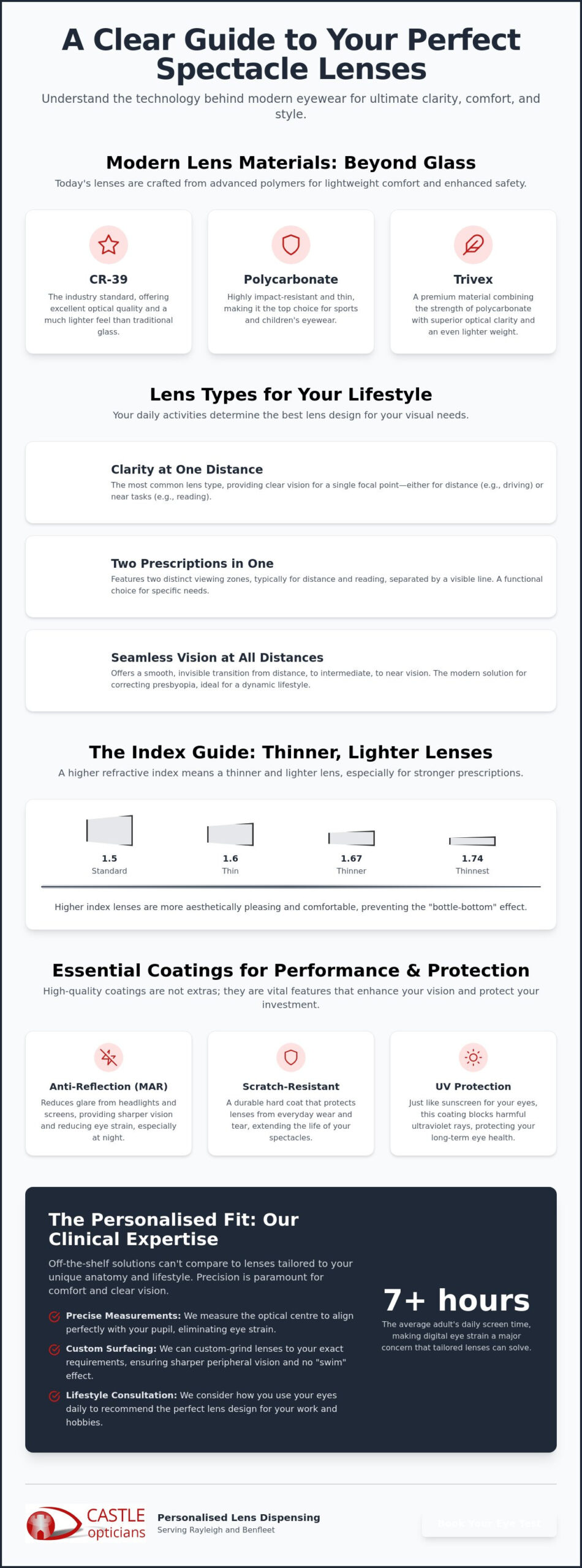
Modern eyewear has moved far beyond the heavy, fragile glass discs of the past. Today, your lenses are precision-engineered optical instruments crafted from advanced polymers that offer both safety and clarity. These materials have evolved to meet the demands of a digital age, focusing on reducing weight whilst maximising visual performance. We typically work with three primary materials to ensure the best result for your prescription:
- CR-39: The industry standard for decades, providing excellent optical quality and a much lighter feel than traditional glass.
- Polycarbonate: Highly impact-resistant and incredibly thin, making it the preferred choice for sports eyewear or children’s spectacles.
- Trivex: A premium material that combines the strength of polycarbonate with superior clarity and an even lighter weight for all-day comfort.
These materials don’t just sit in a frame; they’re designed to be part of your daily life without causing the bridge of your nose to ache by lunchtime. The transition from glass to these lightweight polymers has allowed for larger, more fashionable frame choices without the penalty of added weight.
The Science of Sight: How Lenses Manipulate Light
At its core, a corrective lens works by subtly altering the path of light so it focuses accurately on your retina. Concave shapes are used to spread light to correct myopia (short-sightedness), while convex shapes converge light for hyperopia (long-sightedness). However, the physical shape is only half the story. To see clearly, the “optical centre” of the material must align perfectly with your pupil. If this alignment is even slightly off, you may experience blurred vision or significant eye strain. Bespoke surfacing goes a step further by tailoring the entire surface to your specific eye movements, providing much sharper peripheral vision than standard options.
Why Lens Quality Matters for Long-Term Comfort
You might wonder why two pairs of glasses with the same prescription can feel so different. The answer often lies in the manufacturing process. Generic “stock” lenses are mass-produced and cut to fit a frame, which can sometimes lead to subtle distortions. In contrast, surfaced lenses are custom-ground to your exact requirements and frame dimensions. To see an example of high-precision manufacturing, you can discover Australian Made Vision and their range of premium optical solutions. High-quality optics eliminate the “swim” effect, a disorienting sensation where the world seems to move or warp when you turn your head.
Poor quality optics often force your brain to work harder to stitch together a clear image. This constant processing can lead to nagging headaches and a noticeable drop in concentration by the afternoon. Our dispensing opticians play a vital role here. They don’t just take measurements; they consider how the frame sits on your face, the distance between your pupils, and how you use your eyes throughout the day. This clinical expertise ensures that your final choice doesn’t just correct your vision but actively enhances your comfort and well-being. We take the time to get these details right because we know that even a millimetre of difference can change how you feel at the end of a long day.
Choosing the Right Lens Type for Your Lifestyle
Your daily routine is the most significant factor when selecting new eyewear. While your prescription provides the clinical requirements, your lifestyle dictates how those lenses should be engineered. A lorry driver spending hours on the motorway has vastly different visual needs compared to a graphic designer in Rayleigh. Selecting the right focal type involves looking at your prescription for an “ADD” value, which indicates if you require multiple corrections within a single pair of glasses. Matching the optical design to your primary activities ensures you don’t just see clearly, but also comfortably.
Professional measurements are the foundation of this process. At our Rayleigh and Benfleet centres, we take the time to understand where you sit, how you hold your phone, and even your posture at a desk. These details allow us to recommend a specific design that aligns with your visual habits. If you feel your current eyewear isn’t quite keeping up with your pace of life, our team can help you book an eye test to explore more suitable options.
Single Vision Lenses: Clarity at One Distance
Single vision options are the most common choice, providing a consistent correction across the entire surface. They are ideal for those who are purely short-sighted or long-sighted. However, the way we use our eyes has changed. We now see a high demand for specialised “boost” designs amongst young professionals. These are single vision lenses with a subtle power increase at the bottom. This small adjustment helps the eyes relax during prolonged screen use, effectively reducing the digital eye strain that affects so many office workers. For dedicated tasks like reading a book or long-distance driving, a high-quality single vision lenses Essex option remains the gold standard for edge-to-edge clarity.
Varifocal and Bifocal Specialists: The Multi-Focal Advantage
For those who need help with both distance and near vision, varifocals offer a seamless transition without the visible dividing line found on bifocals. Modern “freeform” varifocals use digital surfacing technology to tailor the optics to your specific frame. This advanced manufacturing process results in sharper peripheral vision and significantly better clarity in low-light conditions. It also makes the adaptation period much shorter than it used to be.
A common concern we hear is the fear of navigating stairs or kerbs whilst wearing varifocals. This discomfort usually stems from poorly positioned focal zones. By taking meticulous measurements of how the frame sits on your face, we ensure the reading area is positioned precisely where you need it. This means you can walk, drive, and read with total confidence, knowing your vision is supported at every angle. If you prefer a distinct, wide area for reading, bifocals are still a fantastic and reliable option that many of our long-term patients find very comfortable. For a deeper understanding of how modern progressive designs can eliminate these common frustrations, our guide to varifocal lens specialists in Essex explains how personalised freeform technology delivers seamless vision at every distance. Some patients also find that alternating between spectacles and contact lenses in Rayleigh gives them the flexibility to enjoy clear vision across different activities and environments.
The Index Guide: Navigating Lens Thickness and Weight
When you look at your prescription, you’ll see numbers that determine the curvature required to correct your vision. In the past, a high prescription meant choosing between heavy, thick glass or bulky plastic. Today, we use the “refractive index” to solve this problem. In simple terms, the index refers to how efficiently a material bends light. A higher index means the material is more efficient, allowing us to use less of it to achieve the same corrective power. This results in lenses that are significantly thinner and lighter than standard options.
The relationship between your prescription and the edge thickness of your glasses is a key clinical consideration. For those with short-sightedness, the edges tend to be thicker; for long-sightedness, the centre carries the bulk. Choosing a higher index doesn’t just improve how your spectacles look; it fundamentally changes how they feel on your face. Heavy eyewear often leads to red marks on the bridge of the nose or constant slipping, which can be incredibly frustrating during a busy day in Benfleet or Rayleigh.
Standard vs. High-Index Lenses
- 1.5 Index: This is the standard plastic material. It’s an excellent, cost-effective choice for lower prescriptions, typically between -2.00 and +2.00 dioptres.
- 1.6 & 1.67 Index: Often called the “sweet spot” for moderate prescriptions, these are up to 35% thinner than standard plastic. They are also much stronger, making them the essential choice for rimless or semi-rimless frames where the material is more exposed.
- 1.74 Index: This is currently the thinnest possible plastic option. It’s designed for complex or very high prescriptions, offering up to a 50% reduction in thickness compared to standard 1.5 lenses.
When to Choose Thinner Lenses
Your choice of frame should always influence the lens index you select. If you’ve fallen in love with a delicate, thin metal frame, a high-index option is necessary to prevent the material from protruding unsightly beyond the rim. Thick acetate frames are more forgiving and can hide a bit of edge thickness, but the weight remains a factor. Nobody wants their glasses to feel like a burden by mid-afternoon.
The “Coke-bottle effect” is a common fear for those with stronger prescriptions, where the eyes can appear unnaturally large or small. High-index materials help to minimise this magnification or minification, ensuring your eyes look natural behind the spectacles. By carefully balancing the index with your frame size, our dispensing team ensures that weight distribution is even. This prevents your glasses from slipping down your nose and keeps your vision perfectly aligned with the optical centres we discussed earlier.
Essential Lens Coatings: Protecting Your Eyes and Your Investment
Think of lens coatings as the final, essential stage of your optical prescription rather than optional extras. While the material and index provide the corrective power, the coatings dictate how you actually interact with the world. A multi-coated lens is a complex sandwich of microscopic layers, each designed to solve a specific visual problem. Research shows that over 65% of consumers now prioritise lenses that minimise glare from sources like computer screens and car headlights. Without these treatments, up to 10% of light can be lost to reflections, meaning less light actually reaches your eye for processing.
From an aesthetic perspective, these coatings make your spectacles appear almost invisible to others. Instead of people seeing a distracting reflection of the room in your glasses, they see your eyes clearly. Maintaining these high-performance surfaces is straightforward, but it requires the right approach. We always recommend avoiding the use of your sleeve or harsh household detergents, which can degrade the delicate layers over time. A simple microfibre cloth and a dedicated optical spray will protect the integrity of the multi-coat for the life of your prescription.
Anti-Reflection and Scratch Resistance
Driving at night becomes significantly safer when you eliminate the “halo” effect around streetlights and oncoming traffic. Modern anti-reflective coatings are now more durable than ever, often incorporating hydrophobic and oleophobic layers. These technical terms simply mean the surface repels water and grease. Raindrops bead off more effectively, and oily fingerprints are much easier to wipe away. Because high-index materials are naturally softer, a scratch-resistant hard coat is vital for anyone with an active lifestyle to prevent the fine abrasions that can cloud your vision over time.
Blue Light and Digital Eye Strain
The average adult now spends over seven hours a day looking at digital devices. This constant exposure to LED lighting and smartphone screens can lead to significant eye fatigue. Blue-filter lenses are a modern solution that can be integrated directly into the lens material, eliminating the yellowish tint of older designs. This technology filters out specific wavelengths of light that are known to disrupt sleep patterns and cause digital eye strain. If you spend your working day in front of a monitor or find yourself scrolling through a tablet in the evening, these enhancements help your eyes feel more relaxed and refreshed.
If you are experiencing glare during your evening commute or fatigue at your desk, view our range of lens enhancements to find the right protection for your eyes.
Personalised Lens Dispensing at Castle Opticians in Rayleigh and Benfleet
Choosing the right eyewear is an investment in your daily quality of life. At Castle Opticians, we have provided thorough clinical eye examinations since 1989. As an independent practice, we prioritise personal consideration over the corporate, volume-driven approach often found in high-street chains. Our focus is on building long-term relationships with the families of Rayleigh and Benfleet. We take the time to understand your visual history and your future needs, ensuring you feel respected and looked after throughout your visit.
The dispensing process is where clinical theory meets practical comfort. Even the most advanced lenses will fail to perform if they aren’t positioned correctly within your chosen frame. We use a series of bespoke measurements to ensure total precision. This includes your pupillary distance (PD), which aligns the optical centre with your eye; the vertical heights, vital for varifocal performance; and the vertex distance, which is the space between the lens and your cornea. These fine details are what make a pair of spectacles feel effortless to wear from the moment you put them on.
The Clinical Advantage of Independent Care
Being independent gives us the freedom to select the best technology from across the industry. We aren’t restricted to a single supplier, allowing us to source premium lenses from world-leading manufacturers such as Essilor, Zeiss, and Hoya. This variety ensures we can find the exact solution for your unique prescription rather than a one-size-fits-all alternative. Our qualified dispensing opticians offer expert advice in an unhurried environment. We believe a consultation should be patient and methodical, mirroring the thoroughness of our comprehensive eye test Essex families rely on, and giving you the confidence that your vision is in expert hands.
Finding Your Perfect Match in Essex
Selecting a frame is about more than just aesthetics; it’s about engineering. Our team provides expert frame styling to ensure your chosen correction fits perfectly and sits comfortably on your face. Much like the precision required by Bowkirk Kitchens & Bedrooms when designing bespoke home storage, a well-fitted frame prevents the slipping and pressure points that can lead to daily discomfort or distorted vision. Beyond the initial collection, we take pride in our commitment to the local community. Our customers enjoy dedicated aftercare, including free adjustments and minor repairs at our Essex branches to keep their vision sharp and their frames secure. This personal attention is the hallmark of our service.
Book your eye test at Castle Opticians today to experience a more personal and professional approach to your eye health.
Experience Sharper Vision and Lasting Comfort
Selecting the right eyewear is a journey from understanding technical specifications to achieving daily visual comfort. By now, you should feel more confident about the difference between high-index materials and the essential role of protective coatings. Whether you require the seamless transition of modern varifocals or the sleek, thin profile of thinned lenses, the right choice always begins with a thorough understanding of your unique lifestyle. Your spectacles should be an effortless extension of your personality, providing clarity without the burden of weight or glare.
As independent Essex opticians serving the local community since 1989, we specialise in providing this level of detailed, personalised clinical care. Our expertise in varifocal and high-index technology ensures that your spectacles are as functional as they are beautiful. We invite you to visit us for a methodical and unhurried consultation where your vision is our absolute priority. We take pride in getting the small details right because we know they make the biggest difference to your day.
Book an Eye Test at Our Rayleigh or Benfleet Branch to start your journey toward clearer, more comfortable vision today. We look forward to welcoming you to our practice and helping you see the world with total confidence.
Frequently Asked Questions
What are the best lenses for driving at night?
Anti-reflective coatings are the best choice for night driving because they reduce distracting reflections from streetlights and oncoming headlights. These specialised coatings allow more light to pass through the material, which improves contrast and safety in low-light conditions. Many drivers find that these lenses significantly decrease the “halo” effect around lights, making the evening commute much less fatiguing for the eyes.
How do I know if I need varifocal lenses?
You likely need varifocals if you find yourself holding a phone or book at arm’s length to see clearly. This is a natural change called presbyopia, which usually begins in your 40s. Varifocals provide a smooth transition between distance, intermediate, and near vision in one pair of glasses. This eliminates the need to constantly switch between different pairs of spectacles throughout your busy day. To learn more about how our team approaches progressive lens fitting, visit our dedicated page on varifocal lens specialists in Essex for a comprehensive overview of the latest digital freeform designs.
Are thinner lenses always better for strong prescriptions?
High-index options are almost always better for strong prescriptions because they reduce the physical thickness and weight of the eyewear. Thinner lenses provide a more attractive finish and prevent the “Coke-bottle” magnification effect that can occur with standard materials. However, the ideal index also depends on your specific frame choice, as thicker acetate frames can sometimes hide edge thickness more effectively than delicate metal rims.
Can I put new lenses into my existing spectacle frames?
We can certainly fit new prescription optics into your existing frames, provided they are in a safe and sturdy condition. This process is a sustainable way to update your vision whilst keeping a favourite style. Our dispensing team will carefully inspect your frames at our Rayleigh or Benfleet branches to ensure they can withstand the pressure of the fitting process without the risk of breaking.
What is the difference between an anti-glare and a blue light coating?
Anti-glare coatings focus on reducing surface reflections to improve clarity, while blue light coatings specifically filter out high-energy visible light from digital screens. Anti-glare is essential for night driving and office lighting to stop distracting bounce-back. Blue light filters are designed to reduce digital eye strain and help maintain natural sleep patterns by blocking the specific wavelengths emitted by smartphones, tablets, and LED monitors.
How long does it take to get used to new varifocal lenses?
Most people take between two days and two weeks to fully adapt to new varifocal designs. During this period, your brain is learning to naturally look through the correct part of the material for different distances. It’s important to wear them consistently rather than switching back to old glasses. If you still feel unsettled after a fortnight, our local team is always available for a professional fitting adjustment.
Do I need a special lens for computer work?
Dedicated “occupational” or office designs are highly beneficial if you spend several hours a day at a desk. Standard varifocals are great for general use, but occupational options offer a much wider field of view for intermediate distances like monitors and keyboards. These specialised designs help prevent “monitor neck” by allowing you to sit in a more natural posture whilst maintaining sharp focus on your screen. If you are unsure whether a dedicated occupational design or a standard single vision lenses Essex option would better suit your working environment, our dispensing team can help you compare both solutions in detail.
How should I clean my prescription lenses to avoid scratches?
You should always use a clean microfibre cloth and a dedicated optical spray to clean your eyewear without causing damage. Avoid using paper towels, tissues, or the corner of your shirt, as these materials often contain abrasive fibres that create fine scratches over time. It’s also wise to avoid household window cleaners or dish soap, which can strip away the delicate performance coatings from the surface.