
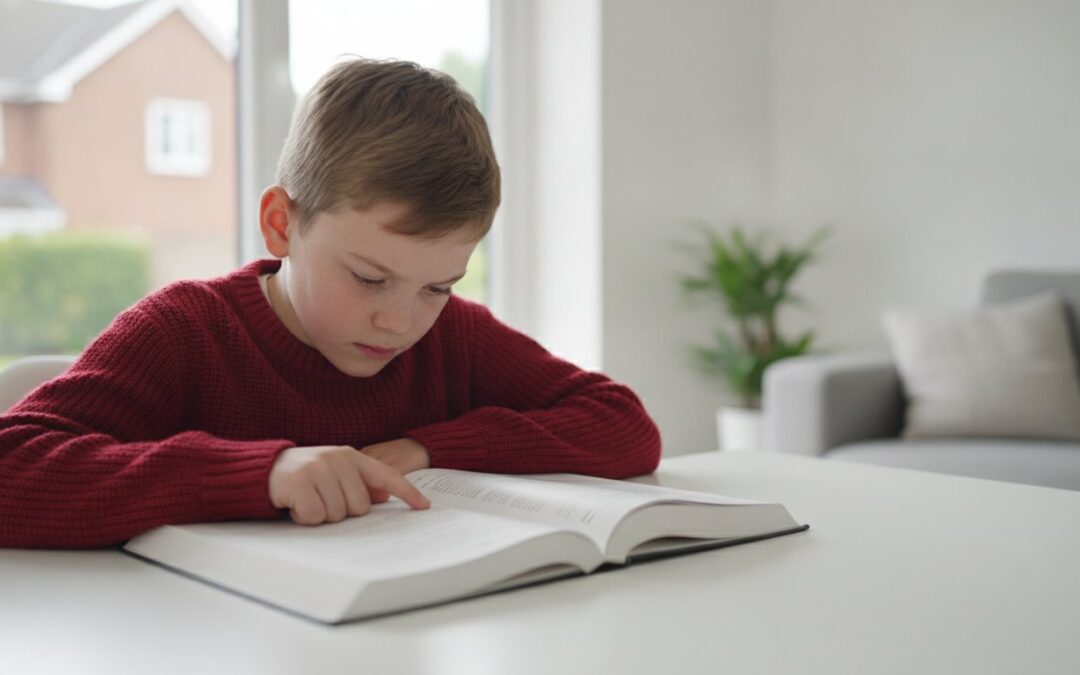
If you are waiting for your child to complain that the whiteboard is blurry, you might be waiting for a moment that never comes. Most children assume that the way they see the world is exactly how everyone else sees it; they have no frame of reference for “perfect” vision. This means they rarely speak up about sight issues, leaving parents to spot the behavioural cues instead.
It’s completely normal to feel a sense of worry if your child seems to be falling behind at school or if you’re confused by their recent fidgety behaviour. You want the best for their development, but knowing when to book that first appointment often feels like guesswork. This article will help you discover the subtle, often-missed signs child needs eye test and explain why waiting for a verbal complaint is a mistake that could impact their learning.
We’ll provide a clear checklist of symptoms to watch for, whilst explaining the vital differences between a basic school screening and a comprehensive professional exam. By the end, you will have the expert guidance needed to ensure your child’s vision is a bridge, not a barrier, to their future success.
Key Takeaways
- Children rarely complain about poor sight because they don’t know what “normal” vision looks like; they simply assume everyone sees the world as they do.
- Learn to identify the ten physical and academic signs child needs eye test, including subtle cues like squinting or using a finger to track text whilst reading.
- Discover why standard school vision screenings are only basic distance checks and often miss critical issues like near-vision tracking and overall eye health.
- Understand the link between uncorrected visual stress and classroom performance, including how myopia can lead to fatigue and a lack of concentration.
- Find out how a child-friendly, unhurried eye examination at an independent practice can build your child’s confidence and support their long-term development.
The Great Misconception: Why Your Child Won’t Tell You They Can’t See
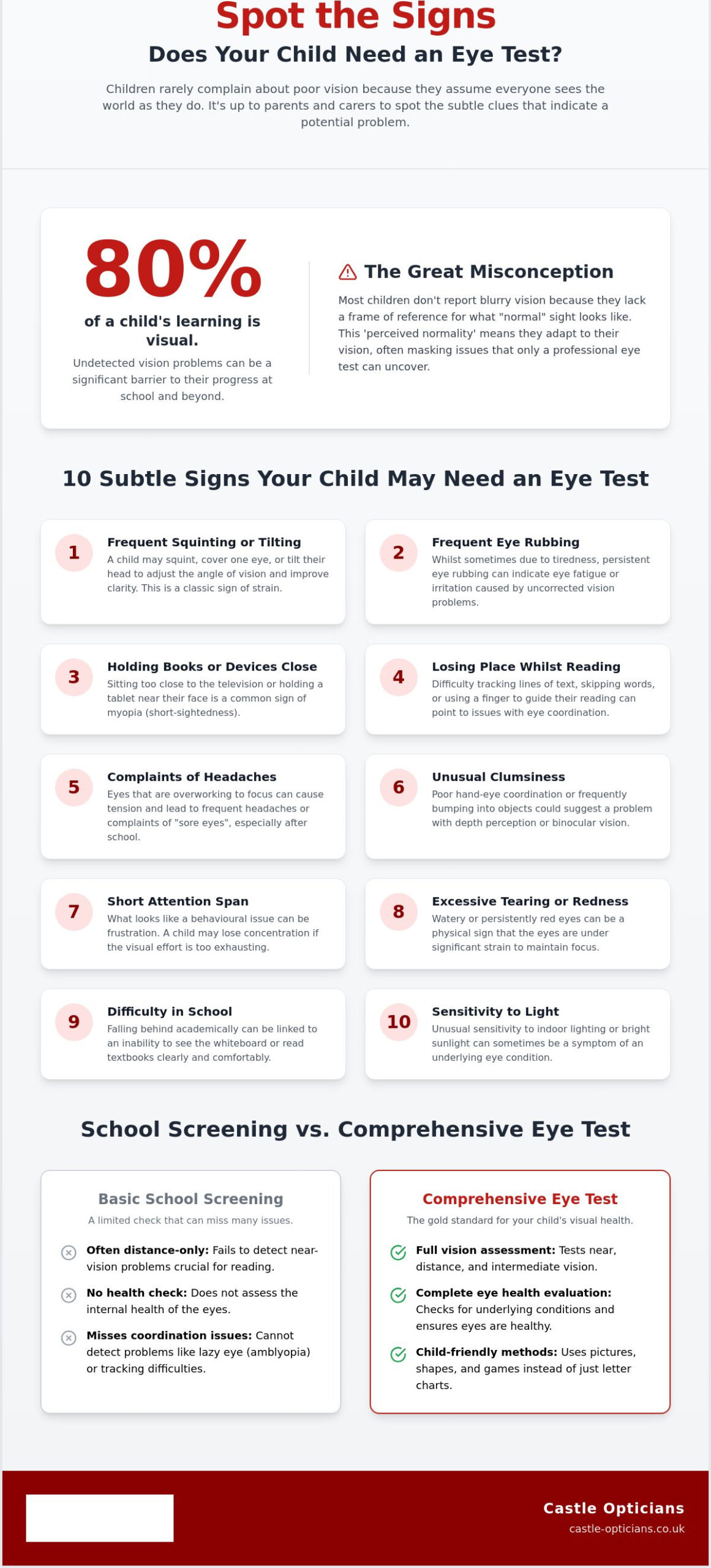
Many parents assume that a vision problem would be obvious. They expect their son or daughter to come home from school and mention that the whiteboard looks fuzzy or that the words in their favourite book are dancing around. In reality, this rarely happens. Because vision is responsible for approximately 80% of a child’s learning in their early years, an undiagnosed issue can create a significant barrier to their progress before they even realise anything is wrong.
Sometimes, what appears to be a behavioural problem or a lack of concentration is actually a frustrated child struggling to see. They might become fidgety or lose interest in tasks because the visual effort required is simply too exhausting. Recognising the signs child needs eye test often requires looking past what they say and focusing on how they behave in different environments. Waiting for a verbal complaint is often the biggest mistake a parent can make.
Myth: “My child would complain if they had blurry vision”
The most common reason children stay silent is a concept called perceived normality. If a child has always seen the world through a slight haze, they have no reason to believe it should look any different. They lack a “baseline” for perfect clarity. Perceived normality is the reason children rarely report vision loss, as they simply assume everyone else experiences the world exactly as they do.
Children are also incredibly resilient and become masters of compensation. They might subconsciously tilt their head to use a stronger eye or rely more heavily on their hearing during lessons. These adaptations mask the underlying issue, making it even harder for parents to spot the signs child needs eye test without a professional consultation. They don’t know they are struggling; they just think that school is harder for them than it is for everyone else.
Myth: “They are too young for an eye test”
We often hear that parents are waiting until their child can read the alphabet before booking an appointment. This is a mistake. Modern comprehensive eye tests for youngsters don’t rely on letter charts. We use specialised tools, including colourful shapes, lights, and picture-matching games, to assess how well their eyes focus and work together.
Testing can begin as early as infancy if there are concerns, but we strongly recommend a formal check-up before they start primary school. Early intervention is vital. Conditions like amblyopia, commonly known as a lazy eye, are much easier to correct when a child is young and their visual system is still developing. Ensuring they are classroom ready gives them the best possible start to their education and prevents long term issues that are harder to treat later in life.
10 Subtle Signs Your Child Needs an Eye Test
Observing your child during their daily routine is the most effective way to identify potential vision issues. Whilst some indicators are obvious, many others are quite discreet. For instance, physical symptoms like squinting or frequent eye rubbing are classic signs of vision problems, but you should also watch for excessive tearing or persistent redness. These physical cues often suggest that the eyes are straining to maintain focus, leading to fatigue long before the school day ends.
Digital habits and academic performance provide further clues. If your child holds tablets or phones unusually close to their face, they may be struggling with myopia. In the classroom, academic indicators often manifest as losing their place whilst reading or a continued reliance on using a finger to track text. These aren’t just habits; they are coping mechanisms for a visual system that isn’t tracking smoothly. If they complain of headaches or “sore eyes” after school, it’s a clear signal that their visual effort is becoming unsustainable.
Spatial awareness is another vital area to monitor. Unusual clumsiness or poor hand-eye coordination during sports can be amongst the most overlooked signs child needs eye test. If a child struggles to catch a ball or frequently bumps into furniture, it might not be a lack of athletic ability. Instead, it could be a problem with depth perception or binocular vision, making it difficult for them to judge distances accurately. Our children’s eye test Essex guide explains in detail how a comprehensive assessment can identify these hidden issues and support your child’s development.
The “Detective” Checklist for Parents
Look closer at how your child aligns their body when focusing. Head tilting is a common sign; it’s often a subconscious attempt to realign the eyes if they are slightly misaligned, a condition known as strabismus. Similarly, if you notice them closing one eye whilst watching television or reading, they may be trying to shut out a blurred image from a weaker eye. You should also watch for extreme sensitivity to light. If they blink excessively or seem distressed in bright sunshine, it could indicate a vision imbalance that requires professional attention.
When “Naughty” Behaviour is Actually a Vision Problem
It is heartbreaking how often a child is labelled as “disruptive” or “naughty” when they are simply struggling to see. A child who won’t sit still or constantly fidgets during lessons may be finding it impossible to focus on a distant whiteboard. This frustration can lead to a lack of confidence in social play, as they might withdraw from games they find visually challenging. To help you navigate these complexities, we have created a child eye test Rayleigh guide to help you prepare for their first visit. If these signs child needs eye test sound familiar, our team at Castle Opticians is here to provide a thorough, unhurried assessment in a calm environment.
School Screenings vs. Comprehensive Eye Tests: The Safety Net Myth
Many parents breathe a sigh of relief when their child “passes” a vision screening at school. It feels like a box has been ticked, providing a sense of security that their child’s sight is perfect. However, relying solely on these checks is a mistake. A school screening is a basic filter designed to catch significant distance-vision problems; it is not a substitute for a full clinical examination. A child can pass a school check with flying colours and still be struggling with undiagnosed Signs of common eye conditions in kids that affect their daily life.
The biggest myth we encounter is that a “pass” at school means a child has perfect vision for the next two years. In reality, these screenings often only test visual acuity at a distance. They frequently miss critical issues such as eye health, binocular vision (how the eyes work together), and near-vision tracking. If a child cannot track text across a page or focus on a book, they will struggle in the classroom, even if they can see the whiteboard perfectly. A qualified Optometrist performs an internal eye health check that a basic screening simply cannot replicate.
The Limitations of the 5-Minute School Check
School screenings are often conducted in noisy, distracting environments like hallways or gymnasiums. They are frequently carried out by non-specialists who, whilst well-meaning, do not have the clinical training to spot subtle signs child needs eye test. These checks are also notorious for missing hyperopia, or long-sightedness. Because young children have a strong ability to “over-focus,” they can often force their eyes to see a distant chart clearly during a short test, masking a problem that causes significant strain during a full day of reading and writing.
Why an Independent Optician Provides Better Care
Choosing an independent practice for your child’s eye care offers a level of thoroughness that a mobile screening unit cannot match. At Castle Opticians, our unhurried appointments allow your child to relax and settle into the environment. When a child is calm, they provide far more accurate results, and we have the time to build the trust necessary for a successful exam. We also utilise advanced diagnostic equipment to look deep into the eye, ensuring that every aspect of their visual development is on track. For a more detailed look at what to expect, you can read our children’s eye test South Benfleet guide. Taking the time to get it right now prevents classroom struggles later, giving you true peace of mind that their vision is fully supported.
How Undetected Vision Problems Affect School Performance
The mental energy required for a child to navigate a school day with uncorrected vision is immense. When a child struggles to focus on small text, they experience what clinicians call “Visual Stress.” This isn’t merely about things looking a bit blurry; it’s about the brain working overtime to decode distorted signals. If a child has myopia, they may find it impossible to engage with the teacher at the front of the room, leading to a sense of isolation from the core of the lesson. They aren’t choosing to tune out; they are physically unable to tune in.
This struggle often carries a heavy emotional toll. A child who tries their hardest but still fails to keep up with their peers can quickly become frustrated or withdrawn. They might begin to believe they are simply “not good at school,” when the reality is a physical barrier that is entirely treatable. Recognising the signs child needs eye test early is essential to prevent this negative self-image from taking root and affecting their long-term academic confidence.
The Link Between Vision and Literacy
Literacy is the foundation of all early education, yet it is the area most heavily impacted by poor sight. If a child has astigmatism, letters on a page can appear doubled or shadowed, making the process of decoding words incredibly taxing. This leads to rapid reading fatigue. You might notice your child starts a sentence well but loses their place or begins to skip words by the second or third line. “Correcting a child’s vision does more than sharpen their sight; it restores their confidence and transforms their entire approach to learning.” Without intervention, many children start to avoid reading for pleasure entirely, which can lead to a significant gap in their vocabulary development compared to their classmates.
Sports and Coordination
Vision is just as vital on the playground as it is at a desk. Depth perception, or 3D vision, is essential for judging the speed and distance of a ball or navigating climbing frames safely. A child who lacks this spatial awareness may appear clumsy or hesitant during PE lessons, which can impact their social integration and physical self-esteem. By correcting these issues, we help children move with more confidence and enjoy the social benefits of team sports. At our Rayleigh and South Benfleet branches, we offer specialised frames designed specifically for smaller faces and active lifestyles, ensuring their eyewear can keep up with every jump and tackle. To give your child the best possible start this term, you can book a comprehensive eye test with our friendly, independent team today.
Making Eye Care Fun: The Castle Opticians Experience
At Castle Opticians, we believe that an eye examination should be an adventure, not an ordeal. Since 1989, our independent practice has focused on building long-term relationships with families across Essex. Unlike corporate chains, we don’t rush our appointments. We understand that a child needs time to feel comfortable in a new environment, especially if they are already feeling frustrated by the subtle signs child needs eye test that we have discussed throughout this article. Our goal is to provide a space where they feel both respected and looked after.
Our approach is deeply rooted in clinical excellence and warm hospitality. We use engaging games, colourful pictures, and interactive tools rather than just standard letter charts. This ensures that even the youngest visitors can participate fully and enjoy the process. Because we are an independent group, we have the freedom to prioritise your child’s comfort, taking as long as necessary to ensure they provide accurate results in a relaxed setting. We take great pride in being a friendly, familiar face for the local community.
It’s also important to remember that high-quality eye care is accessible to all. NHS-funded eye tests are free for all children under the age of 16, as well as those aged 16, 17, or 18 in full-time education. If your child requires vision correction, NHS optical vouchers are provided to help with the cost of lenses and frames. We invite you to visit our Rayleigh or South Benfleet branches to browse our wide selection of children’s glasses in Essex, specifically designed to fit smaller faces comfortably whilst ensuring your child feels great in their new favourite accessory.
Your Child’s First Visit: What to Expect
We take great care to ensure our tests are entirely non-invasive and stress-free. For younger children, we typically avoid the “puff of air” test that can often be startling. Instead, we use gentle, child-friendly methods to check eye pressure and overall health. Our expert team is also highly experienced in supporting children with sensory sensitivities, adapting our communication and techniques to suit their individual needs. We make the frame-fitting process a positive experience, turning it into a fun session where they can find a style that matches their personality and boosts their confidence.
Book Your Child’s Eye Test in Essex Today
Waiting for a problem to become obvious can lead to unnecessary struggles in the classroom and on the playground. Every child should have a formal check-up before they start school to ensure their visual system is developing correctly. To learn more about what our full examination involves, you can read our guide on a comprehensive eye test Essex. If you have noticed any signs child needs eye test, or if it has simply been a while since their last check, our friendly teams in Rayleigh and South Benfleet are ready to welcome you. Give your child the gift of clear vision and the confidence to succeed by booking an appointment with your trusted local experts today.
Give Your Child the Gift of Clear Vision
Understanding that a child won’t always speak up about blurry sight is the first step in protecting their development. By staying alert to the subtle signs child needs eye test, such as squinting or a sudden lack of interest in reading, you can intervene before their school progress is affected. A “pass” at a basic school screening is a helpful start, but it doesn’t replace the thorough health check and binocular vision assessment provided by a qualified Optometrist.
At Castle Opticians, we’ve been providing independent care since 1989. We take the time to make every visit unhurried and fun for your little ones. With free NHS eye tests for under-16s and our expert paediatric frame fitting service, ensuring your child sees the world clearly has never been easier. If your child does need vision correction, our guide to children’s glasses Essex can help you find durable, stylish frames they’ll love wearing. Don’t wait for a classroom struggle to become a permanent hurdle. Book a child’s eye test at Castle Opticians today and give them the visual foundation they need to thrive. We look forward to welcoming your family to our Rayleigh or South Benfleet branches soon.
Frequently Asked Questions
At what age should my child have their first eye test?
We recommend that every child has their first check-up before they start primary school, typically between the ages of three and four. This ensures they are “classroom ready” and that any issues like a lazy eye are caught early whilst the visual system is still developing. However, testing can begin much sooner if you notice any specific signs child needs eye test, such as an eye that appears to turn inwards or outwards.
Are children’s eye tests free on the NHS in Essex?
Yes, all children under the age of 16 are entitled to a free NHS-funded eye test at our Rayleigh and South Benfleet branches. Young people aged 16, 17, and 18 who are in full-time education also qualify for these free examinations. We are proud to support local families by providing thorough, clinical care without any cost for the appointment itself.
How long does a child’s eye test take?
A typical consultation takes between 20 and 30 minutes, although we always work at your child’s pace. As an independent practice, we don’t believe in rushing our young visitors. We take the time to explain each step and use engaging tools, ensuring they feel comfortable and relaxed whilst we conduct a comprehensive assessment of their vision and eye health.
What if my child can’t read yet—can they still have an eye test?
Your child does not need to know their alphabet to have a successful eye examination. We use a variety of child-friendly tools, including matching games, colourful pictures, and lights to assess their sight. These specialised methods allow us to determine if they need vision correction even if they are non-verbal or still learning to recognise letters.
How often should my child have their eyes checked?
Most children should have an eye test every two years to monitor their visual development. However, our optometrists may recommend more frequent visits, such as every six or twelve months, if your child wears glasses or if a specific condition needs closer monitoring. Regular check-ups are vital because a child’s vision can change rapidly as they grow.
Will my child need eye drops during their examination?
Eye drops are not a standard part of every test, but they are sometimes necessary to get a more accurate result. These drops temporarily relax the focusing muscles or widen the pupils, allowing us to see the back of the eye more clearly. If drops are required, we will always explain the process to both you and your child to ensure they feel at ease.
What happens if the school says my child’s vision is fine?
A “pass” at a school screening doesn’t always mean your child has perfect vision. These screenings are basic distance checks and often miss issues like long-sightedness or problems with how the eyes work together for reading. If you still notice signs child needs eye test at home, you should book a professional examination to ensure no underlying issues have been overlooked.
How much do children’s glasses cost at Castle Opticians?
The cost of glasses is often covered, either partially or fully, by NHS optical vouchers. We offer a wide range of frames that are completely free with a valid voucher, as well as more specialised or designer options for an additional cost. Our team will guide you through the voucher process to ensure your child gets a high-quality fit and a style they feel confident wearing.