
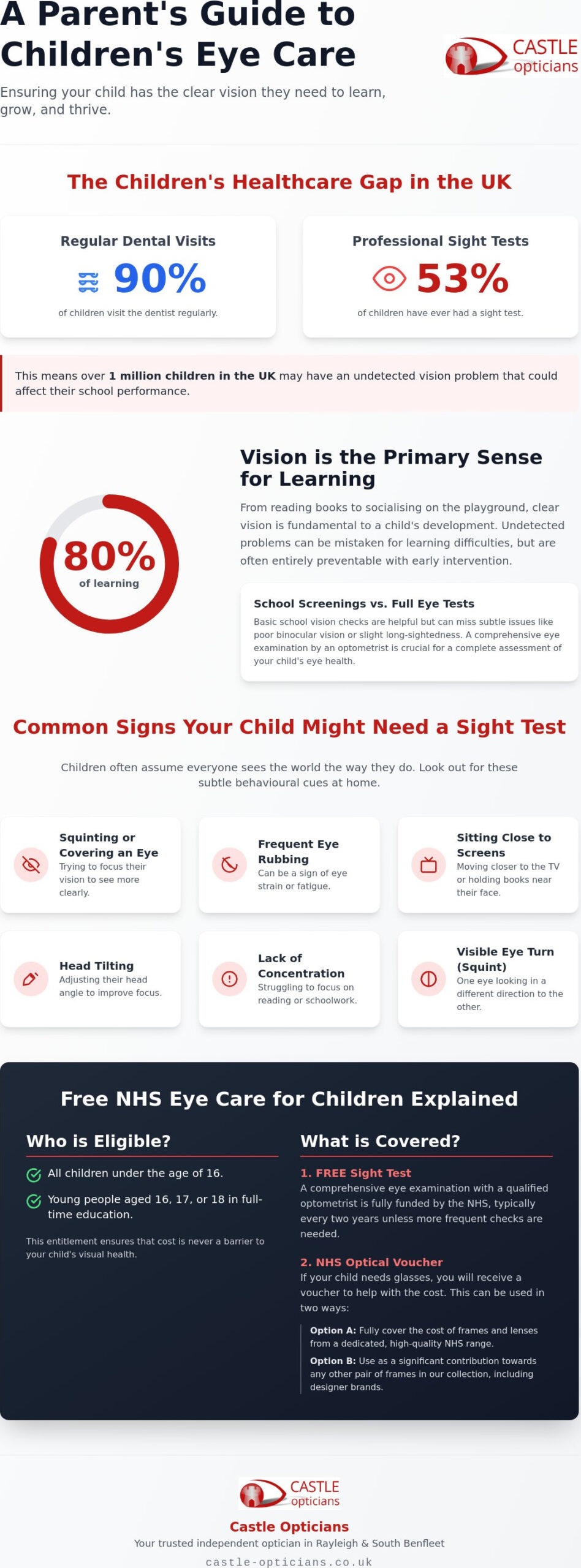
Did you know that while 90% of UK children visit the dentist regularly, only 53% have ever had a professional sight test? It’s a startling gap, especially when you consider that over a million children are currently living with an undetected vision problem that could hinder their school performance. Booking a children’s eye test in Essex is one of the most impactful steps you can take for your child’s development, ensuring they have the visual clarity needed to thrive and learn with confidence.
It’s completely natural to feel a little anxious about how a toddler might react to clinical equipment or to feel confused by the latest NHS voucher rules. We understand that you want a healthcare experience that feels more like a warm community visit than a sterile appointment. This guide will explain exactly how to access free NHS-funded eye care and what to expect from a patient, independent optician. We will also outline the subtle signs of vision trouble to watch for at home and how the NHS optical voucher scheme helps cover the cost of new frames and lenses.
Key Takeaways
- Understand why visual health accounts for 80% of your child’s learning and why early detection is critical before they begin school.
- Learn how to access the free NHS children’s eye test Essex families are entitled to, including details on how optical vouchers help with the cost of glasses.
- Discover the friendly, unhurried steps of a paediatric eye examination designed to put even the most nervous toddlers at ease.
- Identify the common signs of myopia and hyperopia and how professional intervention supports your child’s school readiness.
- Find out why choosing a trusted independent optician in Rayleigh or South Benfleet ensures personal continuity of care and a better choice of frames.
Why a Children’s Eye Test in Essex is Essential for Early Development
Vision drives about 80% of everything a child learns. It’s the primary way they process the world, from their first steps to their first day at school. For a child in Rayleigh or Benfleet, clear vision isn’t just about reading a whiteboard; it’s about social confidence on the playground and coordination during Saturday morning football. Despite this, local data suggests that only 41% of children in Essex attend regular eye tests. This gap means many young people are navigating their formative years with a disadvantage that is entirely preventable.
Many parents naturally rely on school vision screenings to catch potential problems. Whilst these programmes are a helpful starting point, they are basic checks that don’t replace a comprehensive understanding of what happens during an eye test with a qualified optometrist. A screening might miss subtle issues like poor binocular vision or slight long-sightedness, which can still cause significant strain during a long school day. Early detection is vital because some conditions, such as a “lazy eye” (amblyopia), are much easier to treat before a child reaches the age of seven or eight.
Common Signs Your Child Might Need an Eye Test
Children rarely complain about their sight because they don’t know any different. They assume everyone sees the world through the same soft blur. You might notice physical cues like frequent eye rubbing, squinting to see the TV, or a visible “turn” in one eye. Other behavioural clues include sitting unusually close to screens or tilting their head to one side to focus. If you’ve noticed these habits, it’s worth reviewing these signs child needs eye test to see if a professional consultation is required.
The Link Between Vision and Literacy in Essex Schools
Undiagnosed vision problems are frequently mistaken for learning difficulties or behavioural issues. If a child’s eyes don’t work together effectively, words can appear to jump or blur on the page. This makes reading an exhausting task rather than an enjoyable one. A children’s eye test Essex providers offer can identify if a lack of concentration is actually a struggle with binocular vision. For families in Rayleigh, making an eye examination part of the “back-to-school” routine ensures that a child’s literacy isn’t held back by something as simple as an uncorrected prescription. Healthy eyes give children the best possible start in the classroom.
NHS Eye Tests for Children: Eligibility and Vouchers Explained
Every child in the UK is entitled to Free NHS sight tests for children. This universal provision ensures that cost is never a barrier to a child’s visual health. Specifically, any child under the age of 16 qualifies for these funded examinations. If your teenager is aged 16, 17, or 18 and remains in full-time education, they also continue to receive this support. Booking a children’s eye test Essex families can rely on means accessing professional clinical care without the worry of a private fee.
When you visit our Rayleigh or South Benfleet branches, we’ll ask you to sign a GOS (General Ophthalmic Services) form. This is a standard NHS document that allows us to claim the cost of the test directly from the health service on your behalf. Most children are eligible for a funded test every two years. However, if our optometrist identifies a clinical reason to monitor your child’s vision more closely, the NHS may cover more frequent appointments. This is particularly common if we’re managing rapid changes in a prescription or monitoring a specific condition like a squint.
What Does the NHS Voucher Cover?
If the results of the eye test show that your child needs glasses, the NHS provides an optical voucher. This voucher isn’t a fixed cash payment but rather a credit that contributes towards the cost of frames and lenses. At Castle Opticians, we offer a dedicated “NHS range” of spectacles. These are high-quality, durable frames that are completely covered by the voucher value, meaning there’s nothing for you to pay. If your child has their heart set on a specific designer frame from our wider collection, you can simply use the voucher as a partial payment and pay the difference. For a full overview of how to make the most of NHS support and find frames your child will love wearing, our guide to children’s glasses in Essex covers everything from voucher values to style tips. Our goal is to ensure every child leaves feeling proud of their new look.
Booking Your Child’s NHS Appointment in Rayleigh or Benfleet
Securing an appointment with our friendly local team is a straightforward process. You don’t need a referral from a GP or school; you can simply contact us directly. When you book, please have your child’s date of birth and school details ready so we can prepare their patient file. We recommend scheduling the visit for a time when your child isn’t too tired, such as a Saturday morning or early after school, to help them get the most out of the experience. To help you prepare, you can view our guide on how to Book an NHS eye test in Rayleigh and ensure you have everything you need for a smooth visit.
What Happens During a Kids’ Eye Examination?
When you arrive for a children’s eye test Essex families often comment on the unhurried atmosphere of our practice. We understand that a clinical environment can feel daunting for a little one, so we prioritise a warm, friendly welcome. Our independent approach means we don’t operate a conveyor-belt system. Instead, we take the time to build rapport with your child, ensuring they feel comfortable and curious rather than anxious. This unhurried pace is essential for getting accurate results and making the experience something they actually look forward to.
The consultation begins with a gentle conversation about your child’s daily life. We’ll discuss any family history of wearing glasses, as many conditions like myopia have a genetic link. We also talk about school performance and hobbies. Sometimes, a child’s struggle with reading or a sudden lack of interest in sports can be the first clue that their vision needs support. Following NHS guidelines on children’s eye tests, we ensure the history-taking is thorough and tailored to their specific developmental stage.
Testing Vision for Non-Readers
You don’t need to worry if your child hasn’t started school or isn’t confident with their letters yet. We use “Lea symbols” or picture-matching games instead of the standard Snellen letter chart. This allows us to measure their visual acuity accurately through simple recognition. To determine a prescription without relying on the child’s feedback, we use a technique called retinoscopy. By bouncing a light off the back of the eye, we can calculate exactly how the eye focuses. It’s a completely objective way to find the right lens power without ever having to ask “which is better, one or two?”. We also include fun 3D vision games and colour vision checks that feel like play whilst providing vital clinical data.
Advanced Clinical Checks for Children
A children’s eye test Essex parents trust involves more than just checking if a child can see clearly. We conduct detailed assessments of eye muscle coordination to rule out squints or “lazy eyes” (amblyopia), which are most effectively treated when caught early. We also use a “magic torch” (an ophthalmoscope) to look at the health of the retina and optic nerve. This internal health check is a core part of a comprehensive eye test Essex providers perform. It ensures that the foundations of your child’s vision are healthy and developing as they should. By the end of the visit, you’ll have a clear, jargon-free explanation of your child’s eye health and any steps we might need to take next.
Common Childhood Eye Conditions and School Readiness
In Essex, we’re seeing myopia (short-sightedness) appear much earlier in primary school children than in previous decades. This shift makes a children’s eye test Essex providers offer essential before a child even starts Year 1. Myopia occurs when the eye grows slightly too long, causing distant objects to look blurry. Conversely, hyperopia (long-sightedness) is often harder for parents to spot. A long-sighted child can usually see the whiteboard clearly, but they might find near tasks like drawing, writing, or reading incredibly tiring. If your child seems to lose interest in books quickly or complains of headaches after homework, it might be a visual struggle rather than a lack of focus.
We also look closely for astigmatism, where the eye is shaped more like a rugby ball than a round football. This causes vision to be blurred or distorted at all distances. Perhaps most critical is the detection of amblyopia, commonly known as a “lazy eye”. There is a vital clinical window for treating this condition, typically before the age of seven or eight. If caught early at our Rayleigh or Benfleet branches, we can often correct the issue effectively, ensuring the brain and eye learn to work together properly before the visual system fully matures.
The Essex School Screening vs. A Full Eye Test
Many parents naturally assume the “vision sweep” provided in some Essex schools is a comprehensive check. Whilst these screenings are a helpful basic filter, they are not a substitute for a full clinical examination. School checks often only test distance vision, meaning they can easily miss long-sightedness, eye teaming issues, or internal health concerns. A child might pass a school screening but still struggle to track words across a page. For a more detailed look at why these screenings aren’t enough to guarantee school readiness, you can read our South Benfleet parent’s guide.
Myopia Management: The Future of Kids’ Vision
The rise in myopia is often linked to the modern lifestyle of increased screen time and less time spent outdoors. As a trusted local expert, we now offer specialised lenses designed specifically to slow down the progression of short-sightedness in children. This proactive approach isn’t just about providing clear sight today; it’s about protecting their long-term eye health. We recommend parents encourage the “20-20-20 rule”: every 20 minutes, look at something 20 feet away for 20 seconds. Research also suggests that two hours of outdoor play each day can significantly support healthy eye development. If you’re ready to ensure your child has the best visual start, you can book an appointment at Castle Opticians to discuss the best options for their needs.
Why Choose an Independent Optician in Essex for Your Child?
Choosing an independent practice for a children’s eye test Essex parents often find, makes a significant difference in how their child views eye care. Unlike high-street chains where you might see a different clinician at every visit, our independent status allows for genuine continuity of care. We believe that seeing the same friendly face helps build a vital bond of trust, especially for nervous children. When an optician knows your child’s history and personality, the consultation becomes a familiar, stress-free conversation rather than a daunting medical appointment.
Our community roots run deep. Castle Opticians has been caring for families across Rayleigh and South Benfleet since 1989. This longevity means we’ve seen generations of local children grow up, and we take immense pride in being a trusted part of the local fabric. We don’t just provide a service; we invest in long-term relationships. This personal attention ensures that your child’s visual development is monitored with a level of care and detail that only a dedicated local expert can provide.
Choosing the Right Frames in Rayleigh
If your child needs glasses, the selection process should be exciting, not overwhelming. We offer a carefully curated selection of spectacles that children actually want to wear. We look for durability factors like flexible hinges and robust materials that can keep up with active Essex schoolchildren. Whether they are looking for something subtle or a bold splash of colour, we help them find a style that boosts their confidence. You can explore our approach to quality and style in our guide to spectacle frames Rayleigh families love. For a deeper look at finding resilient, fashionable children’s glasses in Essex that your child will actually be proud to wear, our complete parent’s guide covers everything from frame materials to the latest NHS voucher updates.
Expert fitting is just as important as the frames themselves. Children aren’t just small adults; their facial features, particularly the bridge of the nose and the position of their ears, require specialised accommodation. Our team ensures that every pair of glasses is perfectly adjusted for comfort and stability. A well-fitted pair of glasses stays in the correct position, ensuring the lenses work exactly as the optometrist intended whilst your child plays and learns.
Making the Eye Test a Positive Experience
We’ve designed our practice to be a “no-pressure” environment. We move at your child’s pace, allowing them to explore the equipment and ask questions. If they need a little extra time to feel comfortable, we take it. Rewarding bravery is a core part of our service; that sticker at the end of the visit is more than just a treat. it’s a way to ensure they leave with a smile, feeling proud of their visit. By making the experience positive today, we’re helping them value their eye health for a lifetime. If you’re ready to give your child the best visual start, Book your child’s eye test at Castle Opticians today and experience the difference of independent care.
Give Your Child the Best Visual Start in 2026
Your child’s vision is the foundation for their learning, coordination, and confidence. Since every child is entitled to a free NHS-funded eye examination, you can easily ensure they never miss out on the clarity they deserve. Whether you’re worried about school performance or simply want to establish a healthy healthcare routine, a professional children’s eye test Essex families trust is the most effective way to protect their long-term sight.
At Castle Opticians, we’ve provided independent clinical care since 1989. Our unhurried approach and expert paediatric frame fitting ensure your child feels supported at every step of their journey. We focus on making every visit a positive, rewarding experience that sets the stage for a lifetime of healthy vision. You don’t need to wait for a school screening to provide the answers your child needs today.
Book a friendly children’s eye test at our Rayleigh or Benfleet practice today. We look forward to welcoming you and your family to our practice soon.
Frequently Asked Questions
At what age should my child have their first eye test?
Children should have their first full eye examination at around the age of three or four, ideally before they start primary school. This timing is crucial because it allows us to identify and treat conditions like a lazy eye whilst the visual system is still developing. If you have specific concerns about a younger child’s eye alignment or tracking, we can even perform basic checks on infants to ensure their eyes are healthy.
Is a children’s eye test free in Essex?
Yes, every children’s eye test Essex families book at our practice is completely free under the NHS for all children under 16. This entitlement also extends to students aged 16, 17, or 18 who remain in full-time education. In addition to the free test, you’ll receive an NHS optical voucher that contributes towards the cost of glasses if your child requires a prescription.
What if my child can’t read or is too shy to speak?
Your child doesn’t need to be able to read or even speak to have a successful eye test. We use engaging picture-matching games and Lea symbols that allow children to identify shapes instead of letters. Our optometrists also use objective testing methods, like retinoscopy, to calculate a prescription by observing how light reflects off the back of the eye, requiring no verbal input from your child.
Will my child need eye drops during the examination?
Most children don’t require eye drops during a routine visit; however, we may use them if a more detailed internal health check is necessary. These drops help enlarge the pupils or relax the eye’s focusing muscles, which allows for a more precise measurement in certain cases. If drops are needed, we’ll explain the process clearly to both you and your child to ensure they feel comfortable.
How often should children have their eyes tested?
The NHS typically covers a free eye test every two years, but we may recommend annual visits depending on your child’s specific needs. Because young eyes can change rapidly during growth spurts, more frequent monitoring is often required for conditions like myopia. Regular appointments ensure that your child’s prescription remains accurate and that their vision doesn’t become a barrier to their progress at school.
Can children wear contact lenses?
Children can often start wearing contact lenses as soon as they are mature enough to manage the hygiene and application process. There’s no specific age limit; instead, we look at a child’s individual motivation and responsibility. Lenses are a brilliant solution for active Essex children who find that traditional glasses interfere with sports like gymnastics, football, or swimming.
What happens if the school says my child’s vision is fine?
You should still arrange a professional children’s eye test Essex experts provide even if your child passes a school screening. School “vision sweeps” are basic checks that usually only test distance vision, meaning they can easily miss long-sightedness or eye teaming issues. A full clinical examination is the only way to confirm that your child’s eyes are healthy and ready for the classroom.