
The most expensive pair of designer glasses frames in Essex won’t automatically be the right ones for you. That’s a truth most people discover too late, standing at a counter feeling quietly overwhelmed, unsure whether the frames they’re holding are genuinely flattering or simply fashionable. Choosing designer eyewear is deeply personal, and the sheer volume of options available today can make the whole process feel more stressful than it should.
You’re not alone in that feeling. Most people walk into a frame selection knowing what they vaguely want but lacking the confidence to trust their instincts, and worrying that a higher price tag is no real guarantee of quality, comfort, or longevity.
This guide is here to change that. Whether you’re searching for designer glasses frames in Essex for the first time or returning to update a look that no longer feels like you, what follows will help you understand what genuinely separates a great frame from a costly mistake. You’ll learn how to identify quality craftsmanship, find the style that suits your face shape, and get the kind of personalised guidance that makes the whole experience feel considered rather than rushed.
Key Takeaways
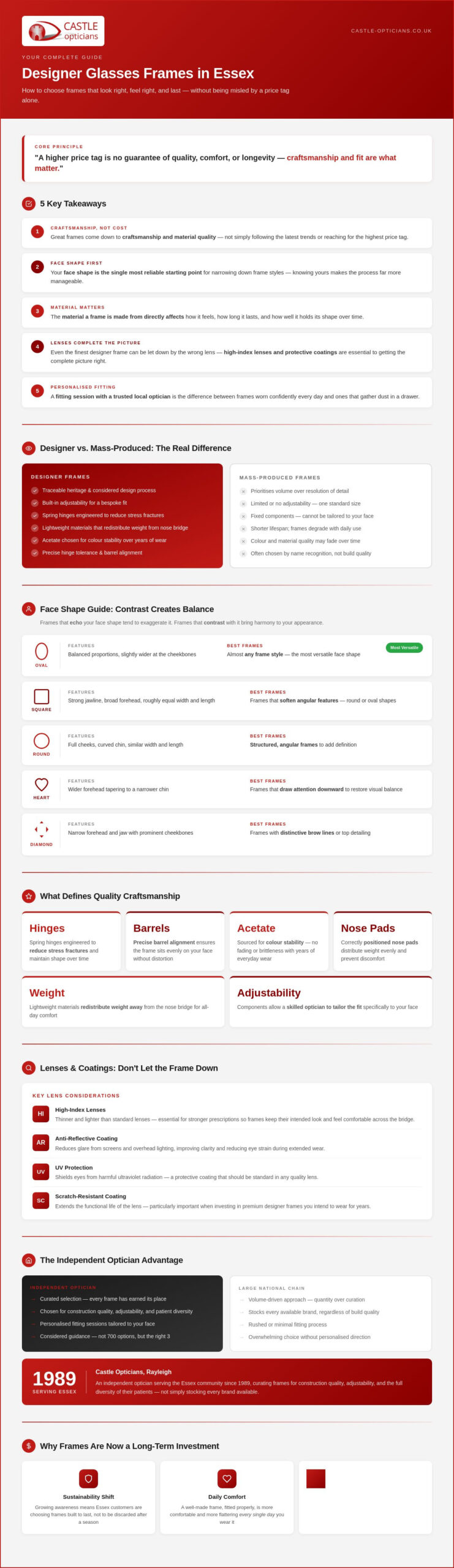
- Choosing designer glasses frames Essex residents will love for years comes down to understanding craftsmanship and material quality — not simply following the latest trends or reaching for the highest price tag.
- Your face shape is the single most reliable starting point for narrowing down frame styles, and knowing yours will immediately make the selection process feel far more manageable.
- The material a frame is made from directly affects how it feels, how long it lasts, and how well it holds its shape — a detail that separates a genuinely considered purchase from an expensive disappointment.
- Even the finest designer frame can be let down by the wrong lens choice, so understanding options like high-index lenses and protective coatings is essential to getting the complete picture right.
- A personalised fitting session with a trusted local optician can make the difference between frames you wear confidently every day and ones that quietly gather dust in a drawer.
The Value of Designer Glasses Frames in Essex
Designer eyewear is a term that gets used loosely, and that looseness can be genuinely misleading. A label stitched to a temple arm doesn’t make a frame designer. What actually defines designer eyewear is something more substantive: a traceable heritage, a considered design process, and a commitment to materials and construction that outlasts the season it was made in. When you pick up a frame from a curated collection, you’re holding the result of that process, not simply a product with a recognisable name.
Understanding that distinction matters more now than it did even a few years ago. Across Essex, there’s a noticeable shift in how people approach eyewear purchases. Frames are increasingly viewed as long-term investments rather than disposable accessories, a change driven partly by a broader awareness of sustainability and partly by the simple realisation that a well-made frame, fitted properly, is more comfortable and more flattering every single day you wear it. That’s a different kind of value to the kind you find on a promotional shelf.
The gap between mass-produced frames and genuinely curated designer glasses frames comes down to intent. Mass production prioritises volume; designer collections prioritise resolution of detail. Hinge tolerance, barrel alignment, acetate thickness, the way a nose pad is positioned: these are the details that determine whether a frame feels like part of you or like something you’re merely tolerating on your face.
Quality Over Quantity: The Independent Advantage
Independent opticians in Rayleigh, including Castle Opticians who have been serving the Essex community since 1989, approach their frame collections very differently to large national chains. Rather than stocking every available brand, they curate specifically, selecting frames based on construction quality, adjustability, and how well they serve a genuinely diverse range of patients. The result is a smaller, more considered selection where every frame has earned its place.
Fast fashion eyewear, the kind found in high-volume retail environments, typically offers limited adjustability. Frames made to a single standard size with fixed components can’t be properly tailored to your face. Designer frames, by contrast, are built with adjustment in mind, allowing a skilled optician to achieve a bespoke fit that holds over time.
What to Expect from a Premium Collection
South Essex boutique collections tend to feature frames distinguished by meaningful innovation rather than novelty: spring hinges engineered to reduce stress fractures, lightweight materials that redistribute weight away from the nose bridge, and acetate sourced for its colour stability over years of wear. In 2026, the designer difference is defined by the integration of precision manufacturing with considered ergonomic design, producing frames that perform as well as they look.
The right designer glasses frames Essex residents will return to year after year aren’t simply stylish. They’re comfortable enough to forget you’re wearing them, and distinctive enough that you notice when you’re not.
Styling Your Look: Face Shapes and Designer Aesthetics
There’s one principle that underpins every successful frame choice: contrast creates balance. Frames that echo your face shape tend to exaggerate it, while frames that contrast with it bring harmony to your overall appearance. It sounds simple, but it’s the kind of guidance that’s almost entirely absent from high-volume retailers who’d rather present you with 700 options than help you narrow them down to three.
Start by identifying your face shape. The five most common are:
- Oval: Balanced proportions, slightly wider at the cheekbones. The most versatile shape, suited to almost any frame style.
- Square: Strong jawline, broad forehead, roughly equal width and length. Benefits from frames that soften angular features.
- Round: Full cheeks, curved chin, similar width and length. Gains definition from structured, angular frames.
- Heart: Wider forehead tapering to a narrower chin. Needs frames that draw attention downward to restore visual balance.
- Diamond: Narrow forehead and jaw with prominent cheekbones. Works well with frames that have distinctive brow lines or detailing.
Colour and texture deserve equal attention. Warm tortoiseshell acetate tends to complement golden or olive skin tones, whilst cooler grey and silver metals sit well against fairer complexions. Hair colour plays a role too: rich, dark frames can create striking contrast against lighter hair, whereas translucent or nude acetate offers a subtler, contemporary effect regardless of colouring.
Bridge fit and temple length are where the ‘designer’ look either holds or collapses. A frame sitting too low on the nose alters your pupillary distance relative to the lens centre, affecting both vision and appearance. Temple arms that are too long or too short throw the frame’s balance across your face. These aren’t cosmetic details; they’re structural ones, and they’re precisely why a proper fitting matters as much as the frame itself.
Matching Frames to Facial Features
Round faces benefit from rectangular or geometric frames, which introduce the definition that softer features naturally lack. Square faces are flattered by round or oval frames that ease the angularity of a strong jaw. Heart-shaped faces suit upswept cat-eye styles, which draw the eye outward and upward, creating balance between a broader forehead and a narrower chin. For a deeper look at how these principles apply to specific frame styles available locally, the guide to choosing glasses frames for your face shape Essex residents can use as a practical reference covers each face shape in detail alongside real-world styling advice.
2026 Eyewear Trends in South Essex
Bold minimalism is the defining aesthetic of 2026: clean silhouettes with considered detail, often executed in transparent or lightly tinted acetate that feels modern without demanding attention. Alongside this, sustainable designer options are becoming increasingly prominent, with frames crafted from bio-acetate and recycled materials entering collections that were previously dominated by conventional plastics. It’s a shift that reflects broader values without compromising on quality or finish.
If you’d like to explore how these trends translate into specific styles suited to your features, the guide to spectacle frames Rayleigh residents are currently choosing offers a useful local perspective alongside practical styling advice.
Finding the right designer glasses frames in Essex is considerably easier when you know which shapes and proportions are working in your favour. A brief conversation with a knowledgeable optician can turn that knowledge into a shortlist, which is a far more useful starting point than browsing without direction.
The Anatomy of Quality: Materials and Craftsmanship
Pick up two pairs of frames side by side and the difference is immediate. One feels substantial, warm to the touch, with a solidity that suggests it was made to last. The other feels hollow, slightly rough at the edges, its hinges loose in a way that already hints at future problems. You haven’t looked at a single label. You don’t need to. The material tells you everything.
Material choice is the single most important factor in how long a pair of glasses will serve you well. It determines how a frame responds to daily wear, how it holds its shape over years rather than months, and crucially, whether it can be repaired and restored when it eventually needs attention. That last point addresses the question most people quietly ask themselves when they’re standing at a counter: is it actually worth the price? The honest answer is yes, but only when the material justifies it.
Acetate vs. Plastic: A World of Difference
Italian cellulose acetate is the material of choice for the finest designer glasses frames, and the reason is straightforward: it’s derived from natural plant sources, which gives it a depth of colour, translucency, and warmth that injection-moulded plastic simply cannot replicate. Acetate frames are cut and shaped from solid sheets, meaning the colour runs all the way through rather than sitting as a surface coating. That matters enormously over time.
Injection-moulded plastic frames, by contrast, are made by forcing material into a mould under pressure. The process is efficient and inexpensive, but it produces frames that are prone to fading, brittleness, and distortion with heat. The colour you chose in the shop is rarely the colour you’re wearing two years later.
Acetate also has a quality that’s easy to overlook until you’ve experienced it: it can be re-polished. A skilled optician can restore the surface of an acetate frame, removing fine scratches and reviving its finish, extending its useful life considerably. That’s not something you can do with a moulded plastic frame, and it’s a meaningful part of what justifies the investment in designer glasses frames Essex residents are increasingly choosing for the long term.
High-Performance Metals: Titanium and Stainless Steel
For those who prefer metal frames, the distinction between materials is equally significant. Titanium offers a strength-to-weight ratio approximately three times superior to standard nickel alloys, meaning a titanium frame can be engineered to be extraordinarily thin and light without sacrificing structural integrity. It’s also fully hypoallergenic, which makes it the right choice for anyone who’s experienced skin reactions to standard metal frames.
Stainless steel sits at a different point on the spectrum: slightly heavier than titanium, but exceptionally resilient and well-suited to sleek, contemporary aesthetics where a clean line is the priority. Both materials hold adjustments reliably, which matters when a precise fit is essential to both comfort and optical performance.
Hand-finishing is what separates a genuinely crafted metal frame from a competent one. The process of manually smoothing, polishing, and inspecting each component before assembly catches the small imperfections that automated production misses: a hinge that’s fractionally misaligned, a temple tip that hasn’t been fully smoothed, a barrel that’s been over-tightened. These aren’t visible at a glance, but they’re felt across every hour of wear.
Quality, in other words, isn’t just about what a frame looks like. It’s about what it feels like to wear it, and how it continues to perform long after the novelty of a new purchase has settled into everyday life.
Practical Considerations: Prescription Lenses and Coatings
A beautifully crafted frame is only half the equation. The lens sitting inside it determines whether you actually see clearly, whether your eyes feel comfortable by mid-afternoon, and whether the overall effect looks as polished as the frame deserves. Choosing the wrong lens for the right frame is a surprisingly common mistake, and one that’s entirely avoidable with a little guidance.
Lens thickness is where this becomes most visible. Higher prescriptions, particularly those for short-sightedness, produce lenses that are noticeably thicker at the edges. In a fine acetate or titanium frame, that thickness can undermine the whole aesthetic. High-index lenses address this directly: they bend light more efficiently, which means the same prescription can be delivered in a considerably thinner profile. For anyone choosing designer glasses frames in Essex with a moderate to strong prescription, specifying high-index lenses isn’t an optional upgrade; it’s the detail that makes the frame look as intended.
Anti-reflective coating deserves equal attention. Without it, light bouncing off the lens surface creates a visual distraction that draws attention away from your eyes and towards the glass itself. With it, your lenses become effectively invisible, which is precisely the effect that careful frame selection is meant to achieve. It also reduces eye strain during prolonged screen use, a meaningful benefit for anyone working in an office environment or commuting regularly.
Varifocals and Designer Frames
Varifocal lenses require sufficient frame depth to accommodate three distinct vision zones: distance, intermediate, and reading. A frame that’s too shallow compresses those zones, making the transition between them uncomfortable and the reading area frustratingly narrow. Selecting the right frame depth is therefore a clinical consideration, not just a stylistic one. The complete guide to varifocal glasses Rayleigh residents rely on covers this in detail, including how fitting precision affects day-to-day comfort. The positioning of the optical centre within your chosen designer frame must be measured and verified individually; it can’t be assumed from frame size alone.
Protecting Your Investment
Once you’ve invested in quality frames and appropriate lenses, protecting both is straightforward with the right coatings:
- Scratch-resistant coating: Preserves the clarity and appearance of your lenses through daily handling, keeping them looking new considerably longer.
- Blue light filters: Increasingly relevant for professionals spending extended hours at screens, reducing the high-energy light that contributes to visual fatigue.
- UV protection: Essential for time spent outdoors, particularly for anyone in Essex who drives regularly or works outside.
The full technical picture, including photochromic options and polarised lenses for driving, is covered in the complete lenses buying guide, which is worth reading before your fitting appointment.
Getting the lens specification right for your designer glasses frames Essex residents choose is something a knowledgeable optician will walk you through as part of a proper consultation. Speak to the team at Castle Opticians to ensure your frame and lens choices work together from the outset.
Personalised Care at Castle Opticians
Everything covered in this guide, from understanding face shapes to selecting the right lens coatings, only becomes truly useful when there’s a knowledgeable person applying it to you specifically. That’s the difference between reading about designer glasses frames in Essex and actually finding the right pair. Castle Opticians has been providing that kind of individual attention across South Essex since 1989, and it shows in the way the practice works.
Being independent matters here. There’s no central buying team dictating which frames fill the display stands, no quarterly targets pushing volume over suitability. Every frame in the collection has been selected by people who understand what their patients actually need, which means when you walk in, you’re choosing from a range that’s already been filtered with care.
The Styling Consultation Experience
A frame styling appointment at Castle Opticians isn’t a sales conversation. It’s a considered process that takes your facial structure, prescription requirements, and lifestyle into account before a single frame is placed on your face. The team will assess bridge fit to ensure the frame sits at the correct height, check temple length against your ear positioning, and look at how the frame aligns with your facial proportions as a whole. These are the details that determine whether glasses feel like yours or feel like a compromise.
Residents closer to the coast can visit the South Benfleet branch, which offers the same personalised approach in a setting that’s accessible for those living across that part of Essex.
The Clinical Foundation
A comprehensive eye test is always the starting point. It’s not simply a prerequisite for getting a prescription; it’s the clinical foundation that ensures your new frames are built around accurate, up-to-date measurements. Pupillary distance, optical centration, and the specific nature of your prescription all affect which frames will work best for you. Skipping this step and selecting frames based on appearance alone is how people end up with eyewear that looks right but never quite feels it.
Castle Opticians offers both NHS and private eye tests, making quality clinical care accessible regardless of how you’re funded.
Ready to Find Your Favourite Pair?
Booking an eye test or styling consultation at either the Rayleigh or South Benfleet branch is the straightforward next step. The team will take the time to understand what you’re looking for, what hasn’t worked before, and what your daily life actually demands from your eyewear.
Finding the right designer glasses frames in Essex isn’t about luck or spending more than you need to. It’s about getting the right guidance from people who genuinely know what they’re doing. That confidence, the kind that comes from wearing something that fits your face and your life perfectly, is entirely within reach.
Your Next Step Towards Glasses You’ll Actually Love Wearing
Finding the right designer glasses frames Essex residents wear with genuine confidence comes down to three things: understanding what quality actually looks like in the materials and construction, knowing which shapes and proportions work for your face, and getting the lens specification right from the outset. None of that happens by chance, and it certainly doesn’t happen by browsing alone.
Castle Opticians has been helping people across South Essex get this right since 1989. As an independent, family-run practice with branches in Rayleigh and South Benfleet, the team brings expert styling advice tailored to your face shape, a carefully curated frame selection, and the kind of unhurried, personal attention that larger chains simply don’t offer.
You don’t need to walk in uncertain. Book your eye test and frame styling consultation at Castle Opticians today and let the team guide you towards a pair that fits your face, your prescription, and your life. The right frames are closer than you think.
Frequently Asked Questions About Designer Glasses Frames in Essex
What is the difference between designer frames and high-street glasses?
The core difference is in construction intent and material quality, not just the label. Designer frames are built from higher-grade materials such as Italian cellulose acetate or titanium, with hand-finished components and adjustable hinges engineered to hold their shape over years of wear. High-street glasses are typically injection-moulded from standard plastics, prioritising speed of production over longevity or adjustability.
That distinction becomes most apparent after the first year of wear. A well-made designer frame retains its colour, its fit, and its finish. A budget frame often doesn’t, and unlike quality acetate, it can’t be re-polished or meaningfully restored when it deteriorates.
How do I know which designer glasses frames will suit my face shape?
The reliable starting point is the contrast principle: frames that echo your face shape tend to exaggerate it, whilst frames that contrast with it bring balance. Round faces benefit from angular or rectangular styles; square faces are softened by rounder silhouettes; heart-shaped faces suit frames with width at the lower half. Knowing your face shape immediately narrows the field considerably.
That said, face shape is a guide rather than a rule. Skin tone, colouring, and personal style all influence which frame will feel genuinely right. A consultation with a knowledgeable optician is the most reliable way to translate these principles into a specific recommendation for you. If you’d like to prepare before your appointment, the full Essex style guide to choosing glasses frames for your face shape walks through each face type with practical, locally relevant advice.
Are designer glasses frames more durable than budget options?
Generally, yes, but durability depends on the specific materials and construction rather than the price tag alone. Titanium and quality acetate frames are inherently more resilient than moulded plastic equivalents. They resist distortion from heat, hold adjustments more reliably, and can be professionally repaired rather than simply replaced when they eventually need attention.
The practical implication is that a well-chosen designer frame, properly maintained, will often outlast two or three budget replacements. For anyone wearing glasses every day, that longevity represents genuine value rather than simply a higher upfront cost.
Can I get designer frames on the NHS in Essex?
NHS funding covers the cost of a standard voucher towards frames and lenses for those who qualify, including children, people on certain benefits, and those with specific clinical conditions. The voucher amount can be applied towards the cost of designer frames, with the patient paying the difference between the voucher value and the frame price.
Castle Opticians offers both NHS and private eye tests at its Rayleigh and South Benfleet branches. If you’re unsure whether you qualify for NHS optical support, the team can advise you during your appointment. It’s always worth checking your eligibility before assuming you need to fund everything privately.
How often should I update my designer glasses frames?
Frames don’t have a fixed replacement schedule, but most opticians recommend reviewing them whenever your prescription changes significantly, when the frame no longer fits correctly, or when visible wear affects either comfort or appearance. For many people, that means updating every two to three years, though a well-maintained quality frame can serve you longer if your prescription is stable.
The more important prompt is your annual eye test. If your prescription has shifted, wearing lenses that no longer match your needs can cause headaches and eye strain regardless of how good the frame looks. Regular testing ensures your eyewear is always doing its job properly.
Do designer frames come with a warranty or guarantee?
Warranty terms vary between manufacturers and are worth confirming at the point of purchase. Many designer frame brands offer a manufacturer’s warranty covering material defects, though the specifics, including duration and what’s covered, differ from brand to brand. Normal wear, accidental damage, and lost frames are typically excluded.
Independent opticians like Castle Opticians can advise on the warranty position for specific frames in their collection. It’s a sensible question to ask before committing, particularly if you’re investing in a premium pair for daily wear.
Which designer brands are best for varifocal lenses?
Frame suitability for varifocals is determined primarily by depth rather than brand. A frame needs sufficient vertical height to accommodate the three vision zones without compressing the reading area uncomfortably. As a general guide, frames with a lens depth of around 30mm or more tend to work well with modern varifocal designs, though the precise requirement depends on your specific prescription and the varifocal design being used.
Selecting designer glasses frames in Essex for varifocal use is best done alongside a clinical consultation. Your optician will measure the optical centration within your chosen frame and confirm whether the depth is appropriate for your prescription before any lenses are ordered. Don’t select a frame on appearance alone if varifocals are involved.
Can I have my current lenses fitted into new designer frames?
In most cases, no. Lenses are cut and shaped specifically to fit the frame they’re ordered for, and the dimensions, curvature, and optical centration of a new frame will almost certainly differ from your existing one. Attempting to refit existing lenses into new frames risks both optical inaccuracy and lens damage.
There are occasional exceptions, typically where frames are very similar in shape and size, but this is something your optician needs to assess directly. The more reliable approach is to treat a new frame as an opportunity to review your full prescription and lens specification together, ensuring everything is optimised from the outset.