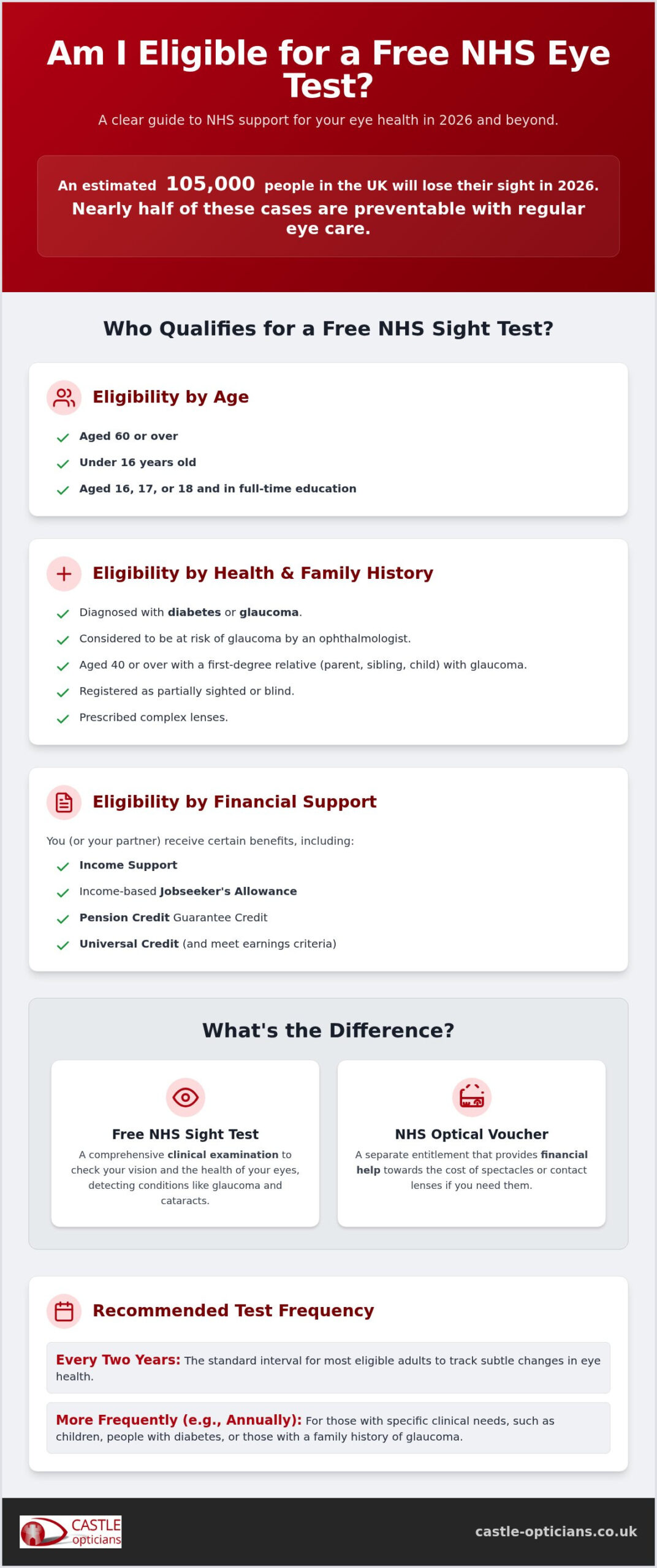
In 2026, an estimated 105,000 people across the UK will lose their sight, yet nearly half of these cases are preventable with regular clinical care. If you are currently wondering, am I eligible for NHS eye test support, you are certainly not alone, especially as benefit rules and income thresholds continue to evolve. It’s completely natural to feel a bit overwhelmed by complex criteria or to worry about unexpected costs when you visit a professional clinic.
We believe that your vision should never be hindered by confusing paperwork or the fear of hidden fees. This guide is here to provide total clarity by detailing exactly who qualifies for a free NHS sight test and how you can access expert, independent care in Rayleigh and South Benfleet. You’ll find a clear breakdown of the latest age and medical requirements, alongside an explanation of what your NHS optical voucher covers. We also provide a simple path to booking a thorough, unhurried consultation with a team that treats you like a neighbour rather than just a patient.
Key Takeaways
- Identify if you qualify for a free sight test based on your age, medical history, or specific income-related criteria for 2026.
- Understand the important distinction between a clinical NHS eye examination and an optical voucher used for lenses and frames.
- Explore why visiting an independent practice in Rayleigh or South Benfleet offers a more thorough and unhurried clinical experience.
- Find a definitive answer to the question, “am I eligible for NHS eye test support?” and learn the simple steps to book your local visit.
- Discover how to access high-quality independent eye care that focuses on both your visual clarity and long-term ocular health.
Understanding the NHS Eye Test: What is Covered and Why it Matters
An NHS sight test is far more than a simple check to see if you need new spectacles. It’s a vital clinical assessment designed to monitor both your visual clarity and the physical health of your eyes. The NHS funds these examinations because regular monitoring is the most effective way to prevent avoidable sight loss across the community. By removing the financial barrier of the clinical fee, the goal is to ensure that everyone can access professional care regardless of their circumstances.
During the consultation, your optometrist looks for much more than a prescription. A thorough examination can reveal early signs of serious conditions such as glaucoma, cataracts, or even systemic health issues like high blood pressure and diabetes. Whilst the NHS covers the cost of the professional time and expertise required for the test itself, it’s helpful to remember that you may still need to pay for additional items like frames or specific lens coatings, unless you qualify for a separate optical voucher.
The Difference Between a Sight Test and a Clinical Screening
Many people assume a sight test is only about measuring vision. While determining your prescription is a core part of the process, a comprehensive eye test in Essex involves a detailed screening of the internal and external structures of the eye. We examine the retina and measure internal eye pressure to ensure everything is functioning as it should. This dual approach is a standard part of eye care in the United Kingdom, ensuring that your long term ocular health is prioritised alongside your immediate vision needs.
How Often Should You Have an NHS Eye Test?
For most eligible adults, the standard interval for a sight test is every two years. This timeframe allows your optician to track subtle changes in your eye health that you might not notice yourself. However, if you are asking, “am I eligible for NHS eye test support more frequently?”, the answer depends on your specific clinical needs. Children, people living with diabetes, or those with a family history of glaucoma often require more regular monitoring, usually every year. It’s vital not to wait for symptoms like blurred vision or headaches to appear before booking. Early detection is the key to preserving sight, and a proactive approach ensures that any underlying issues are managed before they impact your daily life.
Comprehensive Eligibility Criteria: Who Qualifies for a Free NHS Sight Test?
Understanding the Official NHS eligibility criteria is the first step toward securing your eye health without worrying about clinical fees. The system is designed to provide a safety net for specific age groups, those with certain medical predispositions, and individuals receiving financial support. If you’ve been asking yourself, “am I eligible for NHS eye test support?”, the answer usually falls into one of several clearly defined categories.
Age is one of the most common qualifying factors. Children under the age of 16, as well as students aged 16, 17, or 18 who remain in full-time education, are entitled to free tests. At the other end of the spectrum, the NHS automatically covers everyone aged 60 or over. This ensures that as we age, our vision is monitored during the years when age-related conditions become more prevalent. If you’re unsure about your status, our friendly team at Castle Opticians can help you confirm your eligibility before you book.
Eligibility Based on Health and Family History
Your physical health and family background play a significant role in NHS funding. You qualify for a free test if you’re registered as partially sighted or blind, or if you’ve been diagnosed with diabetes or glaucoma. Because glaucoma can be hereditary, the NHS also provides free tests for anyone aged 40 or over who has a first-degree relative (parent, sibling, or child) with the condition. Additionally, if an ophthalmologist has told you that you’re at risk of glaucoma, or if you require complex lenses, you’re likely covered for your clinical examination.
Qualifying Through Financial Support and Benefits
Financial circumstances should never be a barrier to clinical care. You’re eligible if you receive Income Support, Income-based Jobseeker’s Allowance, or Pension Credit Guarantee Credit. For those on Universal Credit, eligibility depends on your earnings during the most recent assessment period. As of 2026, you qualify if your earnings were £435 or less, or £935 or less if your claim includes an element for a child or limited capability for work.
The NHS Low Income Scheme also provides support through HC2 certificates for full help, whilst HC3 certificates offer partial assistance. If you hold a valid NHS tax credit exemption certificate, which usually applies if your annual income is £15,276 or less and you receive specific tax credits, you’re also entitled to a free sight test. Keeping these documents to hand makes the registration process at our Rayleigh or South Benfleet branches quick and simple.
NHS Optical Vouchers: Help with the Cost of Glasses and Contact Lenses
It’s a common misconception that a free sight test automatically includes free spectacles. When you ask, “am I eligible for NHS eye test support?”, it’s helpful to understand that the clinical examination and the optical voucher are two distinct forms of assistance. While many people qualify for the test itself based on age or medical history, the voucher is a separate grant intended to help with the actual cost of vision correction. This ensures that those who need glasses can afford high-quality lenses and frames without financial strain.
Eligibility for these vouchers is generally more targeted than the test criteria. You’ll typically qualify if you’re under 16, a student under 19 in full-time education, or if you receive specific income-related benefits. By following the official NHS eligibility criteria, you can determine if you’re entitled to this support. At our practices, these vouchers can be used towards a wide range of spectacle frames in Rayleigh, and in some clinical cases, they can even contribute toward the cost of contact lenses.
How the Voucher System Works
The NHS uses a tiered system where vouchers are assigned a “letter” based on the strength of your prescription. For example, Voucher A is for basic single-vision lenses, while higher letters like Voucher H are reserved for more complex bifocal or prism prescriptions. Each letter carries a specific monetary value. You aren’t limited to a “budget” range; you can choose to put your voucher value towards more expensive designer frames and simply pay the difference. We take pride in offering a diverse selection of frames that are fully covered by the voucher value, ensuring you don’t have to compromise on style or comfort if you’re working within the grant amount.
Help for Children and Students
Children always receive an optical voucher if our optometrist determines that vision correction is necessary. We cannot overstate the importance of childrens eye tests in South Benfleet, as undiagnosed vision issues are a leading cause of poor school performance and reduced confidence. A child’s voucher covers the full cost of standard lenses and a variety of durable frames designed for active lives. Furthermore, the NHS provides repair and replacement vouchers for children under 16. This is a vital safety net for parents, as we know that spectacles can occasionally get damaged during play or school activities. Our team is always on hand to help you navigate these options to keep your child’s vision clear.
Private vs. NHS Eye Tests: Why Independent Care in Rayleigh Makes a Difference
Choosing where to have your vision checked is just as important as knowing the answer to “am I eligible for NHS eye test” questions. High-street chains often operate on high-volume models, which can sometimes lead to a clinical experience that feels slightly detached or hurried. As an independent group, we choose a different path. We provide a warm, community-focused environment where every visitor is treated with the same high level of professional care, regardless of whether their test is funded by the NHS or paid for privately. We believe that clinical excellence and genuine hospitality should go hand in hand.
The Value of Independent Clinical Expertise
Our independence is our greatest asset when it comes to protecting your sight. It allows our optometrists the freedom to spend as much time as necessary on complex cases without the pressure of corporate targets or rigid time-slots. This unhurried approach is essential for identifying subtle changes in ocular health that might otherwise be overlooked. Whilst determining the answer to “am I eligible for NHS eye test” criteria is important, the quality of the actual examination is what truly protects your long-term health.
Since we’ve been operating since 1989, many of our patients value seeing the same friendly, familiar faces at every visit. This continuity of care builds long-term relationships and ensures your clinical history is understood in context. We are deeply committed to advanced eye health checks in Essex, investing in diagnostic technology that allows for a level of detail often missing in standard high-street screenings.
A Personalised Selection of Frames and Lenses
Beyond the clinical room, the independent difference continues with our carefully curated collections. We don’t stock a generic range dictated by a corporate head office. Instead, we hand-select frames and lenses that reflect the styles and quality preferences of our Rayleigh and South Benfleet community. Our dispensing staff are clinical experts in their own right, providing honest, personalised advice to ensure your spectacles fit perfectly and suit your unique lifestyle.
Whether you need specialised coatings for digital screen work or durable, lightweight frames for outdoor activities, we take the time to find the right solution for you. We aim to make the process of choosing your eyewear as enjoyable and stress-free as the eye test itself. Experience the difference that personal, unhurried care makes to your vision by visiting us to book your eye examination at one of our local branches.
Book Your NHS Eye Test at Castle Opticians: Local Guide
Once you have found the answer to the question, “am I eligible for NHS eye test support?”, the process of securing your clinical care is straightforward. We pride ourselves on making the transition from checking your status to sitting in the examination chair as smooth as possible. Our team is deeply integrated into the South Essex community, and we are always happy to provide a quick confirmation of your eligibility over the phone if you remain unsure about the latest 2026 criteria.
Booking your appointment involves four simple steps. First, verify your eligibility using our guide. Second, decide which of our local branches is most convenient for you. Third, gather the necessary physical evidence required by the NHS to process your claim. Finally, contact our friendly reception team to secure a time that suits your schedule. We recommend booking in advance, as our unhurried approach means we dedicate significant time to every individual consultation.
What to Bring to Your Appointment
To ensure your NHS-funded test can be processed on the day, you will need to bring specific documentation. The NHS requires physical proof of eligibility for benefit-based claims. If you’re unsure what to pack, our team can advise you before you arrive. Generally, you should bring:
- Your most recent benefit award letter (for Universal Credit, JSA, or Income Support).
- A valid NHS tax credit exemption certificate or HC2/HC3 certificate if applicable.
- Your current spectacles or contact lens packaging.
- A list of any current medications, as these can sometimes affect your ocular health.
Having these items ready allows us to focus entirely on your clinical care rather than paperwork. If you are attending for an age-based test, such as being over 60 or under 16, we simply need to verify your date of birth.
Finding Our Rayleigh and South Benfleet Branches
We operate two welcoming practices in South Essex, each designed to feel like a calm, professional retreat from the busy high street. Our Rayleigh branch is a long-standing fixture of the local community, known for its warm hospitality and expert clinical team. Similarly, our South Benfleet practice offers the same high standards of independent care, ensuring residents across the area have access to thorough eye examinations without needing to travel into the city.
Choosing an independent local business for your healthcare ensures that your investment stays within the Essex community. More importantly, it guarantees you a level of personal attention that corporate chains often struggle to match. When you visit us, you aren’t just a number in a database; you are a neighbour. We invite you to experience our methodical, patient approach to eye care by contacting Castle Opticians today to arrange your next visit.
Take the Next Step Toward Clearer Vision in Essex
Regular eye care is a cornerstone of your overall health, and understanding your entitlements makes accessing that care much simpler. Whether you qualify through age, a medical condition, or income-related support, the 2026 criteria ensure that essential sight tests remain accessible. By choosing an independent practice, you benefit from a thorough, unhurried consultation that prioritises your long-term ocular health over corporate targets. We’re here to help you see clearly.
If you’ve been wondering, am I eligible for NHS eye test support, you now have the clarity needed to book with confidence. Since 1989, our family-run team has provided expert clinical care to residents across South Essex. We take great pride in our highly rated local service in Rayleigh and Benfleet and look forward to looking after you. Please book your NHS eye test at Castle Opticians today at your preferred branch. Clearer vision and peace of mind are just a conversation away.
Frequently Asked Questions
How often can I have an NHS eye test if I am over 60?
If you’re aged 60 or over, you’re typically eligible for a free NHS sight test every two years. However, your optometrist may recommend more frequent visits, perhaps annually, if they identify specific clinical needs or if you have certain medical conditions. Regular monitoring is essential as we age to detect conditions like cataracts or glaucoma early. If you’re unsure of your last visit date, our Rayleigh or Benfleet teams can help.
Do I need to bring a physical letter to prove I am on Universal Credit?
Yes, you should bring your most recent award letter or show your digital statement during your visit. To answer “am I eligible for NHS eye test” while on Universal Credit, your earnings in the last assessment period must meet specific thresholds. Providing this evidence ensures we can process your claim immediately. If you’re having trouble finding your documents, please call our South Benfleet practice for guidance before your appointment.
Can I get a free NHS eye test if I am pregnant?
Pregnancy does not automatically qualify you for a free NHS sight test in the United Kingdom. While the NHS provides free dental care during pregnancy, the criteria for eye care are different. You would still need to meet one of the standard eligibility categories, such as being over 60, having diabetes, or receiving specific income-based benefits. We recommend checking our full guide to see if you qualify under another clinical or financial category.
What happens if I lose my NHS optical voucher?
If you lose your NHS optical voucher, you should contact the practice where your eye test was performed as soon as possible. The NHS generally only issues one voucher per clinical examination, and they can be difficult to replace once lost. We keep thorough records at our Rayleigh and South Benfleet branches, so we can advise you on the best course of action to ensure your vision correction isn’t delayed by paperwork issues.
Can I use an NHS voucher for contact lenses instead of glasses?
You can choose to use your NHS optical voucher towards the cost of contact lenses instead of spectacles. The voucher provides a fixed monetary value based on your prescription, which we can apply to your contact lens supply. This is a popular option for many of our patients in Essex who prefer the flexibility of lenses for sports or social occasions. Our expert team will ensure you receive the correct fitting and care.
Are home eye tests available on the NHS through Castle Opticians?
Castle Opticians provides comprehensive clinical care at our established practices in Rayleigh and South Benfleet. We don’t currently offer home eye tests, as our branches are equipped with advanced diagnostic technology that is difficult to transport. By visiting us in person, you benefit from a thorough examination in a professional, unhurried environment. This ensures we can provide the most accurate assessment of your vision and long term eye health using our full clinical suite.
Does the NHS cover the cost of retinal photography or OCT scans?
The standard NHS sight test covers the essential clinical assessment of your vision and eye health, but it doesn’t typically include advanced screenings like OCT scans or retinal photography. These specialised services provide a much deeper look at the structures of your eye and are available as optional extras at our Essex clinics. We highly recommend these advanced checks for a more complete picture of your ocular health, especially for patients with specific risk factors.