
What if the yearly “stronger prescription” for your child’s glasses wasn’t an inevitable part of growing up? If you’ve noticed your child moving closer to the television or struggling to see the school whiteboard, you’re likely familiar with the frustrating cycle of ever-increasing prescriptions. Many parents share your concerns about myopia control for children in Essex. It’s natural to worry about how thick their lenses might become or the future risk of serious eye conditions like glaucoma. You want your child to enjoy an active childhood without being held back by their eyesight, yet the variety of different treatment options can feel overwhelming.
We agree that your child’s vision is too precious to leave to chance. This guide promises to simplify the latest clinically proven methods that can slow down the progression of short-sightedness, protecting their future eye health at our Rayleigh and South Benfleet practices. We will preview the most effective specialised lenses and contact lens programmes available in 2026, giving you the professional guidance needed to make an informed choice for your family’s peace of mind. By taking action now, you can help your child maintain a clearer outlook on the world.
Key Takeaways
- Understand why managing the axial length of the eye is the primary goal in stopping your child’s prescription from worsening every year.
- Explore the latest clinically proven options for myopia control for children in Essex, including specialised spectacle lenses and comfortable daily contact lenses.
- Learn how simple lifestyle adjustments, such as the 20-20-20 rule and daily outdoor time, can significantly support your child’s long-term vision.
- Discover why early intervention, often starting from age six, is the most effective way to protect against serious eye conditions in later life.
- Find out how our independent, unhurried approach in Rayleigh and South Benfleet provides the personalised care your child needs to thrive.
Understanding Myopia: Why Short-Sightedness is Rising in Essex
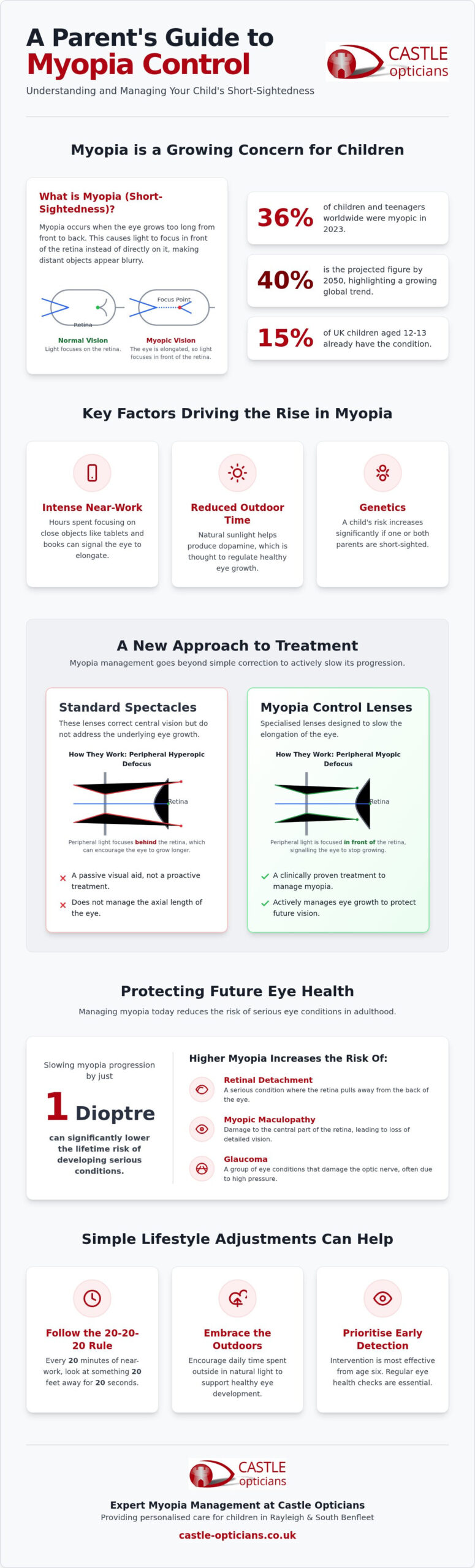
At its simplest, myopia occurs when the eye grows slightly too long from front to back. This physical change means light focuses in front of the retina instead of directly on it, making distant objects appear blurry. To help you understand the clinical foundations, you can read a detailed overview of What is myopia (short-sightedness)? online. In our Rayleigh and South Benfleet practices, we often see children whose prescriptions “creep” upwards every six to twelve months. This happens because the eye continues to elongate as the child grows, particularly during the intense developmental years of school.
The rise in myopia isn’t just a global trend; it’s a local reality for families across Essex. Data from 2023 shows that approximately 36% of children and teenagers worldwide are myopic, and this figure is projected to reach 40% by 2050. In the UK, about 15% of children aged 12 to 13 already have the condition. Recognising this shift is the first step toward effective myopia control for children in Essex, moving beyond simple correction to active management.
The “Why” Behind the Myopia Epidemic
Modern life has fundamentally changed how our children use their eyes. The intensity of “near-work” on tablets, smartphones, and books is a significant driver of the current myopia spike. When children spend hours focusing on objects close to their faces, it signals the eye to grow in a way that accommodates near vision, often at the expense of distance clarity. Reduced time spent in natural outdoor light also plays a crucial role. Sunlight helps the eye produce dopamine, which is thought to regulate healthy eye growth. Genetics remain a vital piece of the puzzle too. If one or both parents are short-sighted, a child’s risk of developing myopia increases significantly.
Standard Glasses vs. Myopia Control
Many parents assume that a comprehensive eye test Essex will simply result in a standard pair of glasses to “fix” the problem. However, traditional single-vision lenses only correct the blur; they don’t address the underlying cause of the worsening prescription. They act as a visual aid rather than a treatment. Myopia control for children in Essex represents a shift in clinical philosophy. Instead of just correcting the current vision, we use specialised lenses designed to signal the eye to slow its growth. By managing the progression now, we can help ensure your child doesn’t end up with the very high prescriptions that lead to greater health risks in adulthood.
The Science of Myopia Management: Protecting Future Vision
Axial length is the measurement from the front of the eye to the back. When this distance grows too quickly, myopia progresses. Our primary goal with myopia control for children in Essex is to manage this growth. Clinical evidence suggests that intervention is most effective when started early, sometimes for children as young as six. By slowing the rate at which the eye elongates, we aren’t just improving their vision today; we’re protecting their sight for the next sixty or seventy years.
Reducing Long-Term Ocular Risks
High myopia isn’t just about needing thicker glasses. It significantly increases the risk of developing life-altering conditions like retinal detachment, myopic maculopathy, and glaucoma in adulthood. Research indicates that slowing myopia progression by just one dioptre can significantly lower the risk of these diseases in later life. This is why we view every eye health check Essex families attend as a preventative medical appointment. We look beyond the prescription to the structural health of the eye, ensuring a holistic approach to your child’s well-being.
How Myopia Control Lenses Work
Modern myopia control treatments rely on a clever optical principle called peripheral defocus. Standard glasses focus light perfectly in the centre of the retina but cause it to fall behind the retina at the edges. This “peripheral hyperopic defocus” actually encourages the eye to grow longer to reach that light. Myopia control lenses feature a central zone for clear vision and a surrounding treatment zone that brings peripheral light forward. Peripheral defocus is a clinical method to signal the eye to stop elongating.
These specialised lenses “trick” the eye into thinking it has already grown enough. Clinical studies have shown remarkable results, with some daily contact lenses slowing progression by an average of 59% over three years. Similarly, advanced spectacle lenses have demonstrated a 60% reduction in progression compared to standard single-vision lenses. If you’re concerned about your child’s changing prescription, you might want to speak with our independent experts about which technology suits their lifestyle best.
Comparing Myopia Control Options: Spectacles vs. Contact Lenses
Choosing the right method for myopia control for children in Essex depends entirely on your child’s age, personality, and daily hobbies. At Castle Opticians, our independent status is a significant advantage for local families. Unlike large high-street chains that might be restricted to specific brands, we have the freedom to select the most effective Myopia control treatments from across the entire market. This ensures your child receives a solution tailored to their specific rate of progression and lifestyle needs, rather than a one-size-fits-all approach.
Specialist Myopia Control Spectacles
For many younger children or those who aren’t quite ready for contact lenses, specialised spectacle lenses are an excellent, non-invasive starting point. These aren’t your typical glasses; they look like standard lenses but contain invisible treatment zones that manage how light enters the eye to signal it to slow its growth. Because these lenses rely on precise positioning, finding the right spectacle frames Rayleigh offers is vital for lens efficacy. If frames slip down the nose, the treatment zones won’t align correctly with the pupil, which can reduce the effectiveness of the treatment. We prioritise durable frames with high-quality coatings designed to withstand the rigours of school and play whilst providing consistent vision correction.
Contact Lens Solutions: MiSight and Ortho-K
Many parents are surprised by how quickly children adapt to contact lenses Rayleigh kids can wear comfortably. MiSight 1-day lenses are soft, daily disposables specifically designed for myopia control. They’re easy to handle and offer a high level of hygiene since a fresh pair is used every day, which is often a relief for busy parents. For active children who enjoy swimming or contact sports, Orthokeratology (Ortho-K) offers a unique overnight solution. These custom-designed lenses are worn only whilst sleeping to gently reshape the cornea. In the morning, the child removes them and enjoys clear vision all day without needing glasses or lenses at school.
Safety and hygiene are our primary concerns during the fitting process. During our unhurried consultations, we take the time to support families through every step, teaching both you and your child proper handling techniques. Whether your child prefers the simplicity of frames or the freedom of lenses, our goal is to find the most comfortable and effective path for their myopia control for children in Essex.
Practical Guidance for Parents: Lifestyle and Early Detection
Clinical treatments like specialised lenses are incredibly effective, but they work best when paired with healthy visual habits at home. One of the simplest ways to protect your child’s sight is by following the 20-20-20 rule. During homework or tablet use, encourage them to look at something at least 20 feet away for 20 seconds, every 20 minutes. This gives the focusing muscles a vital break and reduces the strain that often accelerates eye elongation. It’s a small change that can make a significant difference in your long-term strategy for myopia control for children in Essex.
Signs Your Child Might Be Myopic
Children rarely complain about their vision because they assume everyone sees the world the same way they do. You’ll need to look for subtle physical cues instead. Common red flags include frequent squinting, sitting unusually close to the television, or rubbing their eyes whilst trying to focus. You might also notice they suffer from headaches after school or have lost interest in far-away activities like football or cricket. If their school performance has dipped, it might simply be because they can’t clearly see the whiteboard. At the first sign of these behaviours, it’s wise to book a children’s eye test South Benfleet families trust to catch issues before they progress.
The Role of Outdoor Play
Clinical recommendations now suggest that children should spend at least two hours a day outdoors to help regulate eye growth. Natural sunlight triggers the release of dopamine in the retina, which acts as a natural signal to prevent the eye from growing too long. We’re fortunate in Essex to have wonderful open spaces like Hadleigh Country Park or the woods in Rayleigh and Benfleet. Encouraging your child to swap a screen for a scooter or a walk in the park isn’t just good for their fitness; it’s a fundamental part of myopia control for children in Essex. Balancing academic pressure with these visual breaks is essential for maintaining healthy development.
Before your first specialised consultation, talk to your child about what to expect. Explain that it’s a relaxed, unhurried process designed to help them see more clearly. There are no wrong answers, and our friendly team is here to make them feel at home. If you’re ready to start this journey, you can book a consultation at our independent practices today to discuss a personalised plan for your child’s future vision.
Expert Myopia Management at Castle Opticians Essex
Castle Opticians has been a fixture of the local community since 1989. Our family-run values mean we don’t treat eye care as a simple retail transaction. Instead, we offer a patient, clinical environment where your child can feel at ease. When you visit our practices in Rayleigh or South Benfleet, you’ll see the same friendly faces who understand your family’s history. This continuity is vital for myopia control for children in Essex, as it allows us to build a detailed picture of how your child’s vision is changing over several years.
A dedicated myopia management consultation is much more thorough than a standard sight test. We use advanced diagnostic tools to monitor the axial length of the eye, which is the gold standard for tracking progression. By measuring the physical growth of the eye rather than just the prescription, we can tell exactly how well the chosen treatment is working. This level of precision ensures we can make adjustments early, providing the best possible protection for your child’s future sight.
Why Independence Matters for Your Child
Being independent gives us a unique advantage that corporate high-street chains often lack. We aren’t tied to specific manufacturers or restricted by head-office sales targets. Our clinical team has the freedom to choose from the very best myopia control technologies available globally. Whether a child would benefit most from specific specialised lenses or a particular brand of daily contact lenses, we can provide it. This independence means our recommendations are always based purely on what’s best for your child’s eye health. We focus on clinical outcomes rather than corporate quotas.
Booking Your Consultation in Rayleigh or Benfleet
Getting started is a straightforward process. We recommend a specialist assessment where we can discuss your child’s lifestyle, school habits, and family history in detail. We’re committed to clear communication, ensuring you understand the science behind our recommendations without being overwhelmed by technical jargon. Our pricing is transparent, and we take the time to explain the long-term benefits of each management plan. We believe that informed parents are the best partners in protecting a child’s vision.
Many families across Essex already trust us to manage their children’s vision. We take great pride in being a reliable, authoritative guide in this specialised field whilst maintaining the warmth of a local, independent practice. If you’re ready to move beyond standard glasses and start an active management programme, our teams in Rayleigh and South Benfleet are here to help. You can expect a thorough, unhurried service that prioritises your child’s comfort and future well-being.
Securing Your Child’s Visual Future in Essex
Taking proactive steps today can fundamentally change how your child sees the world for decades to come. We’ve explored how managing axial length through early intervention is the most effective way to protect against future eye health risks. Whether you choose advanced spectacle lenses or comfortable daily contact lenses, the goal remains the same: slowing down the progression of short-sightedness whilst your child is still growing. Combined with simple lifestyle changes like increased outdoor play, these modern clinical methods offer a powerful solution for families.
At Castle Opticians, we’ve provided independent eye care since 1989. As specialist paediatric lens experts, we pride ourselves on offering unhurried, personalised guidance that corporate chains often lack. Our practices in Rayleigh and South Benfleet are equipped with the latest technology to monitor your child’s vision with clinical precision. If you’re ready to discuss myopia control for children Essex parents can trust, our friendly team is here to support you every step of the way.
Book a Specialist Myopia Consultation at Castle Opticians and give your child the gift of clearer, healthier vision for their future.
Frequently Asked Questions
At what age should my child start myopia management?
Myopia management is most effective when started as soon as short-sightedness is identified, typically in children aged between six and fourteen. Because a child’s eyes grow rapidly during these school years, early intervention provides the best chance to slow down axial elongation. At our Rayleigh and South Benfleet practices, we assess each child individually to determine their readiness for specialised lenses or contact lenses based on their prescription and maturity.
Is myopia control available on the NHS in Essex?
Currently, specialised myopia control for children in Essex is only available as a private, self-funded service. Whilst children are entitled to an NHS optical voucher, this is designed to cover standard vision correction rather than the advanced technology used in myopia management. We provide transparent pricing for our private plans, which include the cost of specialised lenses and the detailed clinical monitoring required to track your child’s progress effectively.
Can my child still play sports while using myopia control treatments?
Absolutely, and many treatments actually make an active lifestyle easier for children in Rayleigh and Benfleet. Daily disposable contact lenses offer excellent peripheral vision and safety during contact sports compared to traditional frames. Alternatively, Ortho-K lenses are worn only at night, meaning your child has clear vision all day without needing any eyewear for swimming, rugby, or gymnastics. We’ll help you choose the option that best fits their favourite hobbies.
How long does the myopia management programme last?
A myopia management programme typically continues until the eye has finished growing and the prescription has stabilised, which is usually in the late teens or early twenties. It’s not a one-off fix but a long-term healthcare commitment. We monitor changes through regular reviews at our Essex practices, ensuring the treatment remains effective as your child matures. The duration is tailored to each individual’s unique rate of eye development and lifestyle needs.
Are myopia control contact lenses safe for young children?
Clinical studies have shown that contact lenses are safe for children, provided they follow proper hygiene and handling routines. Many children as young as eight successfully wear daily disposables like MiSight. At Castle Opticians, we provide unhurried, one-to-one training sessions to ensure both you and your child feel confident with application and removal. Because these are daily lenses, the risk of infection is significantly lower than with older reusable lens types.
Will myopia management completely stop my child’s eyes from getting worse?
Myopia management is designed to slow down the progression of short-sightedness rather than stop it entirely. Clinical evidence for specialised lenses shows an average reduction in progression of around 50% to 60% compared to standard glasses. The goal is to keep the final prescription as low as possible, which significantly reduces the long-term risk of serious eye diseases. Every dioptre we save helps protect your child’s future ocular health and well-being.
What is the difference between Ortho-K and MiSight lenses?
The primary difference lies in when the lenses are worn. MiSight lenses are soft, daily disposable contact lenses worn during the day and discarded each evening. Ortho-K lenses are rigid, custom-shaped lenses worn only whilst sleeping to gently reshape the cornea overnight. This allows for clear vision during the day without any lenses. Both are highly effective for myopia control for children in Essex, and we’ll recommend the best fit for your family.
How often will my child need a follow-up appointment at your Essex practice?
Most children on a myopia management plan will need a follow-up appointment every six months. These regular reviews are essential for monitoring axial length and ensuring the treatment is performing as expected. During these visits at our Rayleigh or South Benfleet branches, we’ll check the health of the eyes and adjust the prescription if necessary. This consistent monitoring is a core part of the personalised, independent care we’ve provided since 1989.