
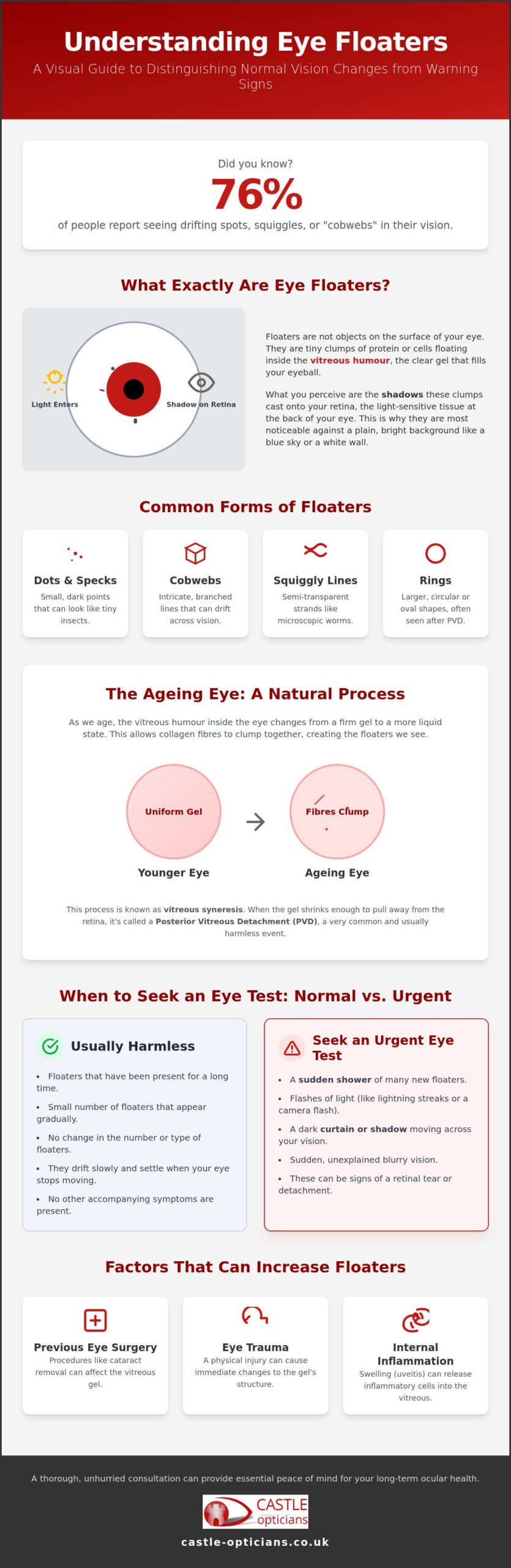
Did you know that approximately 76% of people report seeing drifting spots, squiggles, or “cobwebs” in their vision? Whilst these visual interruptions are remarkably common, understanding the presence of floaters in eye disease is essential for anyone noticing sudden changes. It’s natural to feel anxious when a new shape appears, especially if you’re unsure whether it’s a normal part of ageing or a clinical emergency that requires an urgent assessment.
We understand that describing these symptoms can be difficult, and the uncertainty often leads to unnecessary worry. Our goal is to provide you with the clarity you need to look after your sight with confidence. You’ll learn how to distinguish between harmless, age-related vitreous changes and the warning signs of serious conditions that require professional intervention from your local Essex opticians.
We’ll explain the “1-100 rule” for spotting risks, the link between floaters and health issues like diabetes, and provide clear criteria for when you should book a thorough eye test. Whether you need simple reassurance or a clinical examination, we’re here to help you navigate your eye health with a calm, expert, and unhurried perspective.
Key Takeaways
- Understand that floaters are actually shadows cast by tiny protein clumps within your eye’s gel rather than objects on the surface of your vision.
- Learn why Posterior Vitreous Detachment (PVD) is a common part of the ageing process and how to distinguish it from more serious complications.
- Identify the specific warning signs of floaters in eye disease, such as retinal tears or diabetic complications, that require immediate clinical attention.
- Master the “Rule of Three” and a simple home check to monitor your vision effectively and decide when to book a professional eye test.
- Discover how a thorough, unhurried consultation at an independent Essex optician can provide essential peace of mind for your long-term ocular health.
What exactly are floaters in eye disease?
Many people describe the experience of seeing tiny “flies,” drifting squiggles, or translucent cobwebs that seem to dance across their field of vision. These visual phenomena are caused by microscopic particles suspended within the inner structure of your eye. Whilst they may feel like they’re sitting on the surface of your cornea, they’re actually floating deep inside the eye’s internal cavity. Understanding What are eye floaters? involves looking at the microscopic clumps of protein or stray cells that occasionally drift into your line of sight.
The shapes you see aren’t the particles themselves, but rather the shadows they cast. When light enters your eye, these tiny clumps block a portion of that light, throwing a shadow onto the retina, which is the light-sensitive layer at the back of the eye. This “shadow effect” explains why floaters are most visible when you’re looking at a plain, bright background, such as a clear blue sky or a white wall. While most are a natural result of getting older, a sudden increase in these shadows can be a clinical indicator of floaters in eye disease, such as internal bleeding or inflammation.
Floaters often appear in several distinct forms:
- Dots and Specks: Small, dark points that look like tiny insects.
- Cobwebs: Intricate, branched lines that can drift across a large portion of your vision.
- Squiggly Lines: Semi-transparent strands that look like microscopic worms.
- Rings: Larger, circular shapes that often appear after specific changes in the eye’s gel.
The role of the vitreous humour
The vitreous humour is the clear gel that maintains the eye’s spherical shape. In our younger years, this substance has a thick, jelly-like consistency that is uniform throughout. However, as we progress from birth through to adulthood, the composition of the vitreous begins to change. It gradually becomes more liquid, a process that allows the internal collagen fibres to pull apart and form the clumps we recognise as floaters. This transition is a standard part of ocular development, though it’s the primary reason why floaters become more prevalent as we age.
Why they seem to “dart away”
If you’ve ever tried to focus directly on a floater, you’ll notice they seem to zip out of view the moment you look at them. This happens because of the physics of fluid movement within your eye. The floaters are suspended in the vitreous fluid and follow the movement of your eye, but they do so with a slight delay due to inertia. When your eye stops moving, the floaters continue to drift for a second before settling. This drifting behaviour is typical and usually quite harmless. It’s only when this movement is accompanied by other symptoms that we begin to investigate the possibility of floaters in eye disease.
Common causes: Why ageing eyes develop floaters
As we get older, the internal structure of the eye undergoes a series of natural, physical changes. The most significant of these is a process called vitreous syneresis. This involves the gradual liquefaction of the vitreous humour. Whilst this gel is firm and uniform in our youth, it slowly begins to shrink and lose its consistency over time. As the gel thins, the microscopic collagen fibres within it start to clump together. These clumps are what eventually cast the shadows we recognise as floaters. While this is often a benign part of getting older, it’s vital to stay aware of the warning signs of serious eye diseases that can occasionally mimic these common changes.
Several factors can accelerate these developments or make you more likely to notice them. Age is the most common driver, but other influences include:
- Previous Eye Surgery: Procedures such as cataract removal can sometimes alter the stability of the vitreous gel.
- Internal Inflammation: Swelling in the back of the eye can release cells into the vitreous.
- Trauma: Physical injury to the eye can cause immediate changes to the gel’s structure.
For residents in our local community, booking a regular eye test over 60 Essex provides an essential opportunity for us to monitor these transitions. During these consultations, we take the time to map any new floaters and ensure they aren’t masking more significant issues like floaters in eye disease.
Posterior Vitreous Detachment (PVD)
Posterior Vitreous Detachment, or PVD, is a very common life event where the vitreous gel finally pulls away from the retina at the back of the eye. This usually happens quite suddenly and can lead to a dramatic increase in the number of floaters you see. It’s important to distinguish PVD from a retinal detachment. Whilst PVD is generally not sight-threatening, the physical act of the gel pulling away can sometimes create a tear in the retina. This is why a sudden “shower” of new floaters should always be professionally assessed.
The impact of short-sightedness
If you are short-sighted (myopic), you may notice floaters much earlier in life than those with perfect vision. This is due to the physical shape of a myopic eye, which is often slightly longer than average. This elongated shape puts extra stress on the vitreous gel, causing it to liquefy and clump at a younger age. We often advise our younger myopic patients to stay vigilant. If you’ve noticed a change in your vision, a quick chat with our clinical team at Castle Opticians can help put your mind at rest.
Distinguishing normal floaters from serious eye diseases
Whilst most spots and squiggles are a normal part of getting older, distinguishing them from floaters in eye disease is a critical skill for maintaining your sight. It’s not just about the shapes you see; it’s about the speed at which they appear and the other symptoms that accompany them. A single, familiar floater that has drifted in your vision for years is rarely a cause for concern. However, when new shapes arrive suddenly, they can indicate a shift in your ocular health that requires professional attention.
There are several conditions where floaters act as a primary warning sign. These include:
- Retinal Tears: Small breaks in the light-sensitive layer at the back of the eye.
- Vitreous Haemorrhage: Bleeding into the gel-like substance inside the eye.
- Uveitis: Inflammation of the eye’s middle layer, which can release inflammatory cells into the vitreous.
Understanding the Symptoms and causes of eye floaters helps you recognise when a routine change becomes a clinical priority. In many cases, the underlying cause isn’t the floater itself, but a more significant issue occurring on the retina or within the blood vessels.
Retinal detachment: The “curtain” effect
A retinal tear or detachment is the primary emergency concern for any optician. When the retina begins to pull away from the back of the eye, it’s often preceded by a sudden shower of new floaters. One specific warning sign is the “curtain” effect, where a dark shadow or veil moves across your field of vision, usually starting from the periphery. If you experience this alongside persistent flashes of light, you must seek clinical help immediately. Sudden onset is the key differentiator here; age-related floaters tend to appear gradually, whereas detachment symptoms are often abrupt and alarming.
Diabetic retinopathy and floaters
This is where systemic health meets ocular health. High blood sugar levels can damage the tiny, fragile blood vessels in the retina. In response, the eye may grow new, even more delicate vessels that are prone to leaking. When these vessels bleed into the vitreous gel, the result is a sudden onset of dark, dense floaters. These aren’t clumps of protein; they’re actually tiny droplets of blood. For those managing this condition, our eye test for diabetics Essex provides the specialised screening required to catch these changes early.
Because the causes can range from natural ageing to serious systemic issues, we always recommend a comprehensive eye health check in Essex. We use advanced diagnostic tools to look deep into the eye, ensuring that what looks like a simple floater isn’t actually a sign of floaters in eye disease. Taking the time for a thorough assessment is the best way to protect your long-term vision.
Actionable guidance: When to seek an eye test in Essex
Knowing when to act is the most important part of managing your vision. Whilst many people live with a few stable spots for years, a sudden change in your visual landscape requires a methodical approach. We often advise our patients in Rayleigh and South Benfleet to follow the “Rule of Three” when monitoring their sight. If you experience a sudden increase in new floaters, persistent flashes of light, or a dark shadow creeping into your peripheral vision, these are the primary indicators that you need a professional assessment. These symptoms can be the first signs of floaters in eye disease, particularly those involving the retina.
You can perform a simple “bright wall” check at home to monitor your symptoms. Find a plain, well lit surface such as a white wall or a clear patch of sky. Look at the surface with one eye at a time. If you notice a persistent floater that is blocking your direct line of sight, try keeping your head still and glancing quickly up and then down. This movement swirls the vitreous gel within the eye, often moving the floater out of your central vision. If the floater doesn’t move, or if it’s accompanied by a “shower” of tiny dark spots, it’s time to seek clinical advice.
The urgency checklist
It’s helpful to distinguish between a routine concern and a clinical priority. You should contact us for a priority appointment if you notice any of the following:
- A sudden “shower” of floaters: Seeing dozens of new spots at once rather than just one or two.
- Flashes of light: Visual disturbances that look like lightning or camera flashes, especially in dark rooms.
- Blurred vision: A sudden drop in clarity that isn’t corrected by blinking or cleaning your glasses.
- A dark veil: A shadow that seems to be moving in from the side, top, or bottom of your vision.
If you’re unsure, your local optician should be your first port of call. We have the specialised diagnostic equipment, such as OCT scanners, to look deep into the eye and identify if you’re experiencing floaters in eye disease. Most floaters are stable and harmless, but a quick check provides the reassurance you need to stay confident in your eye health. If you’ve noticed any of these changes, don’t wait; book a clinical eye test with our experienced team today.
Monitoring other symptoms
Sometimes, other ocular issues can make floaters feel more intrusive. For example, managing eye dryness is essential for maintaining a clear tear film. When your eyes are dry, the surface of the eye becomes irregular, which can scatter light and make internal floaters appear more prominent or “sharper.” You might also find that floaters are much more noticeable when looking at white computer screens or bright blue skies. If your symptoms are changing gradually over weeks rather than seconds, keeping a simple “symptom diary” can help you describe exactly what you’re seeing during your next consultation.
Expert eye health care at Castle Opticians
Castle Opticians stands as a dedicated independent group in South Essex, providing a level of clinical care that prioritises your long-term ocular health. Our practices in Rayleigh and South Benfleet serve as local hubs for eye health, where we combine advanced diagnostic technology with a welcoming, community-focused atmosphere. When you visit us with concerns about floaters in eye disease, we don’t just check your prescription. Instead, we conduct a meticulous investigation into the internal structures of your eyes to ensure every layer is healthy and functioning as it should.
We use state-of-the-art equipment, including high-resolution scanners, to capture detailed images of the retina and the vitreous humour. This technology allows our clinical team to identify microscopic changes or subtle signs of tension that might be missed during a basic check. Our comprehensive eye test Essex is designed to be the definitive way to rule out serious disease, giving you total peace of mind regarding those drifting spots and shadows. We believe that a thorough, unhurried examination is the cornerstone of preventative care.
A personalised approach to clinical care
We believe that every patient deserves an unhurried and patient consultation. Since 1989, our independent group has focused on building long-term relationships with the residents of South Essex. By seeing the same professional clinical team in Rayleigh or South Benfleet, you benefit from a continuity of care that is often missing from larger corporate providers. We take the time to listen to your specific visual concerns and history, ensuring you never feel like just another number on a spreadsheet. This personal attention is what allows us to spot the subtle differences between normal ageing and more complex issues.
Booking your consultation
Whether you are eligible for an NHS sight test or prefer a private examination, we offer flexible options to suit your needs. If you have noticed a sudden change in your vision that matches the warning signs of floaters in eye disease, please contact our friendly team for an assessment. We understand the anxiety that sudden vision changes can cause. Our goal is to provide the clinical expertise and personal reassurance you need to feel looked after. Remember that whilst most floaters are a natural evolution of the eye, we are here to ensure yours are normal and your vision remains protected for the years ahead.
Protecting your vision for the years ahead
Whilst most visual floaters are simply a natural part of the ageing process, your peace of mind is our priority. By understanding the “Rule of Three” and knowing when a sudden shadow or flash requires clinical attention, you’ve taken the first step in proactive ocular care. It’s important to remember that professional clinical monitoring is the only definitive way to rule out floaters in eye disease and protect your sight from underlying complications like retinal tears or diabetic changes.
As an independent, family run opticians serving the Rayleigh and Benfleet communities for over 35 years, we pride ourselves on providing thorough, unhurried consultations. Our expert clinicians focus on preventative eye health, using advanced technology to ensure your eyes remain healthy and your vision stays clear. Whether you’ve noticed a new squiggle or simply want the reassurance of a professional assessment, we’re here to look after you with a personal touch.
Book your comprehensive eye health check at our Rayleigh or Benfleet practice and let our dedicated team provide the expert care you deserve. We look forward to welcoming you soon and helping you maintain your visual health for the future.
Commonly asked questions about eye floaters
What is the main cause of floaters in eye disease?
The primary cause of floaters in eye disease is often related to internal inflammation or bleeding. Whilst most floaters result from the natural ageing of the vitreous gel, disease-related floaters can be caused by white blood cells released during uveitis or red blood cells from leaking vessels in diabetic retinopathy. These particles disrupt the clarity of the eye’s internal fluid and cast prominent shadows onto the retina.
Can eye floaters go away on their own?
Floaters don’t physically leave the eye, but they often become less noticeable over time. This happens because the microscopic clumps eventually settle toward the bottom of the vitreous cavity, moving out of your direct line of sight. Your brain also performs a clever trick called neuroadaptation, where it learns to filter out these persistent shapes, much like how you don’t constantly notice the tip of your own nose.
When should I be worried about floaters and flashes?
You should seek an urgent clinical assessment if you experience a sudden “shower” of dozens of new floaters. This is particularly concerning if accompanied by persistent flashes of light or a dark veil moving across your vision. These symptoms can indicate that the vitreous gel is pulling on the retina with enough force to cause a tear, which requires immediate professional attention to prevent sight loss.
Is there a treatment for eye floaters in the UK?
Most floaters don’t require any clinical treatment and are simply monitored during your regular eye tests. For the vast majority of patients, the risks of intervention outweigh the benefits. In exceptionally rare cases where vision is severely obscured, a surgical procedure called a vitrectomy can replace the vitreous gel. However, this is generally reserved for extreme circumstances due to the potential for complications.
Can stress or tiredness cause black dots in my vision?
Stress and tiredness won’t physically create new floaters, but they can make you much more aware of the ones you already have. When you’re fatigued, your brain’s ability to ignore or “filter out” these visual interruptions often decreases. It’s also common to mistake the visual aura of an ocular migraine, which can be triggered by stress, for a new floater or flash of light.
Do floaters always mean my retina is detaching?
No, the presence of floaters does not automatically mean your retina is detaching. In fact, the most common cause of a sudden increase in floaters is a Posterior Vitreous Detachment (PVD), which is a normal, non-sight-threatening part of the ageing process. Whilst PVD can occasionally lead to a retinal tear, most cases settle down without any long-term damage to your vision.
How does an optician check for floaters during an eye test?
We use advanced diagnostic tools like a slit-lamp microscope and OCT (Optical Coherence Tomography) scanners to look deep inside your eye. By illuminating the internal cavity, we can see the vitreous gel in high definition and identify the exact location of any clumps. This thorough approach allows us to confirm if your symptoms are harmless or signs of floaters in eye disease that require further care.
Are floaters more common in people with diabetes?
Yes, people with diabetes are more prone to a specific type of floater caused by vitreous haemorrhage. If blood sugar levels aren’t managed effectively, the tiny vessels in the retina can become fragile and leak small amounts of blood into the eye’s gel. These droplets appear as new, dark spots or “clouds” and are a significant clinical indicator of diabetic retinopathy that needs urgent review.