
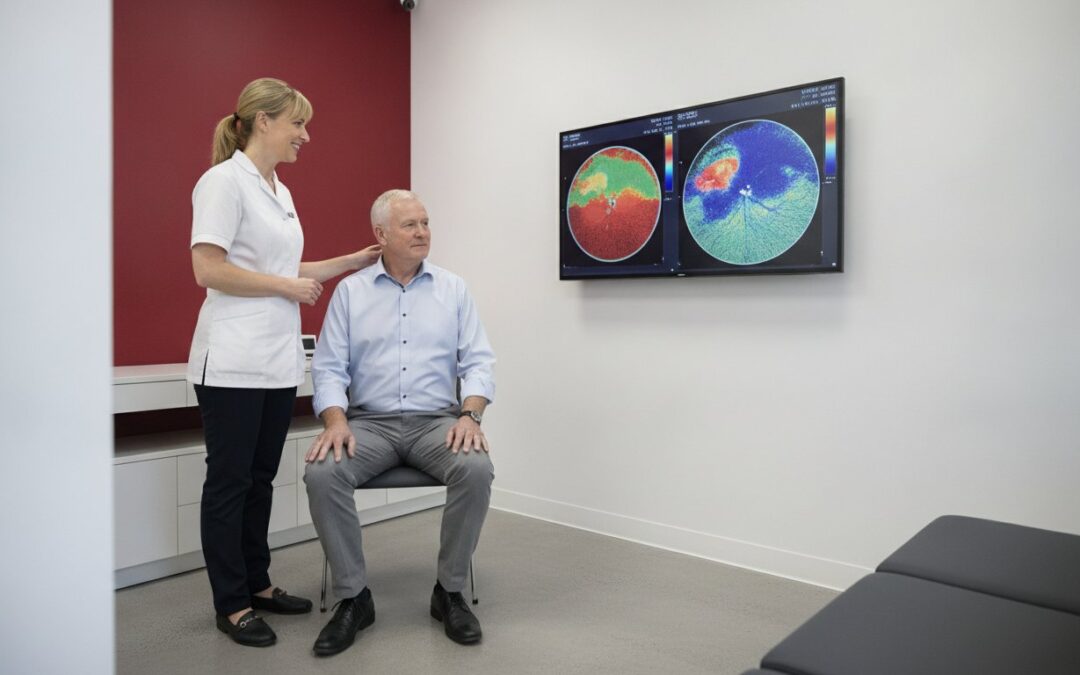
If you’ve just received your invitation for an NHS diabetic eye screening, you might assume your vision is fully covered for the year. But what if that specialised check-up is only telling you half the story? It’s natural to feel a little confused or even anxious about managing multiple health appointments, especially when you’re focused on preventing sight loss from conditions like diabetic retinopathy. Many people in our local community feel the same way, wondering why a separate eye test for diabetics Essex is necessary when they’re already being screened.
In this guide, you’ll discover the vital difference between the national screening programme and a comprehensive eye examination. We want to help you understand how these two appointments work together to protect your sight. We’ll look at the specialised technology available at independent practices in Rayleigh and Benfleet, such as OCT scans, and explain how a dual-track approach to your eye care provides the most thorough protection for your vision. By the end, you’ll have total clarity on which appointments you need and how to keep your eyes healthy for the long term.
Key Takeaways
- Learn why the NHS diabetic screening is a specialised check for retinopathy that does not replace your regular sight test.
- Discover how a comprehensive eye test for diabetics Essex at an independent practice identifies health issues that screening cameras might miss.
- Understand the impact of blood sugar on your retina and the importance of early detection in preventing long-term sight loss.
- Explore the advanced diagnostic technology used at our local practices in Rayleigh and South Benfleet to monitor your vision.
- Gain clarity on how to coordinate your appointments to ensure both your eye health and your prescription are expertly managed.
Eye Tests for Diabetics in Essex: Screening vs. Comprehensive Exams
Managing your health when you live with diabetes often feels like a series of endless appointments and check-ups. In Essex, this is particularly true for your vision. There’s often a significant amount of confusion regarding the different types of eye care available. You might receive an invitation for an NHS screening and assume it’s the only eye test for diabetics Essex you need. However, relying solely on screening can leave dangerous gaps in your ocular health. We believe in a “Dual Care” approach, where two distinct appointments work together to protect your sight.
What is the Mid and South Essex Diabetic Eye Screening Programme?
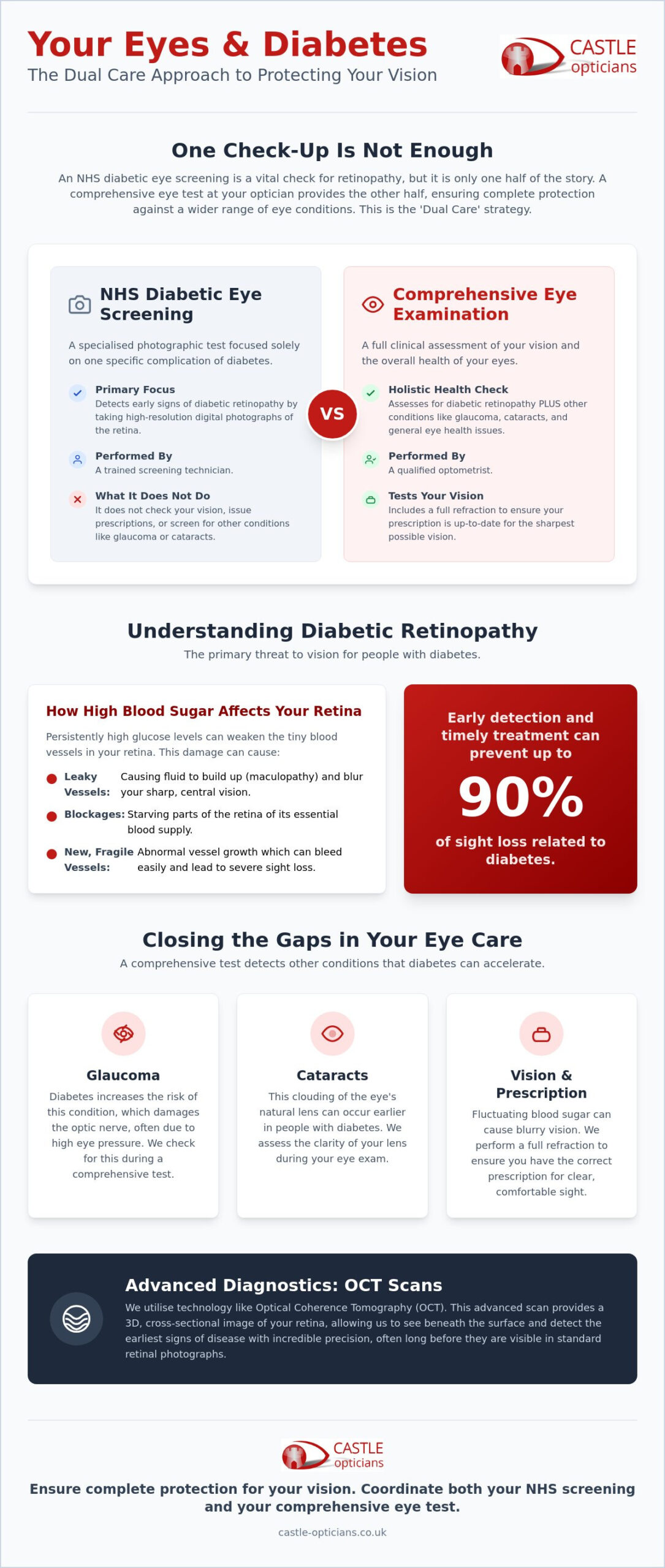
The Mid and South Essex Diabetic Eye Screening Programme is a vital NHS-led service offered to everyone with diabetes aged 12 and over. This is one of the 11 national population screening programmes in England. Its purpose is very specific: it uses high-resolution digital photography to look for early signs of damage to the blood vessels in the back of the eye. By Understanding Diabetic Retinopathy, you can see why this specialised check is so important for preventing blindness.
It’s essential to remember that this is a photographic test, not a full clinical examination. The technician is looking purely at your retina. Whilst the results are sent directly to your GP to help manage your condition, the screening does not include a vision check. If you’ve noticed your vision becoming blurry or if you’re struggling to read, the screening programme won’t provide you with a prescription for new lenses or frames.
The Role of Your Local Independent Optician
Because the NHS screening is so specialised, a comprehensive eye health check in Essex remains a clinical necessity. At our practices in Rayleigh and South Benfleet, we provide the second half of your “Dual Care” strategy. Diabetes doesn’t just affect the retina; it also increases the risk of developing other conditions like glaucoma and cataracts earlier than the general population. A standard screening camera won’t always detect these issues in their earliest stages.
When you visit us for an eye test for diabetics Essex, we take a much broader view of your eye health. We assess the internal pressure of your eyes, check the clarity of your crystalline lens, and perform a detailed refraction to ensure your vision is as sharp as possible. Our independent status allows us to offer a more patient, unhurried environment. We take the time to discuss how your blood sugar levels might be impacting your daily vision, providing a level of personal attention that high-volume screening centres simply cannot match.
Understanding Diabetic Retinopathy and Why Screening Matters
When you live with diabetes, the tiny blood vessels in your retina are particularly sensitive to fluctuations in blood sugar. Over time, high glucose levels can weaken these vessels, causing them to leak or become blocked. The danger lies in its subtlety; you might not notice any change in your vision until the damage is advanced. This is why an annual eye test for diabetics Essex residents receive is so critical. Medical evidence suggests that early detection and timely treatment can prevent up to 90% of sight loss related to diabetes. For those feeling apprehensive about the process, reading about What to Expect During Your Eye Test can provide peace of mind before your appointment.
How Diabetes Affects the Back of Your Eye
Think of your retina as the film in an old-fashioned camera. To capture a clear image, that film needs a constant, healthy blood supply. Diabetic retinopathy is a complication where high blood sugar damages retinal vasculature. When these vessels become “leaky”, fluid can build up in the macula, the part of the eye responsible for your sharp, central vision. This condition, known as maculopathy, can make it difficult to recognise faces or read fine print. Retinopathy typically progresses through stages, starting with “background” changes where small bulges appear in the vessels, and potentially moving toward the “proliferative” stage, where fragile new vessels grow and bleed into the eye.
Symptoms to Watch For Between Appointments
One of the biggest challenges with diabetic eye disease is that it often has no symptoms in the early stages. However, you should never ignore changes that occur between your scheduled check-ups. If you notice new floaters in eye disease, it’s important to seek advice promptly. While floaters are often harmless, they can sometimes signal a bleed in the back of the eye. Other warning signs include sudden blurred vision or “patchy” areas where your sight seems to disappear. Don’t wait for your next screening invitation if you experience these changes. If you are concerned about your vision, our team at Castle Opticians is here to provide a thorough assessment and professional reassurance.
Early changes identified during an eye test for diabetics Essex are often treatable with modern medical interventions. By attending every appointment, you give yourself the best possible chance of maintaining clear vision for life. We pride ourselves on being a trusted local expert, helping our neighbours in Rayleigh and Benfleet manage their eye health with confidence and care.
Why a Standard Eye Test is Still Essential for Diabetics
Many patients feel that once they’ve had their digital photographs taken at a screening centre, their eyes have been “checked”. However, a screening camera is not a diagnostic tool for your vision. It doesn’t measure whether you need new glasses, nor does it assess the front of your eye or your internal eye pressure. A comprehensive eye test for diabetics Essex is the only way to ensure your prescription is accurate and your eyes are free from other common complications. At Castle Opticians, we take a patient, methodical approach to these examinations, ensuring you never feel like just another number in a system. We believe that a thorough consultation shouldn’t be rushed, especially when managing a complex condition like diabetes.
Fluctuating Vision and Your Prescription
Diabetes can cause your vision to change from day to day. When your blood sugar levels are high, the lens inside your eye can swell, altering its ability to focus. This often results in temporary blurring that can’t be fixed by simply changing your glasses. We always recommend booking your sight test for a time when your blood glucose levels are most stable. Our optometrists specialise in identifying these fluctuations, helping you choose precision lenses that provide the most consistent clarity. If we suspect your vision is currently unstable due to sugar levels, we’ll give you honest, professional advice on whether to wait before updating your frames.
Checking for Glaucoma and Cataracts
It’s a medical fact that people living with diabetes are approximately twice as likely to develop glaucoma compared to those without the condition. Whilst the NHS guide to diabetic eye screening focuses on the retina, it doesn’t monitor the health of your optic nerve or the fluid pressure within your eye. Similarly, cataracts often develop at an earlier age in diabetic patients, appearing as a clouding of the eye’s natural lens.
Our thorough examinations at our Rayleigh and South Benfleet practices include these vital health checks as standard. For our older patients, we often refer to our eye test over 60 Essex checklist to ensure every age-related risk factor is covered. We believe that by combining clinical excellence with a warm, welcoming environment, we can help you manage these risks without the anxiety often associated with medical appointments. By choosing an independent eye test for diabetics Essex, you’re investing in a long-term relationship with a professional who knows your history and cares about your future sight.
What to Expect During Your Eye Test at Castle Opticians
Walking into our Rayleigh or South Benfleet practices, you’ll immediately notice that we do things a bit differently. We’ve built our reputation on a blend of professional clinical authority and warm, community-focused hospitality. We know that managing your health can be stressful, so we’ve designed our eye test for diabetics Essex to be as unhurried and reassuring as possible. Your journey with us is about more than just reading letters on a chart; it’s a comprehensive assessment of your long-term ocular well-being.
The Clinical Examination Process
Our examination follows a logical, methodical path to ensure no detail is overlooked. We prioritise your comfort at every stage, guiding you through the process with quiet confidence.
- Step 1: We begin with a patient discussion about your diabetic history. We’ll talk about your blood sugar management and any subtle changes you’ve noticed in your vision. This context is vital for our optometrists to understand your specific needs.
- Step 2: Next, we perform a precise refraction. This determines your latest prescription for lenses, ensuring your vision is as sharp and comfortable as it can be.
- Step 3: We then conduct an internal health check using advanced diagnostic technology. This includes high-resolution retinal imaging and OCT scans, which allow us to see beneath the surface of the retina to identify issues that traditional cameras might miss.
- Step 4: Finally, we carry out pressure checks and peripheral vision testing. These are essential for monitoring the increased risk of glaucoma that we discussed in previous sections.
Personalised Advice and Frame Selection
Once the clinical side is complete, we don’t just hand you a prescription and send you on your way. We take the time to discuss the best lens coatings for your specific needs, such as anti-reflective layers that can help with the glare often experienced by diabetic patients. You’ll then have the opportunity to browse our wide selection of frames in a relaxed environment. Our dispensing opticians are experts at finding styles that fit your face shape and your lifestyle, ensuring your eyewear is both functional and a pleasure to wear.
If our tests reveal any changes that require further medical attention, we coordinate directly with your GP or the wider diabetic care team. This seamless communication ensures your health is managed holistically. To experience this dedicated level of care for yourself, you can book your eye test for diabetics Essex at one of our local practices today.
Accessing Diabetic Eye Care in Rayleigh and South Benfleet
Finding a reliable provider for your eye test for diabetics Essex doesn’t have to be a complicated process. We understand that life with diabetes involves many moving parts. Our goal is to make your vision care as straightforward and stress-free as possible. Our practices in Rayleigh and South Benfleet are deeply integrated into the local community. We offer a level of personal consideration that larger corporate providers often overlook. Whether you’re eligible for an NHS-funded sight test or you’re visiting us as a private patient, we ensure you receive the same high standard of clinical attention and unhurried care.
We believe that being proactive is the best way to manage your health. By choosing a local independent optician, you’re not just getting a prescription; you’re building a relationship with a professional who understands your history. We’ve seen first-hand how consistent, dual-track care prevents vision complications from progressing unnoticed. Our teams in South Essex are always ready to offer advice and support, helping you stay on top of your appointments with confidence.
How to Book Your Appointment
Booking your consultation is simple. You can reach out to our Rayleigh or South Benfleet branches directly via telephone or by visiting us in person for a friendly chat. When you get in touch, it’s helpful to have the date of your last NHS screening to hand. This allows us to time your comprehensive exam perfectly alongside your screening cycle. We’ve been serving our neighbours as a Trusted Local Expert since 1989. This long-standing presence means we truly value the well-being of our visitors and take pride in maintaining the highest standards of personal consideration.
Preparing for Your Visit
To get the most out of your eye test for diabetics Essex, a little preparation goes a long way. We suggest bringing a list of any current medications you’re taking, as these can sometimes affect your ocular health. If you keep a log of your latest blood sugar readings, please bring that along too. It helps our optometrists understand how your condition is currently being managed. Don’t forget to bring your current spectacles or contact lens details so we can accurately compare them with your new results. Being organised with these details allows us to provide the most precise and personalised care possible during your time with us.
Your vision is one of your most precious assets. Whilst the national screening programme is a fantastic tool for spotting retinopathy, it’s the combination of that screening and a thorough clinical exam that truly protects your sight. We’re here to guide you through that process with expertise and a friendly face. Taking this dual approach today is the best way to ensure you continue to see clearly for years to come. Book your comprehensive eye test at Castle Opticians today and take the next step in protecting your vision.
Take Control of Your Vision Health Today
Protecting your long-term sight requires more than just attending your annual screening appointment. As we’ve explored, the most effective way to manage your ocular health is through a dual-track approach that combines specialised NHS photography with a thorough clinical examination. By prioritising a regular eye test for diabetics Essex, you ensure that conditions such as glaucoma or cataracts are identified early, whilst keeping your prescription perfectly up to date for your daily needs.
Castle Opticians has been a proud, independent family-run business serving the local community since 1989. At our Rayleigh and South Benfleet practices, we utilise advanced retinal imaging technology to provide a level of detail that goes far beyond standard checks. We invite you to experience our unhurried, personal approach to care where your well-being is always the priority. Book Your Comprehensive Eye Health Check in Essex today to secure your vision for the years ahead. We look forward to seeing you soon and helping you manage your eye health with complete confidence.
Frequently Asked Questions
Is the diabetic eye screening the same as a normal eye test?
No, a diabetic eye screening is a specialised photographic check that focuses solely on detecting damage to the blood vessels in your retina. Whilst the screening is essential for monitoring retinopathy, it doesn’t include a vision check or a prescription for glasses. A comprehensive eye test for diabetics Essex at an optician is required to assess your overall ocular health, including checks for glaucoma and cataracts, which the screening programme doesn’t cover.
How often should a diabetic have an eye test in Essex?
You should typically have a comprehensive sight test every year, in addition to attending your annual NHS screening invitation. If your blood sugar levels are fluctuating or you notice changes in your vision, we may recommend more frequent visits to our Rayleigh or Benfleet practices. Regular monitoring is the most effective way to detect subtle changes early. Always check with your optometrist to establish a schedule that’s tailored to your specific clinical needs.
Can I get a prescription for glasses at my NHS screening appointment?
No, you cannot get a prescription for glasses at an NHS screening appointment. The screening programme is designed purely to take digital photographs of your retina to check for signs of diabetic retinopathy. To update your prescription or choose new frames, you’ll need to book a separate eye test for diabetics Essex at an independent practice like ours. We’ll then perform a full refraction to ensure your vision is perfectly corrected and comfortable.
Why is my vision blurry even if my screening results were clear?
Screening only looks for damage to the blood vessels in your retina; it doesn’t account for other causes of blurred vision. Your sight might be blurry due to a change in your prescription, the development of cataracts, or even temporary swelling of the eye’s lens caused by high blood sugar levels. If you’re experiencing blurriness, it’s vital to have a full clinical examination to identify the exact cause and find the right solution for your sight.
Does the NHS pay for eye tests for diabetics in Essex?
Yes, everyone diagnosed with diabetes is entitled to a free NHS sight test in addition to their specialised screening. This means you can have your vision and general eye health checked at our Rayleigh or South Benfleet practices without a clinical fee. We’re proud to support both NHS and private patients, ensuring that high-quality, expert eye care remains accessible to everyone in our local community who is managing this condition.
What should I do if I notice new floaters or flashes?
You should contact your optician or GP immediately if you notice a sudden increase in floaters or see flashes of light. Whilst these symptoms are often related to age-related changes in the eye’s vitreous gel, they can sometimes indicate a more serious issue like a retinal tear or a bleed. Our team is here to provide urgent assessments and professional reassurance, ensuring any potential complications are addressed quickly to protect your long-term vision. For a detailed explanation of the causes and warning signs to look out for, our guide on floaters in eye disease and their warning signs can help you understand when to seek urgent care.
Can I wear contact lenses if I have diabetes?
Yes, most people with diabetes can safely wear contact lenses, provided their blood sugar levels are well-managed. It’s important to maintain excellent hygiene habits, as diabetics can sometimes be more prone to eye infections and slower healing. During your consultation, we’ll discuss the best lens types for your comfort and show you how to monitor your eyes for any signs of redness or irritation that might require a temporary break from lens wear.
How long does a comprehensive eye test take at Castle Opticians?
A comprehensive eye examination at our practices typically takes between 30 and 40 minutes. We pride ourselves on offering an unhurried experience, allowing plenty of time for a thorough clinical assessment and a meaningful discussion about your eye health. This methodical pace ensures we can perform advanced imaging and answer any questions you have about your vision or your diabetic care plan without you ever feeling like you’re being rushed through.