
You have spent weeks choosing the perfect frames; however, within minutes of wearing your new spectacles, you feel a dull ache behind your eyes and the world looks strangely distorted at the edges. It is a frustratingly common experience, yet many people assume they simply need more time to adjust to the common problems with glasses from a chain store. You might feel that your lenses are “swirly” or find that your frames constantly slip down your nose, making what should be a clear experience feel like a persistent daily chore.
We understand how unsettling it is when your vision doesn’t feel quite right. You deserve more than a conveyor-belt service that prioritises retail volume over your unique visual anatomy. In this guide, you will discover why high-street spectacles often fall short and how independent clinical care in Essex provides a superior, more comfortable alternative. We will explain the technical reasons your vision feels “off” and show you how a professional who takes the time to adjust your frames properly can provide the clarity and comfort you expect.
Key Takeaways
- Recognise the physical signs, such as the “fish-bowl effect” or lasting eye strain, that indicate your new lenses are not performing as they should.
- Discover why relying on “average” measurements often leads to problems with glasses from a chain store, particularly regarding your pupillary distance and lens alignment.
- Learn how a rushed, retail-focused eye test can lead to prescription inaccuracies that a more methodical, clinical approach easily avoids.
- Find out how to check your own frame alignment in a mirror and the best way to resolve persistent discomfort with your current provider.
- Understand the long-term value of choosing an independent expert who prioritises a thorough, unhurried consultation to ensure your spectacles fit perfectly.
Common Signs Your New Glasses Aren’t Right
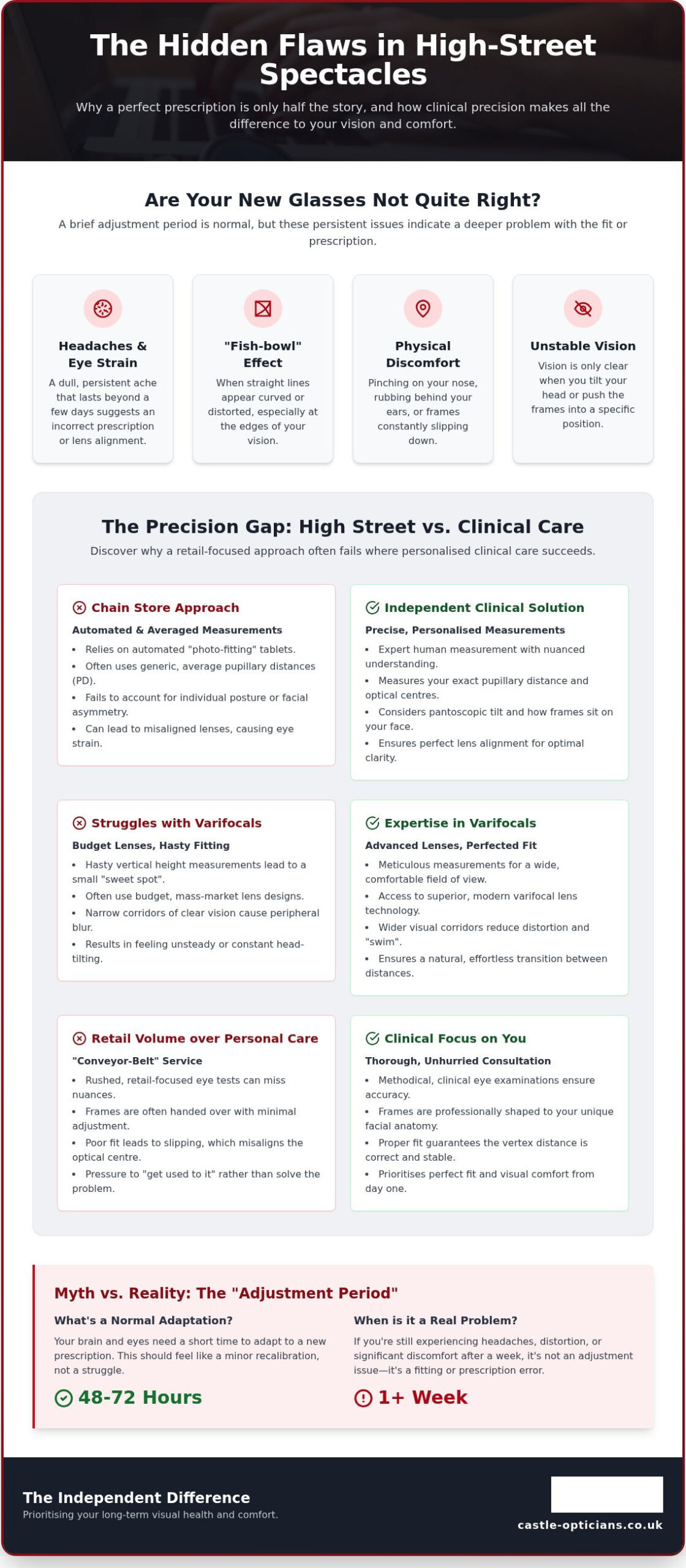
New glasses should feel like a relief, not a burden. Ideally, you would put them on and immediately enjoy crisp, clear vision. However, many people find themselves squinting or rubbing their temples, wondering if the problems with glasses from a chain store they have heard about are affecting their own sight. Whilst a small period of adjustment is normal, certain symptoms indicate that your spectacles simply aren’t fit for purpose.
Keep an eye out for these specific warning signs:
- Persistent headaches or eye strain: If your eyes feel tired or painful after a week of wear, the prescription or lens alignment is likely incorrect.
- The “fish-bowl effect”: This occurs when straight lines, such as door frames or computer screens, appear curved or distorted at the edges of your vision.
- Physical discomfort: Sharp pinching at the bridge of your nose or rubbing behind your ears suggests the frames haven’t been shaped to your anatomy.
- Blurry vision that shifts: If your sight only becomes clear when you manually lift the frames or tilt your head at an awkward angle, the lenses are not sitting where they should be.
The Myth of the “Adjustment Period”
It’s common for retail staff to suggest you “just need to get used to them.” It’s true that your brain takes a day or two to process a new prescription, but this shouldn’t involve significant pain. Generally, you should feel comfortable within 48 to 72 hours. If you’re still struggling after a full week, the issue is likely a genuine prescription error rather than a slow adaptation. Don’t feel pressured to keep “trying” if the discomfort persists. Seeking a professional second opinion is often the quickest way to find relief.
Physical Fit: More Than Just Comfort
A frame that fits poorly isn’t just an annoyance; it’s a clinical failure. If your frames constantly slip down your nose, the optical centre of the lens moves away from your pupil. This changes the “vertex distance”, which is the space between your eye and the lens. Even a few millimetres of movement can render a high-quality lens ineffective. The technical specifics of an eyeglass prescription require precise alignment to work correctly. When frames aren’t adjusted to your unique facial structure, you lose the visual clarity you paid for. We prioritise this level of precision to ensure your vision remains stable and comfortable throughout the day.
The Precision Gap: Why Measurements Matter
A prescription is only the first step toward clear vision. To work effectively, your lenses must be perfectly aligned with your pupils. This level of accuracy is where many problems with glasses from a chain store begin. Whilst a high-street shop might use automated “photo-fitting” tablets to take measurements, these tools often lack the human nuance required to account for your unique facial features. A digital snapshot cannot always predict how a frame will settle on your nose after an hour of wear, or how your posture affects your line of sight.
One of the most critical measurements is your Pupillary Distance (PD). This is the space between the centres of your pupils. If this measurement is based on a generic average rather than your specific anatomy, the “optical centre” of the lens won’t sit where it should. This misalignment forces your eye muscles to work harder, leading to the strain and headaches mentioned earlier. Beyond PD, we also consider the “pantoscopic tilt”, which is the angle at which the frame sits on your face. If the tilt is incorrect, light enters the lens at an oblique angle, creating subtle but constant distortion.
The Difficulty with Varifocals in Chain Stores
Varifocals are the most technically demanding lenses to dispense. They contain a complex “corridor” of different focal points, transitioning from distance vision at the top to reading strength at the bottom. In a retail-heavy environment, vertical heights are often measured hastily. If the height is off by even a tiny margin, you may find yourself tilting your chin up just to see the pavement or struggling to find the “sweet spot” for reading. Many chains also opt for budget, mass-market varifocal designs. These typically have much narrower corridors of clear vision, leaving you with significant peripheral blur that makes you feel “closed in” or unsteady.
Lens Quality and Coatings
The material of the lens itself plays a huge role in your visual comfort. Low-grade plastics used in some budget ranges are more prone to chromatic aberration, where colours appear to bleed at the edges of objects. Optical aberrations are imperfections in how a lens focuses light, often resulting in halos or blurred “starbursts” around streetlights during night driving. Furthermore, standard anti-reflective coatings in high-volume stores can sometimes be prone to smudging or even peeling over time. If you are tired of struggling with sub-par optics, it may be time to book a personalised dispensing consultation with an expert who prioritises precision over speed.
Understanding How to Read an Eyeglasses Prescription can help you appreciate the complexity of your own eyes, but only a methodical, unhurried fitting ensures those numbers translate into a comfortable pair of spectacles.
Eye Tests: Clinical Care vs. Retail Volume
The retail model of many high-street opticians is built on speed. In these environments, eye tests are often squeezed into 20-minute slots to keep the “conveyor belt” moving. This time pressure is a major contributor to the problems with glasses from a chain store that many patients experience. When a refraction is rushed, there is a higher risk of being over-prescribed. This happens when the eyes are forced to work too hard during the test, leading to a prescription that feels sharp in the chair but causes significant strain during a full day of wear.
We take a different approach. A clinical examination shouldn’t feel like a transaction. It requires a patient discussion about your lifestyle, your occupation, and how you actually use your eyes. We consider factors such as:
- Your typical working distance and screen setup
- Driving habits, especially during twilight or night hours
- Hobbies that require specific focal ranges, like crafting or golf
Our independent status allows us to prioritise clinical time over retail targets, ensuring we get the foundations right before you even look at a frame. Taking this extra time prevents the discomfort that often follows a hurried consultation.
Beyond the Sight Test
A thorough examination is about much more than just numbers on a page. A comprehensive eye health check in Essex acts as a vital window into your overall wellbeing. Rushed exams in volume-driven stores can sometimes overlook early markers of systemic health issues like diabetes or high blood pressure, which often show their first signs in the retina. By maintaining a relationship with a local expert, you benefit from continuity of care. We keep detailed records of your eye health over years, allowing us to spot subtle changes that a busy chain store might ignore.
NHS vs. Private: Quality Should Not Change
Many patients worry that their level of care depends on how they pay. At our practice, NHS eye tests in Rayleigh receive the same methodical attention as our private consultations. We don’t believe that using a voucher should ever mean a lower standard of clinical rigour or a hurried dispensing process. The common problems with glasses from a chain store often arise because the business model relies on high turnover. Our commitment to the South Essex community since 1989 has always been based on thoroughness, regardless of whether you are an NHS or private patient.
How to Resolve Problems with Your Current Glasses
If you’re currently struggling with your vision, don’t suffer in silence. Solving the problems with glasses from a chain store often requires a methodical approach to identifying whether the fault lies in the frame, the lenses, or the original test. You can begin this process at home with a few simple observations before seeking professional help.
Follow these steps to get your vision back on track:
- Step 1: The Mirror Check. Stand in front of a mirror and look at your spectacles. Are they sitting level on your face? If one side is higher than the other, or if the bridge is skewed, the optical centres will be misaligned.
- Step 2: Return to the Provider. You have a right to spectacles that are fit for purpose. Return to the original shop and clearly state that the glasses are causing discomfort.
- Step 3: Request a Technical Re-check. Don’t just ask for an adjustment. Request that they manually verify the lens power against your written prescription and double-check the horizontal and vertical centres.
- Step 4: Seek an Independent Audit. If the chain store insists everything is correct but you’re still in pain, it’s time for a second opinion. An independent optician can perform a clinical audit to find errors that a busy retail environment might have missed.
- Step 5: Prioritise Qualified Dispensing. For your next pair, ensure you are seen by a qualified Dispensing Optician. They possess the technical training to match frame geometry to your prescription.
What to Say to Your Optician
When you go back, using specific clinical terms can help the staff understand your issue. If you feel like you’re walking on a moving floor, describe the vision as “swimming.” If you see two of everything, mention “double vision.” For physical fit, be precise about “temple pressure” behind the ears or “bridge pinching” on the nose. Always ask them to manually verify the lens power using a focimeter; this ensures the lenses were manufactured exactly as the optometrist intended.
When to Cut Your Losses
Sometimes, the issue isn’t the prescription, but the frame itself. A frame might be too large for your face, causing the lenses to be excessively heavy or thick at the edges. Many “fashion” frames are incompatible with complex prescriptions; they may lack the depth needed for a functional varifocal corridor. Whilst it’s tempting to keep trying with a cheap pair, the long-term cost of persistent headaches and reduced productivity at work is much higher. If you’re tired of making excuses for poor vision, book a clinical audit with our team to find out exactly why your current spectacles aren’t performing.
The Independent Difference at Castle Opticians
Castle Opticians has been a fixture of the South Essex community since 1989. We’ve spent over three decades proving that eye care should be a personal journey, not a hurried transaction. Unlike the high-volume models that lead to common problems with glasses from a chain store, we operate with a clinical focus. Our independent status means we answer to our patients, not to corporate shareholders or retail targets. This freedom allows us to provide unhurried consultations where your visual health is the only priority.
Whether you visit our Rayleigh or South Benfleet branches, you’ll find a team that values long-term relationships. We believe that professional standards and a warm, hospitable environment should go hand-in-hand. We aren’t just here to sell you a product; we’re here to ensure you experience the world with absolute clarity and comfort. We take our time. Every patient is treated as an individual with unique requirements.
Personalised Frame and Lens Selection
Choosing the right frames is a technical task as much as a stylistic one. We carefully curate our collections based on build quality and material excellence, rather than just popular brand names. Having a wide selection of glasses frames in Essex means little if the frames aren’t suited to your prescription. Our experts specialise in matching spectacle frames in Rayleigh to the specific requirements of your lenses.
We also take the time to understand your daily habits. Your visual needs at a computer screen are vastly different from your needs behind the wheel or whilst enjoying a hobby like painting. By tailoring your lenses to these specific distances and environments, we eliminate the “off” feeling that so often plagues mass-market spectacles. This personalised approach ensures that your vision remains crisp and your eyes remain relaxed throughout the day.
A Warm Welcome in South Essex
We take great pride in being a “Trusted Local Expert.” This means combining clinical authority with the genuine hospitality you’d expect from a family-run business. When you support us, you’re supporting an independent business that is deeply integrated into the local fabric of Rayleigh, Benfleet, and Canvey Island. We know our patients by name, and we understand the specific needs of our community.
You don’t have to settle for distorted vision or uncomfortable frames. Experience the difference that personalised, unhurried care makes to your daily life. We invite you to book your next appointment with us and see why so many of our patients have stayed with us for decades. Your journey toward clearer, more comfortable vision begins with a consultation that truly puts you first.
Prioritise Your Vision with Expert Care
You shouldn’t have to tolerate headaches or distorted vision as part of your daily routine. As we have explored, many problems with glasses from a chain store stem from rushed consultations and a lack of precise, personalised dispensing. By choosing an independent expert, you ensure that your spectacles are tailored to your unique anatomy and lifestyle needs, rather than a corporate retail target.
Since 1989, our teams in Rayleigh and South Benfleet have prioritised clinical excellence and unhurried care for every visitor. Whether you require a complex varifocal fitting or a simple prescription update, our personalised dispensing process is designed to provide maximum comfort and lasting clarity. Don’t settle for vision that feels “off” when expert, local help is just around the corner.
Book your thorough eye examination at Castle Opticians today and experience the difference that three decades of independent expertise can make. We look forward to helping you see the world more clearly.
Frequently Asked Questions
Why do my glasses from a chain store give me headaches?
Headaches often result from an incorrect prescription or poor lens alignment. In a high-volume retail environment, measurements like pupillary distance are sometimes rushed or based on generic averages rather than your specific anatomy. This forces your eye muscles to strain to find the clear point of the lens. If your frames aren’t adjusted to sit level on your face, the resulting visual imbalance is a primary cause of persistent discomfort.
Can I take a prescription from a chain store to an independent optician?
Yes, you are legally entitled to a copy of your prescription immediately following your eye test, which you can take to any provider. Bringing your prescription to an independent practice in Rayleigh or Benfleet allows you to benefit from a more unhurried dispensing process. Our experts take the time to ensure the frames you choose are technically compatible with your specific lens requirements, reducing the risk of common problems with glasses from a chain store.
Why do my varifocals feel blurry at the bottom when I bought them from a high-street shop?
Blurriness at the bottom of varifocals usually indicates that the reading corridor is set too low or the lens design is too narrow. High-street chains often use budget, mass-produced varifocals with restricted viewing areas. If the vertical height measurement was taken hastily during a busy shift, you may find yourself constantly tilting your head to find the sweet spot. Precision dispensing ensures these focal zones align perfectly with your natural posture.
Is it normal for new glasses to feel “swirly” or distorted?
A mild swimming sensation is normal for the first 48 hours, but significant distortion is a sign of a technical error. This “fish-bowl effect” often happens if the lens curvature doesn’t match your previous pair or if the pupillary distance is incorrect. Whilst your brain needs time to adapt to a new prescription, you shouldn’t feel unsteady or nauseous. If the world looks curved at the edges, the lens quality or fitting likely needs professional review.
How long should I wait for my eyes to adjust to new spectacles?
Most people adapt to new spectacles within two to three days. If you are wearing varifocals for the first time, it might take up to a week to feel completely natural. However, if you are still experiencing eye strain, blurred vision, or physical pinching after seven days, it is unlikely to resolve on its own. At this point, we recommend returning for a clinical audit to check both the prescription and the frame alignment.
What is pupillary distance and why is it often wrong in mass-market glasses?
Pupillary distance (PD) is the exact measurement between the centres of your pupils. It ensures the optical centre of the lens sits directly in front of your eye. In mass-market settings, staff might use automated tools that miss subtle facial asymmetries or even rely on generic averages. An incorrect PD measurement is one of the most frequent problems with glasses from a chain store, leading to permanent eye fatigue and poor visual clarity.
Are independent opticians more expensive than high-street chains?
While the initial price might appear higher, independent opticians often provide better long-term value through superior lens quality and unhurried clinical care. We prioritise precision fitting and durable frames that don’t require constant adjustment or early replacement. When you factor in the reduced risk of prescription errors and the personalised service we provide in South Essex, the total cost of ownership is often comparable to that of high-street alternatives.
What should I do if the chain store refuses to fix my uncomfortable glasses?
If your original provider cannot resolve the issue, you should seek a second opinion from a trusted independent optician. We can perform a clinical audit to identify manufacturing errors or fitting issues that the chain store may have overlooked. You have a right to spectacles that are fit for purpose. If a retail-focused shop won’t help, our experts in Rayleigh and Benfleet are here to provide the technical expertise you need.