

Imagine you’re finishing a long day at your desk in Rayleigh, but your head is throbbing after hours of computer work. You try to check a message on your phone, but the text is a blur through your distance lenses, forcing you to reach for a second pair of spectacles just to read a single sentence. It’s a frustrating cycle that many of our visitors know all too well. If you’ve been weighing up the pros and cons of varifocals vs bifocals, you aren’t alone in wondering if there’s a simpler way to see the world.
We understand that the idea of changing your lenses can feel a bit daunting, especially when you’re worried about how long it takes to adapt. This guide will help you spot the clear signs that it’s time for a change and show you how to choose the best vision solution for your specific lifestyle. We’ll explore the benefits of modern lens technology and explain why precise, local measurements at our Benfleet or Rayleigh branches are the key to achieving seamless vision at every distance without the constant need to switch frames.
Key Takeaways
- Recognise the physical signs that your vision is changing, such as holding reading material at arm’s length or experiencing headaches after using a computer.
- Understand the functional differences between varifocals vs bifocals to help you decide which lens type offers the best support for your daily activities.
- Discover how a ‘three-in-one’ lens design can simplify your routine by removing the constant need to swap between different pairs of spectacles.
- Learn practical techniques for a smooth transition, including the “point with your nose” method to help you focus clearly and adapt with confidence.
- Explore why personalised, expert measurements at our Rayleigh or Benfleet practices are essential for achieving a perfect fit and truly seamless vision.
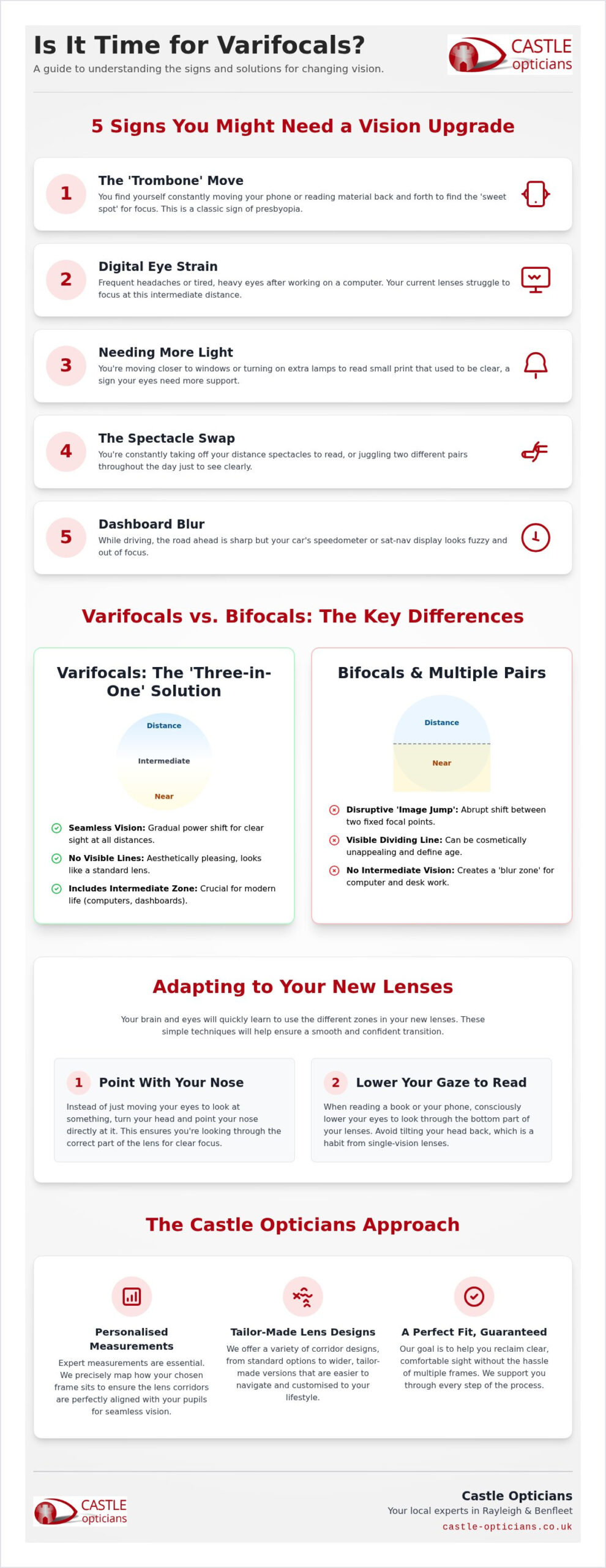
5 Signs You Might Need Varifocal Lenses
Recognising the need for a change in your vision often starts with small, daily irritations rather than a sudden loss of sight. You might find yourself squinting at a receipt in the supermarket or adjusting your posture to see your computer screen more clearly. These subtle shifts in behaviour are your eyes’ way of telling you they need a little extra support. At our practices in Rayleigh and Benfleet, we often see visitors who have spent months struggling with these symptoms before realising a single solution exists.
The Trombone Move and Presbyopia
Presbyopia is a natural evolution of sight, not a disease. It occurs as the crystalline lens inside your eye gradually loses its flexibility over time, usually becoming noticeable once you reach your 40s. This change is the reason your arms suddenly feel too short to read a menu or a text message. You might find yourself moving your phone back and forth, much like a trombone player, to find the “sweet spot” where the text snaps into focus. Whilst your current distance spectacles might still be perfect for seeing the road, they lack the power required for these close-up tasks.
Digital Eye Strain in Your 40s
Our modern screen habits place a unique demand on our intermediate vision. If you spend your working day at a laptop or monitor, you may notice that the screen isn’t quite as sharp as it used to be. When your eyes have to work harder to bridge this gap, the result is often late-afternoon tension headaches or a feeling of heavy, tired eyes. When comparing varifocals vs bifocals, it is this intermediate zone that makes the biggest difference. Unlike bifocals, which jump between two fixed points, varifocals offer a smooth transition that covers the exact distance of your desk and monitor.
Beyond these primary signs, there are other common indicators that it’s time to consider an upgrade to your lenses:
- Needing more light: You find yourself moving closer to a window or turning on extra lamps just to read small print clearly.
- The spectacle swap: You are constantly taking your glasses off to see things up close, or you’re juggling two different pairs throughout the day.
- Dashboard blur: Your vision is clear on the road ahead, but the car’s speedometer or sat-nav looks fuzzy.
Choosing the right lens is about more than just a prescription; it’s about matching your eyewear to your lifestyle. Understanding Varifocals and how they function can help you see why they have become the preferred choice for those who want to reclaim seamless vision without the faff of multiple frames. By addressing these five signs early, you can avoid unnecessary strain and enjoy clear sight at every distance.
Understanding Varifocals: The ‘Three-in-One’ Vision Solution
A varifocal lens is a sophisticated piece of optical engineering designed to mimic the way your eyes naturally worked before presbyopia. Instead of having a single focal point, these lenses feature a gradual change in power from the top of the lens to the bottom. This creates three distinct viewing zones within a single pair of spectacles, allowing you to see clearly at any distance without ever needing to change frames. It’s a seamless transition that caters to every aspect of your daily life.
- The Distance Zone: Located at the top of the lens, this area is perfect for looking at things far away. It’s what you use when you’re driving through Benfleet, watching a film at the cinema, or simply walking down the street.
- The Intermediate Zone: This is the middle section of the lens. It is the “secret” area that provides clarity for objects at arm’s length, such as your car dashboard, a computer monitor, or even the items on a supermarket shelf.
- The Near Zone: The bottom portion of the lens is dedicated to close-up tasks. It provides the magnification needed for reading a book, sewing, or checking a notification on your mobile phone.
How the Gradual Power Shift Works
One of the most significant aesthetic benefits when considering varifocals vs bifocals is the lack of a visible line across the lens. Bifocals have a distinct, often age-defining segment for reading, whereas varifocals look exactly like standard single-vision lenses. Your eye naturally learns to find the correct power by looking through different parts of the lens. As you lower your gaze to read, your pupils move through a “corridor” of increasing power. At Castle Opticians, we offer a variety of corridor designs, from standard options to tailor-made versions that are wider and easier to navigate based on your chosen frames.
Why Intermediate Vision is the Modern Priority
In our digital age, intermediate vision has become more important than ever. If you’ve ever struggled to read labels while cooking or found yourself leaning uncomfortably toward your laptop, you’ve felt the lack of intermediate support. Reading glasses are often too strong for these mid-range tasks, but varifocals bridge that gap perfectly. By providing clear sight at this specific distance, they help you maintain a more natural, upright posture at your desk, reducing neck strain and fatigue. If you’re unsure which zone is most critical for your daily routine, our team can help you book an eye test to discuss your specific lifestyle needs and find the perfect lens match.
Varifocals vs. Two Pairs of Glasses: Which Is Right for You?
Deciding between varifocals vs bifocals or simply sticking with two separate pairs often comes down to how you move through your day. Whilst some people prefer the simplicity of a dedicated prescription, many find the constant “spectacle swap” exhausting. Varifocals offer a level of visual continuity that separate pairs cannot match. They provide a natural way of seeing that flows from the dashboard to the road without a sudden break in clarity or the need to reach for a different case.
Investing in one premium pair of varifocals can often be more cost-effective than maintaining two separate prescriptions. When you factor in the cost of two high-quality frames and the necessary lens coatings for each, the price gap narrows significantly. For active residents in Rayleigh or Benfleet, having one versatile pair of spectacles means you’re always ready for whatever the day brings, whether that’s a walk in the park or a quick check of a recipe whilst cooking.
The Problem with The Great Spectacle Swap
Misplacing one pair of glasses can disrupt your entire morning. If you’re constantly taking frames on and off to switch between distance and reading, you increase the risk of damaging the hinges or scratching the lenses. Bifocals are sometimes considered as an alternative to two pairs, but many wearers find the “image jump” between the two distinct lens segments quite jarring. Varifocals eliminate this physical line and the resulting jump, providing a smooth transition that feels much more like your natural, youthful vision.
When Single-Vision Still Makes Sense
There are specific situations where a dedicated pair of single-vision lenses is still the preferred choice. If you spend four hours straight reading a novel or working on a detailed craft project, a dedicated pair of reading spectacles provides a wider, uninterrupted field of view. This can be more comfortable for stationary tasks that don’t require you to look up or into the distance.
A comprehensive eye test in Essex at our practice helps us determine exactly where your vision needs the most support. We take the time to understand your hobbies and work habits to ensure your prescription matches your life. For South Essex drivers, we often suggest a secondary pair of prescription sunglasses to ensure safety and comfort during the brighter months, even if varifocals remain your primary choice for daily wear.
Adapting to Your New Lenses: Tips for a Smooth Transition
Transitioning to your first pair of varifocals is a unique experience. Unlike the distinct split found in the debate of varifocals vs bifocals, where you have a hard line across your vision, varifocals use a sophisticated gradient. This design naturally creates areas of “soft focus” at the very edges of the lens. It is a normal characteristic of the technology, and understanding this from the start helps you feel more confident as you begin to wear them.
The most effective way to master your new spectacles is the “Point with Your Nose” technique. In single-vision glasses, you might be used to glancing sideways with just your eyes. With varifocals, you’ll get the sharpest results by moving your head slightly so your nose points directly at your target. This ensures your line of sight stays within the central corridor where the focus is clearest.
Consistency is your best friend during the first 48 hours. We always recommend wearing your new lenses from the moment you wake up. You’ll need to be mindful when navigating stairs or kerbs initially. Tuck your chin in slightly to look through the distance portion of the lens rather than the reading zone at the bottom. This prevents the floor from appearing blurred or closer than it actually is.
Training Your Brain to See
Adapting to these lenses is actually a neurological process rather than just an ocular one. Your brain is incredibly clever and will soon learn to ignore the “peripheral swim” effect that some people notice at first. It’s essentially training your mind to find the right focal zones automatically. Don’t be discouraged if things feel a bit different for a few days. Most people adapt fully within two weeks of consistent wear.
The Importance of Frame Fit
For the lens technology to work correctly, the alignment must be perfect. If your glasses slip down your nose, the focal zones won’t line up with your pupils. This is why choosing spectacle frames in Rayleigh with the help of an expert dispenser is so vital for your success. If things don’t feel quite right, a quick adjustment at our Rayleigh or Benfleet branches can often solve the problem in minutes.
If you’re finding the transition tricky or your frames feel slightly loose, visit us for a professional fitting adjustment to ensure your lenses are perfectly positioned for your eyes.
The Castle Opticians Approach: Personalised Varifocal Dispensing
Choosing where to have your lenses dispensed is just as important as the prescription itself. As an independent group serving South Essex since 1989, we have the freedom to select from a much wider variety of lens manufacturers than a typical high-street chain. This independence is particularly beneficial when comparing varifocals vs bifocals, as it allows us to source the specific lens technology that best suits your unique visual requirements and your chosen frame. We don’t believe in a one-size-fits-all approach; we believe in finding the right fit for you.
Our expert dispensing opticians focus on the fine details that make a pair of spectacles truly comfortable. We take precise measurements, including your pupillary distance and vertex distance, which is the exact space between your eye and the back of the lens. These measurements ensure that the focal zones of your varifocals align perfectly with your pupils. If these figures are even slightly inaccurate, you may find yourself tilting your head uncomfortably to find clarity. Our goal is to ensure your vision feels natural from the moment you put your glasses on.
Bespoke Lenses for Your Lifestyle
We believe your eyewear should adapt to your life, not the other way around. During your consultation, we’ll discuss your daily routine to determine the ideal corridor width for your lenses. A driver might require a broader distance zone, whilst someone working in a data-heavy office role will benefit from an expanded intermediate area. High-quality lenses are designed to minimise peripheral distortion, making the transition between these zones feel much more seamless. We also offer advanced coatings to reduce screen glare and protect your spectacles from everyday scratches.
Visit Us in Rayleigh or South Benfleet
At Castle Opticians, we pride ourselves on providing a warm, community-focused environment where you never feel rushed. Whether you visit us in Rayleigh or Benfleet, you’ll meet a team of Trusted Local Experts dedicated to your long-term eye health. We understand that moving from single-vision lenses or deciding between varifocals vs bifocals can be a big step, so we offer ongoing support to ensure you’re completely happy. If you find that you simply cannot adapt to your new lenses, we’ll work closely with you to find an alternative solution that works for your lifestyle.
Your journey toward clearer, more comfortable vision starts with a personal conversation. Book your eye examination at Castle Opticians today and experience the difference that expert, local care makes to your sight.
Step Into a World of Seamless Sight
Seeing clearly shouldn’t be a chore that involves juggling multiple pairs of spectacles or struggling with the limitations of a single prescription. By recognising the early signs of presbyopia and understanding the modern advantages of varifocals vs bifocals, you’ve already taken the first step toward more comfortable vision. Varifocals offer a sophisticated, line-free solution that supports your distance, intermediate, and reading needs within a single, stylish frame.
At Castle Opticians, we’ve been helping the South Essex community since 1989. Our independent status means we can offer a vast selection of designer and independent frames paired with bespoke lens technology. Whether you visit our Rayleigh or Benfleet practice, our trusted local experts will provide the personalised dispensing and precise measurements needed for a successful transition. You don’t have to settle for blurred vision or constant eye strain when a tailored solution is waiting for you.
Book your comprehensive eye test at Castle Opticians today to discover how the right lenses can transform your daily life. We look forward to welcoming you and helping you see the world with absolute clarity.
Frequently Asked Questions
Do I really need varifocals if I can just take my glasses off to read?
You don’t strictly need them, but relying on removing your distance spectacles for every close-up task often becomes a significant inconvenience. This habit can slow you down during activities like shopping or cooking where you need to see at different distances quickly. Varifocals offer a more fluid experience by keeping your vision clear across all ranges. They eliminate the constant need to take your glasses on and off, which also reduces the risk of misplacing your frames.
How much do varifocal lenses typically cost in the UK?
The cost of varifocal lenses in the UK varies widely depending on the complexity of the lens design and any additional coatings you choose. Standard designs are generally more affordable, while bespoke, high-definition lenses that offer wider fields of vision sit at a higher price point. Because every prescription and frame choice is unique, we recommend a consultation at our Rayleigh or Benfleet practices to discuss the best options for your specific budget and visual needs.
Can I get varifocals on the NHS if I qualify for a voucher?
Yes, if you are eligible for an NHS optical voucher, you can put its value towards the cost of your varifocal lenses. While the voucher might not cover the full price of premium varifocals, it provides a helpful contribution that makes upgrading your spectacles more accessible. Our team can check your eligibility and explain how the current voucher values apply to your choice of frames and lenses during your visit to Castle Opticians.
What happens if I simply cannot get used to varifocal glasses?
It’s very rare for someone to be completely unable to adapt, but if you do struggle, we are here to help. Most reputable independent opticians offer a “non-tolerance” period. If you cannot settle into your new lenses after a consistent two-week trial, we will work with you to find an alternative. This might involve adjusting the frame fit or swapping the lenses for bifocals or separate pairs of single-vision spectacles to ensure you’re happy.
Are there different types of varifocal lenses?
There is a significant range of lens types available today. When comparing varifocals vs bifocals, the main difference within varifocals is the width of the “corridor” of clear vision. Standard lenses have narrower corridors and more peripheral distortion, while premium or bespoke lenses are digitally surfaced to provide much wider viewing areas. At Castle Opticians, our independent status allows us to source the latest technologies from various manufacturers to find the perfect match for your lifestyle.
Can I have varifocals in any style of frame?
Most modern frames are suitable for varifocals, but the lens needs a certain amount of vertical depth to accommodate the different focal zones. If a frame is too shallow, the reading area at the bottom might be cut off, making it difficult to use. Our expert dispensing team in Rayleigh or Benfleet will guide you toward frames that not only look fantastic but also provide enough space for your lenses to function exactly as they should.
How long does it take to adapt to varifocals?
Most people find they adapt to their new lenses within a few days, though it can take up to two weeks of consistent wear for your brain to fully adjust. The key is to wear them all day, every day, rather than switching back to your old spectacles. This helps your system learn to find the correct focal zones automatically. If you’re still finding things tricky after ten days, a small adjustment to the frame alignment often helps.
Can I drive in varifocals straight away?
We recommend waiting until you feel completely confident with your new vision before driving. While the distance zone at the top of the lens is designed for driving, the slight peripheral changes can feel unusual at first. Once you’ve spent a day or two getting used to the “three-in-one” design, you’ll find that driving feels natural. Always ensure you can see your dashboard and the road ahead clearly before starting your journey.