
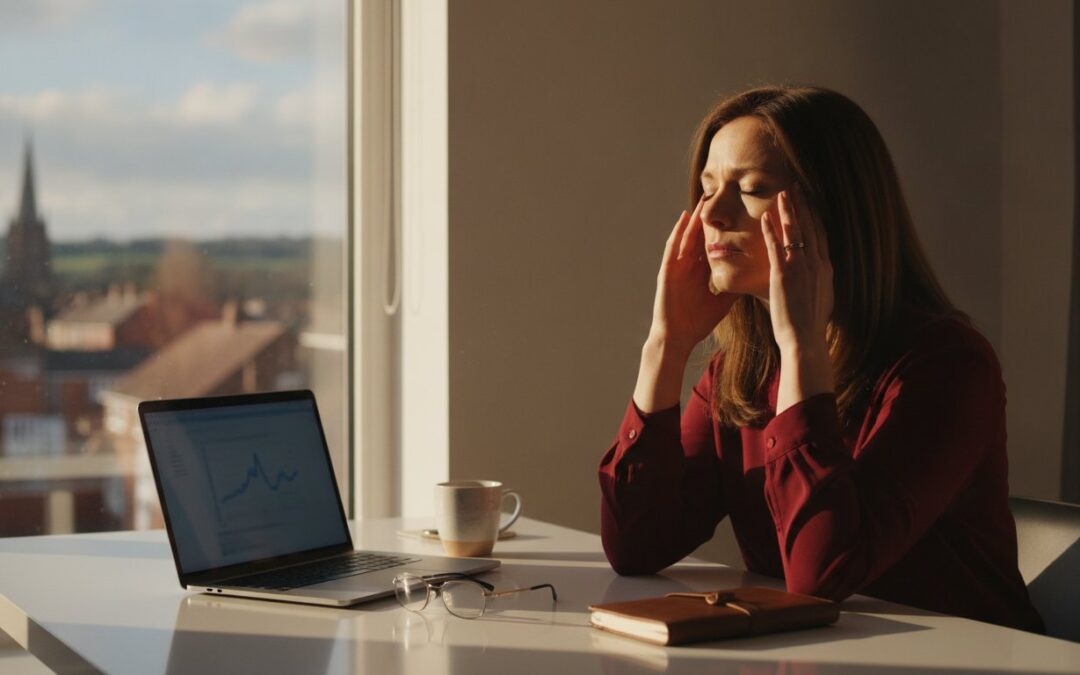
Have you ever wondered why your forehead begins to throb just as you’re finishing your afternoon emails, even when you aren’t particularly stressed? It’s incredibly frustrating to deal with persistent frontal headaches that seem to flare up whenever you’re focusing on a screen or driving home across Essex. Many people find themselves trapped in a cycle of taking painkillers for what they assume is tension, whilst the real culprit remains hidden. You might even feel a sense of confusion over whether you should be booking an appointment with your GP or visiting a local optician for advice.
If this sounds familiar, you aren’t alone, and it’s likely your body is trying to tell you that your eyes are overworking. We’ll help you discover how uncorrected vision often triggers these persistent headaches caused by eyesight and how a professional eye examination can provide the long-awaited relief you need. In the following sections, we’ll explore how to identify if your vision is the root cause of your discomfort. We will also look at the specific types of lenses designed to reduce strain and explain why a thorough, unhurried check-up at an independent practice can make all the difference to your daily comfort.
Key Takeaways
- Learn how subtle visual imbalances force your eye muscles to overwork, leading to physical pain in the forehead and temples.
- Identify how common conditions like astigmatism or farsightedness may be the hidden triggers for persistent headaches caused by eyesight.
- Understand the impact of “Computer Vision Syndrome” and how modern screen use contributes to daily eye fatigue and discomfort.
- Recognise the “red flag” symptoms that indicate when you should prioritise an eye test over a standard GP consultation.
- Discover the benefits of a personalised, unhurried eye examination at an independent Essex practice to find the right lenses for lasting relief.
The Connection Between Vision and Headaches: Why Eyesight Triggers Pain
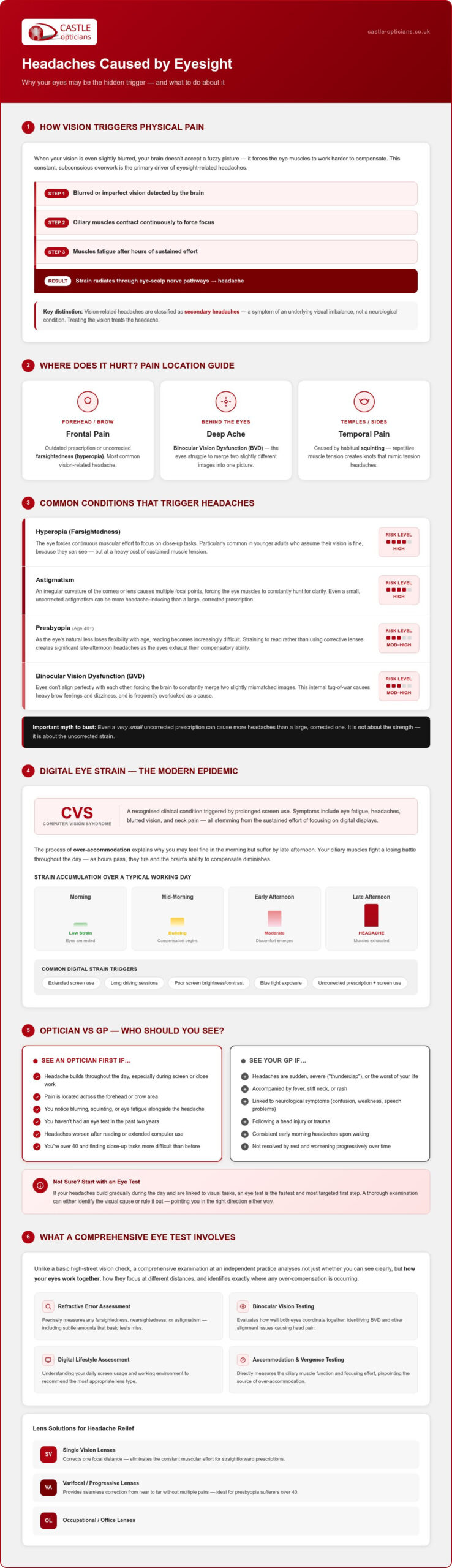
The brain and eyes share a complex, high-speed relationship. Your eyes act as the biological lenses, but your brain does the heavy lifting of processing light into the images you see. When your vision is even slightly blurred, your brain doesn’t just accept a fuzzy picture. Instead, it signals the internal muscles of the eye to work harder to sharpen the focus. This constant, subconscious adjustment is a primary driver for headaches caused by eyesight.
Inside each eye, a tiny ring of muscle called the ciliary muscle is responsible for changing the shape of your lens to focus on objects at different distances. If you’re struggling with uncorrected long-sightedness or astigmatism, this muscle remains in a state of permanent contraction. It’s a bit like trying to hold a physical squat for eight hours straight; eventually, the muscle becomes exhausted. This transition from visual fatigue to physical head pain happens because the strain radiates through the nerves shared by the eyes and the scalp.
Clinically, we distinguish between primary headaches, such as migraines, and secondary headaches. Vision-related pain falls into the secondary category. This means the headache is a symptom of an underlying visual imbalance rather than a neurological condition in its own right. Identifying this distinction is the first step toward finding a permanent solution rather than relying on temporary pain relief.
Where Does it Hurt? Identifying Headache Locations
The location of your pain often provides a vital clue about which part of your visual system is struggling. Frontal headaches, felt directly across the forehead or brow, are the most common sign that your prescription is out of date or that you have uncorrected farsightedness. If you feel a dull ache specifically behind the eyes, it might indicate binocular vision dysfunction, where the eyes struggle to work together as a coordinated team. Temporal pain, located at the sides of your head, often stems from the physical habit of squinting. This repetitive facial tension creates muscle knots in the temples that feel remarkably like a traditional tension headache.
The Mechanism of Ocular Strain
The process of over-accommodation explains why many people feel perfectly fine in the morning but suffer by the late afternoon. Throughout the day, your ciliary muscles are fighting a losing battle to maintain clarity. As the hours pass, these muscles tire and the brain’s ability to compensate diminishes. This cumulative strain is why intensive digital work or long drives often act as triggers. Mapping these specific triggers requires more than a basic vision check. A comprehensive eye test in Essex allows us to look at how your eyes focus together and identify exactly where the over-compensation is occurring, providing a clear path to lasting relief.
Common Eye Conditions That Trigger Persistent Headaches
While we’ve explored the physiological “why” behind head pain, it’s equally helpful to understand the specific clinical conditions that often go undetected. Many people assume that if they can see clearly, their eyes are fine. However, headaches caused by eyesight frequently stem from subtle imbalances that require the visual system to work in overdrive, even when your vision seems sharp on the surface.
Hyperopia, or farsightedness, is a classic hidden culprit, especially amongst younger adults. Unlike those who struggle with distance vision, farsighted individuals can often force their eyes to focus on close-up tasks through sheer muscular effort. This constant “clamping” of the internal eye muscles leads to a dull, nagging ache that builds throughout the working day. Similarly, presbyopia affects almost everyone over the age of 40 as the eye’s natural lens loses its flexibility. Pushing through the initial signs of reading difficulty doesn’t just make the text blurry; it creates significant late-afternoon pain as your eyes finally exhaust their ability to compensate.
Binocular Vision Dysfunction (BVD) is another often-overlooked factor. This occurs when your eyes don’t align perfectly with each other, forcing the brain to constantly fight to merge two slightly different images into one. This internal tug-of-war is exhausting for the nervous system and is a frequent cause of “heavy” brow feelings and dizziness.
Uncorrected Refractive Errors
It’s a common misconception that only “strong” prescriptions cause trouble. In reality, even a very small uncorrected error can be more problematic because the eye thinks it can “fix” the blur by straining, whereas a large error simply remains blurry. When you have different prescriptions in each eye, a condition known as anisometropia, the brain struggles to balance the competing signals, often resulting in lopsided or one-sided headaches. Uncorrected astigmatism forces the brain to work significantly harder to merge distorted or blurred images caused by an irregularly shaped cornea.
Latent Squints and Alignment Issues
Sometimes, the eyes have a natural tendency to drift slightly inwards or outwards, known as a latent squint. Your eye muscles must work tirelessly to keep the eyes straight and prevent double vision. This constant physical exertion leads to muscle fatigue that feels like a tight band around the head. If you’re experiencing these symptoms, our varifocal lens specialists in Essex can help align your vision at all distances, ensuring your eye muscles can finally relax. If you’re worried about persistent aches, it’s always worth speaking with a local expert to see if a simple change in lenses could be the solution you’ve been looking for.
Digital Eye Strain: The Modern Headache Epidemic
Our digital habits have fundamentally changed the way our eyes work. Spending hours each day looking at smartphones, tablets, and monitors has led to a rise in “Computer Vision Syndrome.” This condition isn’t just about tired eyes; it’s a significant contributor to headaches caused by eyesight. Unlike reading a book, digital screens are made of thousands of tiny pixels that constantly flicker. Your eyes are forced to refocus thousands of times an hour, leading to a state of permanent “micro-fluctuation” that the brain finds exhausting.
Then there’s the issue of blue light. This high-energy visible light can disrupt your circadian rhythm, making it harder to sleep and leaving your eyes feeling over-sensitised. Glare from overhead lighting reflecting off your screen adds another layer of stress. You might find yourself leaning forward or tilting your head to avoid these reflections, creating a “posture-vision” link. This physical strain in your neck and shoulders quickly travels upwards, manifesting as a sharp headache by mid-afternoon.
Why Screens Are Different from Paper
When we look at a screen, our blink rate drops significantly. Blinking is essential because it refreshes the tear film on the surface of the eye. Without this regular moisture, your eyes become dry and irritated. This persistent eye dryness often acts as a secondary trigger for tension pain. Screens also lack the sharp contrast of black ink on white paper, meaning your eyes work much harder to distinguish characters from the background whilst you work.
Modern Solutions: Lens Coatings and Blue Light Filters
Thankfully, modern lens technology has evolved to meet these digital challenges. Specialised anti-reflective coatings can virtually eliminate glare, reducing the frequency of glare-induced headaches. Many of our visitors in Rayleigh and Benfleet benefit from “office lenses.” These are specifically designed to provide a wide, clear field of vision for intermediate distances like monitors, unlike standard spectacles which may be optimised for distance or reading only. Incorporating these tailored solutions is a highly effective way to manage headaches caused by eyesight. We also recommend the 20-20-20 rule: every 20 minutes, look at something 20 feet away for 20 seconds. This simple habit gives your eye muscles a vital chance to relax and reset.
When to See an Optician vs. a GP for Your Headaches
Deciding which healthcare professional to visit for a persistent headache can be a confusing process. Most people default to booking an appointment with their GP, yet if your pain is concentrated around the forehead or follows periods of visual concentration, an optician is often the most effective starting point. It’s a common occurrence for GPs to recommend a professional eye examination as a first step to rule out headaches caused by eyesight before they consider prescribing long-term pain relief or stronger medications.
Opticians are primary healthcare providers for anything related to the eyes and the surrounding structures. We don’t just measure your need for spectacles; we assess the overall health and functionality of your visual system. By identifying the root cause of ocular strain early, we can often prevent the need for more invasive medical interventions later on. Regular check-ups serve as a vital preventative measure, ensuring that small changes in your vision don’t escalate into chronic physical discomfort.
The Clinical Eye Examination: More Than Just a Sight Test
A thorough consultation involves much more than reading letters on a chart. During a clinical examination, we use specialised equipment to look at the back of your eye, which can reveal a wealth of information about your general health. For instance, high pressure within the eye can be a sign of glaucoma, a condition that sometimes presents as a deep, throbbing headache. Our eye health checks in Essex include detailed screenings for macular health and retinal integrity, providing a level of diagnostic detail that goes far beyond a simple vision check.
Urgent Advice and Warning Signs
While most vision-related headaches are caused by simple strain or an outdated prescription, some symptoms require immediate clinical attention. You should seek an urgent assessment if your headache is accompanied by sudden flashes of light, a shower of new floaters, or a sensation like a dark “curtain” falling across your vision. Sudden double vision or extreme sensitivity to light are also significant red flags. If you’re experiencing these, it’s essential to contact a professional straight away. For routine concerns or persistent dull aches, booking an eye test with our independent team is the most reliable way to gain peace of mind and find a lasting solution to your discomfort.
Personalised Relief at Castle Opticians in Rayleigh and Benfleet
Finding relief from headaches caused by eyesight requires more than a standard prescription; it demands a thorough understanding of how you use your eyes every day. At Castle Opticians, we’ve remained an independent, family-orientated group since 1989, allowing us to prioritise personalised care over corporate targets. Unlike the fast-paced environment of many high-street chains, our consultations in Rayleigh and South Benfleet are designed to be unhurried and comprehensive. This patient approach gives us the time needed to investigate the subtle visual imbalances that often trigger chronic head pain, ensuring we find a solution that works for your specific needs.
Our team takes great pride in being a “Trusted Local Expert” within the Essex community. We believe that continuity of care is vital, which is why you’ll often see the same friendly faces during your visits. This long-term relationship allows us to track small changes in your vision over years rather than minutes. By combining professional clinical authority with warm, community-focused hospitality, we ensure that every visitor feels both respected and thoroughly looked after. Whether you need specialised high-tech lenses or a simple adjustment to your current frames, we’re here to guide you with quiet confidence.
Our Approach to Headache Diagnosis
We start every consultation by discussing your work environment and lifestyle in detail. If your pain typically flares up during intensive screen work or whilst driving at night, we look for the specific triggers in those environments. We don’t believe in a one-size-fits-all approach; instead, we tailor prescriptions for specific distances, such as VDU use or reading. We also pay close attention to physical comfort. Selecting spectacle frames in Rayleigh isn’t just about finding a look you love; it’s about ensuring the weight is distributed perfectly to avoid pressure points on the bridge of your nose or temples, which can quickly turn into a tension headache.
Booking Your Local Appointment
We offer both NHS-funded and private eye tests across our Rayleigh and South Benfleet branches. Many residents are eligible for NHS care, and we recommend confirming the current NHS eligibility criteria for 2026 to see if you qualify for a funded examination. For those seeking even more in-depth clinical screening, our private examinations utilise specialised diagnostic tools to map your eye health in great detail. You don’t have to live with the daily frustration of headaches caused by eyesight. We invite you to book an appointment with our team today and take the first step toward a more comfortable, pain-free life.
Take Control of Your Comfort and Vision
Persistent head pain doesn’t have to be a permanent part of your daily routine. By understanding that headaches caused by eyesight are often the result of subtle muscular strain or outdated prescriptions, you can move away from temporary fixes and toward a lasting solution. Whether it’s correcting a latent squint or adopting specialised digital lenses for intensive office work, the right optical care can significantly improve your quality of life and general well-being. Identifying these triggers is the first step toward reclaiming your focus and energy.
Since 1989, our independent team has provided unhurried, personalised care to the Essex community. We offer both NHS and private appointments at our branches in Rayleigh and South Benfleet, where we specialise in varifocal and high-tech lenses designed to reduce daily strain. Book your comprehensive eye test at Castle Opticians today to discover how our expert advice can help you live a life free from visual discomfort. We are dedicated to finding the perfect fit for your lifestyle and look forward to welcoming you into our practice soon.
Frequently Asked Questions
Can a small change in my eyesight really cause severe headaches?
Yes, even a minor refractive error can force your internal eye muscles to work constantly to maintain a sharp image. This persistent effort leads to muscle fatigue and tension, which often radiates into significant head pain. It’s frequently the smallest uncorrected errors that cause the most trouble because the eye believes it can “fix” the blur through sheer muscular strain, whereas a large error simply remains blurry.
How do I know if my headache is caused by my eyes or something else?
Eye-related headaches typically develop after periods of visual concentration, such as reading, using a laptop, or driving. If your pain is concentrated in the forehead or temples and tends to worsen as the day progresses, it’s a strong indicator of headaches caused by eyesight. Headaches that are present immediately upon waking or those that occur during the night are less likely to be vision-related.
Will wearing glasses for the first time make my headaches worse initially?
It’s normal to experience a brief adjustment period when you first start wearing a new prescription. Your brain and eye muscles need time to unlearn the habit of over-compensating for blurred vision. This adaptation usually takes a few days; however, if the discomfort persists for more than a week, you should return to your optician. We can then check the fitting and ensure the lenses are perfectly aligned with your pupils.
Are computer glasses different from regular prescription glasses for headaches?
Yes, computer or “office” lenses are specifically optimised for intermediate distances, which is the typical distance of a desktop monitor. Regular spectacles are often set for either far distance or close-up reading, which can leave a “gap” in focus for digital work. Specialised office lenses also include coatings that reduce flicker and glare, providing much better relief for digital eye strain than standard lenses.
Can children get headaches from eyesight problems?
Children frequently experience headaches due to undiagnosed vision issues like long-sightedness or astigmatism. Because children often don’t realise their vision is blurry, they may simply struggle through schoolwork whilst straining their eyes to see the board. If a child complains of a “sore head” after school or whilst reading, a comprehensive eye test is a vital first step to rule out visual fatigue.
Is an eye test for headaches covered by the NHS in Essex?
Many residents in Rayleigh and South Benfleet are eligible for NHS-funded eye tests. This includes individuals under 16, those over 60, and people with certain medical conditions or those receiving specific benefits. We recommend checking the 2026 NHS eligibility criteria to see if you qualify for a funded examination at our independent practice. If you aren’t eligible for NHS care, we offer thorough private examinations for all ages.
How often should I have an eye test if I suffer from recurring headaches?
You should have an eye test at least every two years, but more frequent checks are recommended if you suffer from recurring headaches caused by eyesight. If your pain patterns change or become more frequent, don’t wait for your routine recall date. Booking an unhurried consultation allows us to ensure your prescription remains accurate and your eye muscles aren’t being forced to overwork during your daily activities.
Can contact lenses help with vision-related headaches as well as glasses?
Contact lenses are highly effective at correcting the refractive errors that lead to headaches. In some cases, they provide a more natural field of vision and better peripheral clarity than spectacles. However, if your headaches are linked to dry eyes, we may need to discuss specific lens materials or hydration drops. Ensuring your eyes remain moist and comfortable is essential for preventing strain-related pain whilst wearing contact lenses.