
What if your NHS optical voucher was actually a golden ticket to high-quality, stylish eyewear rather than just a basic necessity? Many people feel a sense of hesitation when they receive a GOS3 form, worrying that it limits them to a small selection of uninspired frames or that their specific benefits won’t quite qualify. It’s understandable to feel overwhelmed by the paperwork and the fear of being restricted to ‘budget’ options that don’t reflect your personality.
We believe that everyone deserves to feel confident in their glasses, regardless of how they’re funded. In this guide, we have NHS optical vouchers explained in clear, simple terms to ensure you understand your entitlements for 2026. You’ll discover the exact values for vouchers A through H, ranging from £42.40 to over £233, and learn how to navigate the eligibility criteria for Universal Credit or Pension Credit. We will also show you how choosing an independent local practice like Castle Opticians allows you to combine clinical excellence with a personalised selection of frames that you’ll truly love to wear.
Key Takeaways
- Learn how the GOS3 form works with our guide to NHS optical vouchers explained, helping you distinguish between a free eye test and financial help for your spectacles.
- Identify if you qualify for a voucher based on age, full-time education, or specific income-related benefits such as Universal Credit and Pension Credit.
- Understand the NHS A to J voucher system to determine the exact value of your contribution based on the complexity and strength of your lens prescription.
- Discover the simple process for claiming your entitlement, including booking a thorough eye examination and providing the correct proof of eligibility.
- Find out how visiting an independent optician in Rayleigh or Benfleet provides access to a broader range of high-quality frames beyond standard NHS selections.
What are NHS Optical Vouchers and How Do They Work?
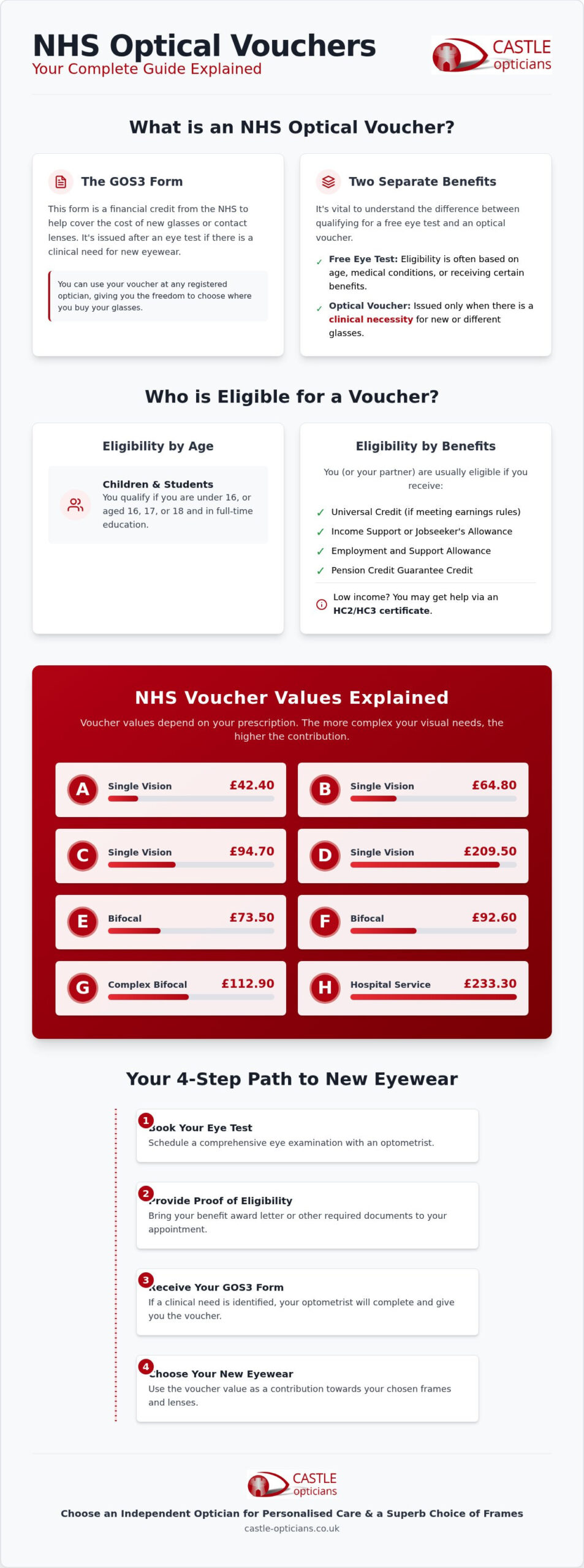
Understanding how to navigate NHS optical vouchers explained starts with the physical form itself. When you complete an NHS-funded eye test, your optometrist may hand you a GOS3 form. This isn’t just a piece of paper; it’s a financial credit from the health service designed to help you cover the cost of new glasses or contact lenses. It serves as a bridge between your clinical needs and the eyewear that helps you see clearly.
It’s vital to separate the eye test from the voucher itself. While many people qualify for a free sight test, the voucher is a separate benefit. You might be entitled to the examination but not necessarily the contribution towards your eyewear. This usually happens if your prescription hasn’t changed or if your current glasses are still clinically suitable for your needs. We always take the time to explain these nuances during your consultation so you know exactly where you stand.
One of the most empowering aspects of the system is your freedom of choice. Even if you have your test at a large hospital or a high-street chain, you aren’t obligated to buy your glasses there. You can take your GOS3 form to any registered optician that accepts NHS vouchers. At Castle Opticians, we frequently welcome patients who’ve had their tests elsewhere but prefer our independent selection of frames and our warm, community-focused fitting service.
The Difference Between Eye Test Eligibility and Voucher Eligibility
Qualifying for a free test is usually based on your status, such as being over 60 or having certain medical conditions. However, the voucher is triggered by ‘clinical necessity’. This means the optometrist must determine that you actually need new glasses. This could be because your prescription has changed or because your existing pair is no longer fit for purpose. You can sometimes receive a voucher even if your prescription is the same, provided your current glasses are worn out and beyond repair through normal use.
How the GOS3 Form Acts as Your Visual Currency
Think of your GOS3 form as a cheque specifically for your vision. Because it’s a physical document, you must keep it safe. If you lose it, obtaining a duplicate can be a slow process. Within the wider framework of NHS eye care services, these vouchers are typically valid for six months from the date of issue. To have NHS optical vouchers explained in a practical sense, consider them a dedicated fund for your eye health. Choosing an independent practice for your voucher often provides better value, as we aren’t restricted to a small range of frames, giving you more variety and better quality for your credit.
Who is Eligible for an NHS Optical Voucher in England?
Determining your entitlement is a straightforward process when you know which criteria apply to your circumstances. Generally, the NHS provides vouchers based on age, income, or clinical complexity. To have NHS optical vouchers explained clearly, we must look at the specific groups the health service supports. The most common qualifying categories include children under 16 and students aged 16, 17, or 18 who remain in full-time education. For adults, eligibility is often tied to your financial situation or specific medical needs. You can find a comprehensive list of Who is eligible for an NHS optical voucher on the official health service portal, but we have broken down the most relevant details for our Essex community below.
Automatic Qualification through Benefits
Income-based eligibility is the most frequent route for adults to receive support. If you receive any of the following benefits, you’re likely entitled to an optical voucher:
- Universal Credit (provided you meet the specific earnings threshold)
- Income Support or Income-based Jobseeker’s Allowance
- Income-related Employment and Support Allowance
- Pension Credit Guarantee Credit
It’s a common misconception that you must be the primary benefit claimant to qualify. If your partner receives a qualifying benefit and you’re included in that claim, you’re usually eligible for the same support. We recommend having your most recent award letter or a valid NHS tax credit exemption card ready when you visit our Rayleigh or Benfleet branches. If you don’t receive these benefits but have a low income, you can apply for help via the Low Income Scheme using an HC1 form. If successful, you’ll receive an HC2 certificate for full help or an HC3 certificate for partial assistance.
Support for High Prescriptions: Complex Lens Vouchers
Even if you don’t meet the income-based criteria, you might still receive help if your prescription is particularly high. The NHS recognises that very strong lenses are more expensive to manufacture and require specialised fitting. If you require lenses with a power of 10 dioptres or more, or if you need certain types of complex bifocals, you’ll be issued a complex lens voucher. This acts as a contribution towards the cost of your lenses regardless of your financial status. It’s a separate clinical category designed to ensure those with significant visual needs aren’t unfairly penalised by the cost of their prescriptions.
Children’s Vision and the NHS
Ensuring children have the best possible start is a priority. Every child under 16 is entitled to an optical voucher if they require spectacles. This support is vital because children’s eyes change rapidly, often requiring more frequent prescription updates. The voucher system also covers the repair or replacement of glasses, which provides peace of mind for parents of active youngsters. If you’re a parent, you might find our Children’s eye test in South Benfleet guide helpful for understanding how we make the process comfortable and engaging for your little ones. If you’re unsure about your specific status, feel free to book an appointment with our friendly team for a personalised consultation.
Decoding Voucher Values: How Much is Your NHS Voucher Worth?
The NHS uses a structured lettered system, from A to J, to categorise how much financial support you receive for your spectacles. This system is designed to reflect the technical complexity and manufacturing costs of the lenses you require. Having NHS optical vouchers explained in this way helps you see that the higher or more complex your prescription, the more support you typically receive. This ensures that everyone can access clear vision, regardless of how specialized their requirements might be.
Single Vision Voucher Breakdown (A to D)
Most people will find themselves within the first four categories of the voucher scale. Voucher A is the most frequent, currently valued at £42.40 for standard single-vision prescriptions under +/- 6 dioptres. A dioptre is a unit of refractive power used by opticians to measure the lens strength required to correct your vision. If your prescription is stronger, you’ll move up to Voucher B (£64.20) or Voucher C (£94.20). For those with very high prescriptions of +/- 10 dioptres or more, Voucher D provides a substantial contribution of £212.40. This tiered approach helps manage the increased costs associated with thinning and surfacing stronger lenses.
Bifocal and Multifocal Vouchers (E to H)
Bifocal and multifocal lenses are more intricate to produce because they incorporate different powers into a single lens. Consequently, these NHS voucher values are significantly higher to account for the extra laboratory work. Values start at £73.10 for Voucher E and can reach as high as £233.56 for Voucher H. Our dispensing opticians specialise in fitting precision lenses in Rayleigh, ensuring that your multifocal voucher is used to secure the most comfortable and effective visual solution for your daily life. We take the time to ensure the measurements are exact, as multifocal lenses require perfect alignment to work correctly.
Supplements for Special Requirements
Beyond the standard lens values, the NHS provides additional supplements for specific clinical needs. These are added to your base voucher value on the GOS3 form, creating a bespoke level of support. Common supplements include:
- Prisms: Used to help with eye alignment and prevent double vision.
- Clinical Tints: Provided when a specific tint is medically necessary for your visual comfort.
- Small Frame Supplement: Available for children who require frames with specific facial measurements that are more costly to source.
When we have NHS optical vouchers explained in this comprehensive manner, it becomes clear that the system aims to be as fair as possible. It doesn’t just offer a flat rate; it looks at the true technical requirements of your spectacles. By choosing an independent practice, you can ensure these supplements are used to provide the highest quality components for your specific needs.
The Practical Guide: How to Claim and Use Your Voucher
Using your entitlement is a straightforward journey that begins with a professional clinical assessment. To start the process, you should book a comprehensive eye test in Essex at one of our practices. During this appointment, our optometrist will perform a detailed examination to determine your current prescription and overall eye health. If a change in your vision is detected or new spectacles are clinically necessary, we will issue the GOS3 form immediately following your test.
Having NHS optical vouchers explained in a practical sense means understanding the importance of your paperwork. You must bring valid proof of your entitlement to your appointment. This might be a recent benefit award letter, your HC2 certificate, or a valid student ID if you’re under 19 and in full-time education. We cannot process the voucher without seeing this physical or digital proof, so keeping these documents organised is essential for a smooth experience.
The ‘Top-Up’ Option: Getting the Frames You Want
A common worry is that a voucher limits you to a small, uninspiring range of ‘NHS glasses’. This is a misconception we take pride in dispelling. Your voucher essentially acts as a fixed-value discount. Whilst you can choose frames that are fully covered by the voucher value, you also have the freedom to ‘top-up’. This means you can select any pair of frames from our extensive independent collection, including designer styles and premium materials, and simply pay the difference. Many of our patients in Rayleigh choose this route to secure high-quality aesthetics whilst still benefiting from their NHS contribution.
Can You Use an NHS Voucher for Contact Lenses?
You can certainly use your voucher towards the cost of contact lenses, provided they are prescribed by your practitioner. The voucher value is applied to the total cost of your lenses and the associated fitting fees. If you’re considering this option, our contact lenses in Rayleigh guide provides more detail on how we ensure a perfect fit for your lifestyle. It’s a flexible way to use your credit if you prefer an alternative to traditional spectacles.
Lost or Damaged Glasses: The Repair Voucher
The rules for repairs and replacements depend heavily on the age of the patient. Children under 16 are automatically entitled to NHS repair or replacement vouchers, acknowledging that accidents happen during play and school. For adults, the criteria are much stricter. The NHS generally only issues repair vouchers for adults in exceptional circumstances, such as if the loss or damage was caused by a specific health condition. If you find yourself with broken spectacles, visit us so we can assess the damage and advise if a claim is possible. If you’re ready to update your look or need a fresh prescription, book your appointment with our expert team today.
Choosing Castle Opticians: Independent Care for NHS Patients in Essex
When you look for a practice to handle your eye care, the distinction between a large corporate chain and a local independent group becomes clear through the level of personal attention you receive. We’ve been a part of the South Essex community since 1989, serving families across Rayleigh and South Benfleet with a commitment to clinical excellence. Choosing an independent optician means you aren’t just a number in a database; you’re a neighbour who deserves tailored advice. We ensure that having NHS optical vouchers explained by our team feels like a helpful conversation rather than a rushed transaction.
Our independence allows us to curate our own collections of frames and lenses. Unlike many high-street giants that are restricted to specific global brands, we source a diverse range of styles to suit every face shape and budget. This freedom ensures that our NHS patients have access to a much broader selection of spectacles than they might find elsewhere. We believe that everyone, regardless of how their eyewear is funded, should have the opportunity to wear something that feels high-quality and looks fantastic.
Personalised Service in Rayleigh and South Benfleet
One of the greatest benefits of visiting our Rayleigh or Benfleet branches is the clinical continuity we provide. You’ll often see the same familiar faces during your visits, which allows us to build a long-term understanding of your visual history and lifestyle needs. We take the time to conduct thorough adjustments and fittings, ensuring your new glasses sit perfectly. There’s no ‘corporate rush’ here. We’ll sit with you for as long as needed to make sure your GOS3 form is used effectively and that you’re completely happy with your choice.
Combining Your Voucher with Designer Style
We’ve organised our practice to bridge the gap between clinical necessity and personal style. Our dispensing teams are experts at helping you find the perfect aesthetic. If you’re looking for inspiration, our guide to spectacle frames in Rayleigh showcases the variety we offer to all our patients. We use our ‘Trusted Local Expert’ status to guide you through the technical aspects of your prescription whilst ensuring the final look reflects your personality.
Whether you choose a pair of glasses fully covered by your voucher or decide to use it as a contribution towards a designer frame, you’ll receive the same meticulous clinical care. We’ve spent decades refining how NHS optical vouchers explained to our patients can empower them to make the best decision for their vision. Visit us at Castle Opticians to experience eye care that prioritises your well-being and your style in equal measure.
Take the Next Step Toward Clearer Vision
Understanding your entitlements doesn’t have to be a complicated process. We’ve had NHS optical vouchers explained to ensure you can move forward with confidence, knowing that your GOS3 form is a valuable asset for your eye health. Whether you’re qualifying through income-related benefits or require support for a complex prescription, the focus remains on ensuring you see clearly without any compromise on quality.
Since 1989, our independent family practices in Rayleigh and South Benfleet have prioritised personal attention over a corporate approach. We provide a wide selection of designer and budget frames, ensuring that every patient finds a look they truly love. Our expert lens fitting team is here to guide you through every step, from the initial clinical exam to the final adjustment of your new spectacles. Book your NHS eye test at Castle Opticians today and experience the difference that independent, community-focused care makes for your vision. We look forward to welcoming you soon.
Frequently Asked Questions
How often can I get an NHS optical voucher?
You can usually receive a voucher every two years, which is the standard interval for a routine eye examination. However, this is flexible if your optometrist determines that your vision has changed significantly or a medical condition requires more frequent monitoring. This is a key part of how NHS optical vouchers explained by our clinical team can help you maintain your eye health as your needs evolve over time.
Can I use my NHS voucher at any optician in Essex?
Yes, you have the freedom to use your voucher at any registered optician that accepts NHS patients. You aren’t tied to the specific practice where you had your eye test. This flexibility allows you to bring your GOS3 form to an independent practice like Castle Opticians. We frequently help patients who’ve had hospital appointments but prefer our personalised frame selection and expert fitting services in Rayleigh or South Benfleet.
Do NHS vouchers cover the full cost of designer glasses?
NHS vouchers provide a fixed contribution rather than covering the full cost of premium or designer frames. Whilst we offer a range of frames that are fully covered by the voucher value, many patients choose to use their credit as a discount against high-end styles. This top-up approach ensures you get the exact look you want whilst still benefiting from the financial support provided by the health service.
What happens if I lose my NHS voucher form?
If you lose your GOS3 form, you should contact the optician who originally issued it as soon as possible. They can apply to the NHS for a duplicate, although this process can take several weeks to complete. It’s best to keep the physical form in a safe place, as it acts like a cheque. Without the original or an official duplicate, we cannot process the credit towards your new spectacles.
Can I get a voucher if my prescription hasn’t changed?
You can sometimes receive a voucher even if your prescription remains the same, provided there’s a clinical need for new glasses. This typically applies if your current spectacles are broken or worn out through normal use and can’t be repaired. The optometrist must be satisfied that new eyewear is necessary for your visual health. This is one of many nuances in how NHS optical vouchers explained by our team can help you.
Are bifocals and varifocals covered by NHS vouchers?
Yes, the NHS provides specific vouchers for bifocal and multifocal lenses, which carry a higher monetary value than single-vision versions. While varifocals aren’t always named specifically on the form, the voucher for bifocals (Vouchers E to H) can often be used as a contribution towards them. Our dispensing team will explain how to apply your specific voucher value to ensure you receive the most comfortable lens technology for your lifestyle.
What proof do I need to bring to my appointment?
You must bring physical or digital proof of your eligibility to your appointment to claim your voucher. This includes your most recent benefit award letter, a valid HC2 or HC3 certificate, or a student ID if you’re in full-time education. For those over 60, your date of birth is sufficient for the free test, but the voucher requires specific income-based or clinical evidence. Having these documents ready ensures a smooth and efficient visit.
Can I use my voucher for prescription sunglasses?
You can use your NHS voucher for prescription sunglasses if they are clinically necessary for your vision. Most patients use the voucher value as a contribution towards the total cost of the frames and tinted lenses. It’s vital to remember that vouchers cannot be used for non-prescription sunglasses. If you’re looking for a stylish way to protect your eyes, we can help you apply your credit to our high-quality sunwear collections.