
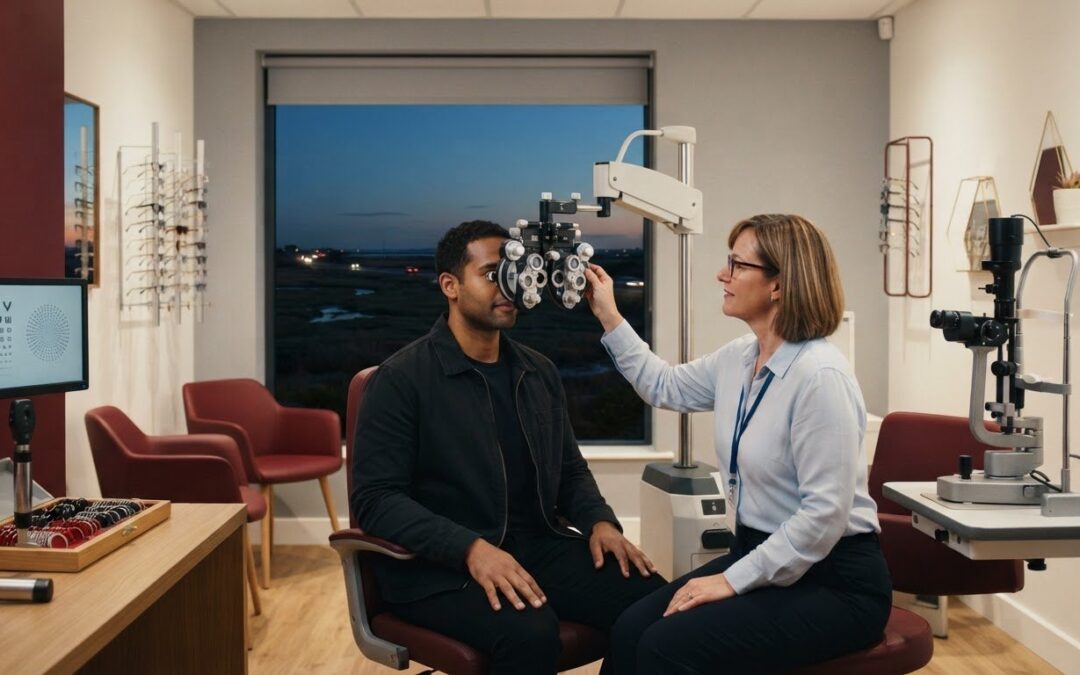
According to the RAC, 65% of motorists are regularly dazzled by oncoming vehicle headlights, turning routine journeys after dark into an exhausting ordeal. If you find yourself squinting through harsh glare across Canvey Way or straining to read road signs along unlit marsh routes, you’re certainly not alone. When facing mounting difficulty driving at night eye test Canvey Island motorists rely on just across the water in South Benfleet provides the clinical answers you need.
It’s easy to worry that struggling in low light is an inevitable sign of ageing or an immediate threat to your DVLA driving licence. In reality, nighttime visual distortion often stems from subtle, treatable optical changes rather than irreversible decline. In this guide, you’ll discover why modern LED headlights cause such debilitating reflections, what an optometrist checks during a thorough examination, and how targeted lens solutions can restore crisp clarity and complete peace of mind behind the wheel.
Key Takeaways
- Learn how low-light conditions along marshland roads trigger pupil dilation, exaggerating minor optical distortions and harsh glare from oncoming LED headlights.
- Discover why scheduling an assessment for difficulty driving at night eye test Canvey Island motorists rely on in nearby South Benfleet quickly uncovers subtle, treatable refractive shifts.
- Understand how targeted clinical checks evaluate visual contrast and acuity to ensure you comfortably meet DVLA legal driving standards.
- Explore the impact of specialised spectacle lenses and anti-reflective coatings engineered to eliminate headlight starbursts and ease night-time eye strain.
- See how an unhurried, independent practice established since 1989 helps you regain road confidence and protect your driving independence.
Why Driving at Night Feels Increasingly Challenging on Canvey Island Roads
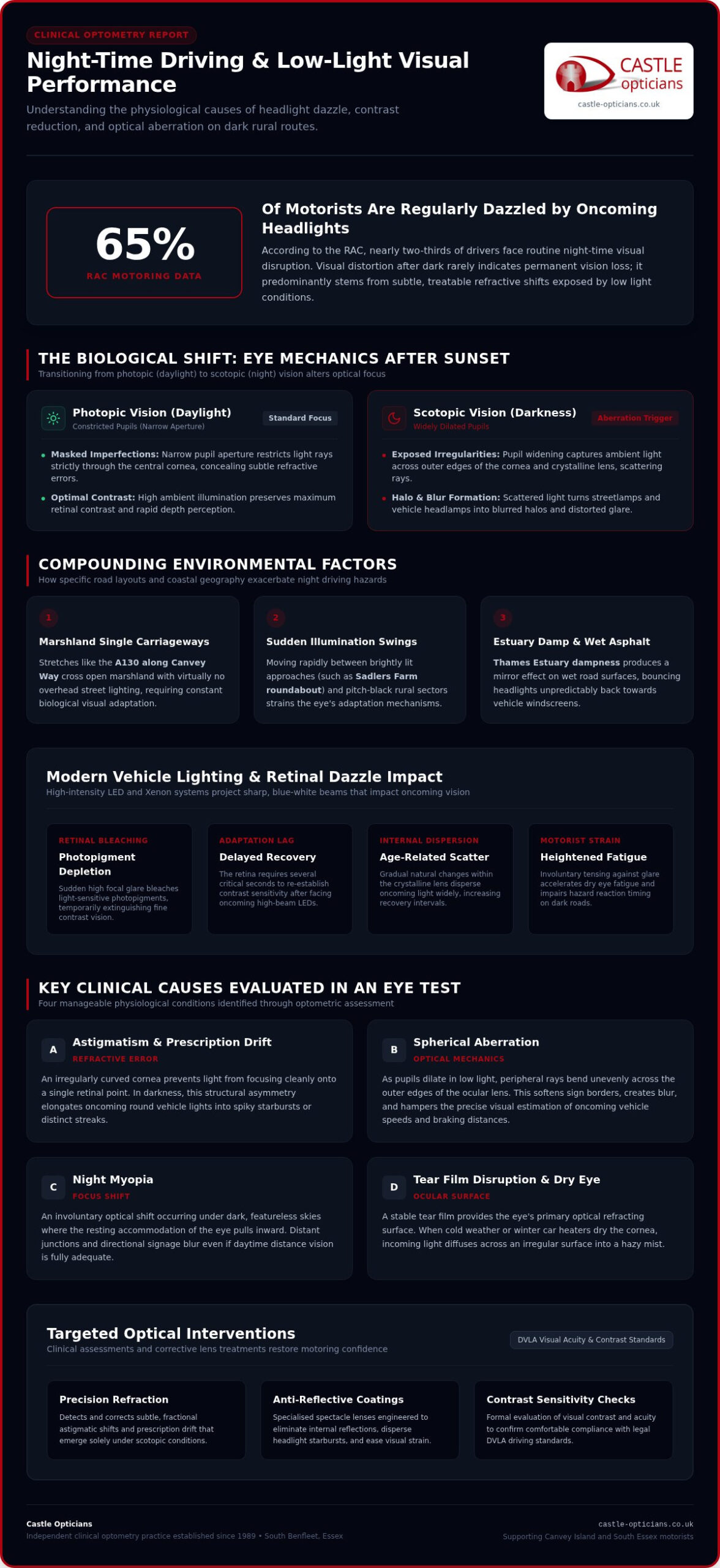
Steering through South Essex after sunset presents real physiological obstacles. Safe motoring relies on sharp contrast sensitivity and rapid depth perception. As daylight fades, the eye transitions from photopic to scotopic vision. In dark environments, biological night vision mechanisms force your pupils to dilate widely to capture ambient light. This natural widening exposes subtle imperfections across the outer edges of your cornea and crystalline lens, scattering rays and turning distant streetlamps into blurry halos.
When you struggle to read unlit directional signs or track road markings, investigating this difficulty driving at night eye test Canvey Island drivers choose nearby can determine whether uncorrected optical aberrations or early lens clouding are degrading your visual comfort.
The Impact of Canvey Island Geography on Night Vision
Local geography magnifies standard low-light driving difficulties. Commuters navigating the A130 along Canvey Way face long, single-carriageway stretches bordered by open marshland with virtually no overhead street lighting. In this sudden darkness, your eyes must continuously adapt between the brightly lit approaches of Sadlers Farm roundabout and pitch-black rural roads.
Thames Estuary dampness and damp road surfaces compound the problem. Moisture creates a mirror effect on the asphalt, bouncing light back towards your windscreen at unpredictable angles. Many commuters experience night myopia, an involuntary optical shift where the eye’s resting focus pulls inward under dark skies, rendering distant junctions blurry even if your daytime sight seems entirely adequate.
Modern Headlights and the Growing Problem of Oncoming Dazzle
Vehicle lighting technology has shifted dramatically. High-intensity LED and Xenon headlights project brilliant, blue-white beams that illuminate long distances for oncoming drivers but create intense visual dazzle for everyone else approaching from the opposite direction.
Sudden focal glare bleaches the light-sensitive photopigments in your retina. Because your pupils are already dilated to negotiate unlit marshes, recovery takes time:
- Delayed recovery: After facing high-beam LEDs, the retina requires several vital seconds to re-establish contrast sensitivity.
- Age-related scatter: Natural, gradual changes in the internal eye lens cause oncoming light to disperse widely across the retina, lengthening dazzle recovery.
- Heightened stress: Tensing up at oncoming traffic leads to dry, strained eyes and slower hazard reaction times.
If unlit estuary routes cause persistent anxiety, booking a comprehensive check for difficulty driving at night eye test Canvey Island motorists access in nearby South Benfleet ensures your eyes are thoroughly assessed and properly corrected for challenging winter conditions.
Underlying Causes of Night Driving Impairment Identified During an Eye Test
Struggling to see after sunset rarely signals sudden, untreatable vision loss. More often, it points to manageable physiological adjustments within the eye. In bright daylight, minor refractive inaccuracies stay hidden behind constricted pupils. Once lighting levels plummet, optical mechanics change, exposing subtle prescription drifts or health changes that demand professional evaluation.
Refractive Errors: Astigmatism and Prescription Drift
Even a fractional shift in your prescription can dramatically compromise low-light motoring. Uncorrected astigmatism, caused by an irregularly curved cornea, prevents light from focusing cleanly onto a single point on the retina. At night, this structural asymmetry turns round headlights and taillights into elongated streaks or spiky starbursts.
As pupils dilate in darkness, peripheral light rays bend unevenly across the lens. This optical phenomenon, known as spherical aberration, softens edges and distorts depth perception. Gauging the speed and braking distance of approaching vehicles becomes guesswork, turning everyday journeys into high-anxiety manoeuvres.
Ocular Health Changes: Cataracts, Glaucoma, and Dry Eye
Beyond refractive shifts, subtle health developments directly influence nighttime sight. A stable tear film provides the eye’s primary focusing surface; when winter car heaters dry the cornea, light entering the eye diffuses into a hazy mist.
Gradual physical changes deeper in the eye also reduce visual comfort:
- Early cataracts: Natural proteins in the crystalline lens slowly clump together, scattering oncoming light rather than focusing it cleanly onto the retina.
- Glaucoma progression: Elevated intraocular pressure can subtly erode peripheral vision long before central sight shows defects, narrowing your awareness of unlit verges or pedestrians.
Meeting the UK’s official driving eyesight rules requires maintaining a visual acuity of at least 6/12 on the Snellen scale alongside an adequate field of view. An unhurried eye health check in Essex identifies these asymptomatic changes long before they risk your motoring independence.
If you are experiencing mounting difficulty driving at night eye test Canvey Island drivers book at an experienced independent clinic like Castle Opticians quickly separates simple prescription drift from underlying ocular health conditions.
What to Expect from a Night Driving Eye Test Near Canvey Island
Visiting an independent optometrist to address evening motoring worries isn’t an intimidating ordeal. A targeted assessment is designed to listen to your personal driving habits, recreate low-light optical demands, and evaluate how your eyes cope outside daylight hours. Rather than rushing through basic letter charts, your consultation begins with an unhurried conversation about the precise road sections where you experience fatigue, halos, or reduced confidence.
When you book an appointment for difficulty driving at night eye test Canvey Island motorists choose across Canvey Way, the focus centres on isolating low-light visual disruption before suggesting bespoke corrective options.
Key Diagnostic Stages for Night Driving Evaluations
Pinpointing nighttime visual strain requires targeted clinical steps. Your practitioner examines internal and external ocular structures using precise instrumentation to track how light travels through your visual pathway:
- Low-illumination refraction: Assessing visual acuity under reduced ambient room lighting to gauge how pupil dilation impacts your prescription.
- Corneal mapping: Checking corneal curvature to identify minor irregularities that create starbursts around headlights.
- Slit-lamp biomicroscopy: Evaluating the clarity of the ocular media, ensuring the natural lens and cornea remain completely transparent.
- Digital retinal imaging: Capturing clear, high-resolution views of the retina and optic nerve head to confirm overall circulatory health.
To understand how these advanced stages integrate into a full clinical visit, explore what happens during a comprehensive eye test in Essex.
Assessing Contrast Sensitivity and Legal Road Standards
Clear night motoring demands more than standard 20-metre distance reading. Your optometrist checks contrast sensitivity, measuring how effectively you distinguish subtle grey shapes against pitch-black backgrounds. This capability determines whether you can spot an unlit cyclist, a dark kerb, or road debris early enough to stop smoothly.
Crucially, the assessment verifies that your binocular vision comfortably surpasses the DVLA legal benchmark of 6/12 acuity on the Snellen chart. If you’re aged 70 or over and completing your three-yearly licence renewal declaration, these findings give you full confidence in your self-certification. Should minor prescription changes or early media haziness emerge, your optometrist outlines a clear, calm management plan to keep your driving relaxed and secure.
Resolving ongoing difficulty driving at night eye test Canvey Island residents schedule at an established, patient-first clinic brings complete clarity to your everyday journeys.
Corrective Solutions: Specialised Lenses and Anti-Reflective Coatings
Wearing the correct spectacle lenses can transform evening travel from a tense, exhausting ordeal into a relaxed journey. Advanced optical designs do far more than sharpen central focus; they widen your field of view and manage how artificial illumination enters the eye. If you’ve noticed mounting difficulty driving at night eye test Canvey Island motorists attend in neighbouring South Benfleet often reveals that modern lens finishes provide immediate relief.
The Science of Anti-Reflective and Anti-Glare Lens Coatings
Standard, untreated plastic lenses reflect up to twelve per cent of incoming light directly off their front and back surfaces. In low-light environments, these stray rays create disorienting ghost images of headlights and streetlights across your spectacles.
Modern multi-layer anti-reflective coatings eliminate these distracting reflections, permitting over ninety-nine per cent of available light to pass cleanly through to your retina. High-quality lens packages incorporate hydrophobic and oleophobic layers. These smooth finishes resist rainwater droplets and fingerprint smudges, preventing greasy smears from scattering evening beams across your line of sight. You can explore these optical treatments in depth through our comprehensive prescription lenses guide.
Comparing Everyday Spectacles with Dedicated Driving Eyewear
While standard single-vision spectacles resolve daytime blur, they frequently struggle under modern motoring conditions. Purpose-designed driving lenses feature specialised filters that dampen the harsh blue wavelengths emitted by modern LED headlights, easing visual glare while keeping dark road verges crisp.
Key differences between standard eyewear and dedicated driving solutions include:
- No hazardous tints: Over-the-counter yellow night-driving glasses are discouraged by eye care professionals because tinting dims critical light transmission, masking roadside hazards.
- Optimised varifocal corridors: Tailored varifocal designs offer wider distance and intermediate viewing zones, preventing edge distortion when checking wing mirrors or looking down at your speedometer.
- Precise optical centration: Professional dispensing ensures your lens centres sit perfectly aligned with your pupils, eliminating unnecessary eye strain during long evening commutes.
Finding the right combination of frame fitting and anti-glare technology restores lasting confidence behind the wheel. To explore personalised options suited to your evening journeys, schedule a consultation with Castle Opticians in South Benfleet.
Booking Your Night Driving Assessment with Castle Opticians
Safeguarding your motoring independence begins with choosing a clinical team that takes time to listen. Rather than enduring conveyor-belt testing or high-pressure retail environments, South Essex motorists benefit from an independent approach centred entirely on individual clinical care. For those facing unresolved difficulty driving at night eye test Canvey Island residents seek just minutes away across Canvey Way provides dedicated diagnostics alongside practical, tailored advice.
Why Canvey Island Residents Choose Castle Opticians in South Benfleet
Castle Opticians has served motorists across South Essex independently since 1989. While based just off the island, our South Benfleet practice sits directly across the bridge, offering straightforward accessibility for Canvey drivers seeking thorough NHS and private eye examinations. We also maintain a sister practice in Rayleigh, ensuring flexible community-based access across the wider district.
Opting for an established independent practice guarantees distinct clinical benefits:
- Unhurried consultations: Optometrists dedicate generous appointment times to investigate subtle low-light complaints without rushing you through basic checks.
- Clinical continuity: You build an ongoing relationship with familiar optometrists who track your ocular health patterns year after year.
- Bespoke optical dispensing: Our qualified dispensing staff take precise facial measurements to guarantee your frames sit securely, ensuring anti-reflective lens zones align exactly with your eyes and vehicle controls.
Simple Steps to Prepare for Your Driving Eye Examination
Arriving prepared helps your optometrist get straight to the heart of your visual concerns. A few straightforward preparations ensure your assessment covers every relevant scenario:
- Current eyewear: Bring all pairs of spectacles you currently use behind the wheel, including distance glasses, varifocals, and prescription sunglasses.
- Medication records: Bring an up-to-date list of prescription medications, as certain general health treatments can subtly influence tear production or pupil dilation.
- Journey notes: Note specific driving situations that feel particularly demanding, such as judging exit distances at unlit junctions or recovering focus after meeting Xenon headlights.
No driver should have to curtail evening social plans or endure anxious commutes. If you are experiencing ongoing difficulty driving at night eye test Canvey Island motorists trust at nearby Castle Opticians in South Benfleet provides the clinical precision and reassuring guidance needed to keep you driving safely and comfortably.
Restore Your Clarity and Confidence on the Road Tonight
Navigating dark roads under the glare of harsh oncoming headlights doesn’t have to be a source of constant dread. Struggling with reduced contrast or haloing around streetlights isn’t an inevitable consequence of getting older, nor does it mean your driving days are numbered. In most cases, these challenges reflect treatable refractive shifts and natural ocular changes that modern lens technology can comfortably resolve.
When you encounter mounting difficulty driving at night eye test Canvey Island drivers rely on just minutes away across Canvey Way delivers the clinical reassurance you deserve. Since 1989, Castle Opticians has provided South Essex motorists with unhurried NHS and private eye examinations backed by thoughtful, independent care. Take the first step towards relaxed, safe evening journeys today. Book your night driving eye assessment at Castle Opticians and rediscover clear, comfortable vision behind the wheel.
Frequently Asked Questions
Can an eye test help with difficulty driving at night on Canvey Island?
Yes, an eye test pinpoints the precise optical reasons why night vision deteriorates and identifies suitable solutions. When facing difficulty driving at night eye test Canvey Island motorists book at nearby Castle Opticians in South Benfleet uncovers whether minor prescription shifts, night myopia, or early lens changes cause low-light blur. Once identified, optometrists prescribe targeted lens corrections with anti-reflective finishes to restore confidence on dark local routes.
What causes halos and starbursts around oncoming headlights at night?
Halos and starbursts typically occur when light refracts unevenly through an imperfect cornea or crystalline lens. When your pupils dilate in darkness, uncorrected astigmatism or microscopic spherical aberrations scatter oncoming beams rather than focusing them sharply onto the retina. Early cataract development and ocular surface dryness can also disperse bright LED light across your field of view, creating prominent rings and flares.
Is yellow-tinted driving eyewear safe for nighttime motoring in the UK?
No, optical professionals strongly advise against using yellow-tinted glasses for night driving. While yellow tints can increase perceived contrast, they inevitably reduce overall light transmission reaching your eyes in already dim conditions. This light reduction can dangerously obscure pedestrians, unlit road verges, or cyclists. Modern clear prescription lenses equipped with advanced anti-reflective coatings offer a far safer, proven way to curb oncoming glare.
How often should South Essex drivers have their vision clinically tested?
Drivers should book an eye examination at least once every two years, or sooner if visual changes arise. Motorists aged 70 and over must legally renew their driving licence every three years, making regular checks essential for self-certifying DVLA fitness. If you notice sudden glare sensitivity or worsening night vision, arrange an assessment promptly rather than waiting for your routine renewal reminder.
What is the DVLA legal eyesight requirement for driving a car at night?
The DVLA requires car drivers to read a post-2001 vehicle number plate from a distance of 20 metres, wearing glasses or contacts if necessary. You must also achieve visual acuity of at least 6/12 (0.5 decimal) on the Snellen scale using both eyes together and possess an adequate visual field. These legal thresholds remain identical whether you are driving in daylight or after dark.
Will I need separate pairs of glasses for daytime and nighttime driving?
Not necessarily, as most motorists can use a single pair of spectacles for all motoring conditions. A high-quality everyday prescription fitted with premium anti-reflective coatings handles both bright daylight and low-light glare effectively. However, drivers with night myopia or high sensitivity to LED beams may choose a dedicated pair of driving lenses optimised specifically for nighttime contrast and dashboard focus.
Does an NHS-funded eye examination cover night driving vision difficulties?
Yes, an NHS-funded examination thoroughly investigates any driving vision symptoms if you qualify for NHS care. During an NHS assessment for difficulty driving at night eye test Canvey Island patients attend at Castle Opticians in South Benfleet, the optometrist checks your visual acuity and internal eye health. While NHS vouchers cover standard sight correction, optional specialist driving coatings or tailored lens upgrades can be chosen privately.