

Your glasses prescription isn’t just a receipt for a purchase; it’s a clinical map of how you see the world. However, for many people across South Essex, staring at a grid of SPH, CYL, and AXIS values feels more like deciphering a secret code than reading a medical document. If you’ve ever left an eye test feeling slightly overwhelmed by technical jargon, you aren’t alone. Truly understanding your glasses prescription UK standards is the first step toward taking control of your ocular health and ensuring you receive the precise level of care you need.
It’s natural to feel a sense of anxiety when those numbers change or to wonder if a recommended lens feature is a clinical necessity or an optional extra. We agree that you deserve total transparency when it comes to your vision. This guide will unlock the meaning behind every symbol on your form, from the plus and minus signs to the legal validity dates of the document itself. You’ll gain the confidence to discuss lens options with your optician and understand your rights as a patient. By the end, you’ll have the knowledge to make informed choices that prioritise your long-term sight and comfort.
Key Takeaways
- Discover how to decode the technical grid of SPH, CYL, and AXIS values to understand exactly how your vision is being corrected.
- Learn why understanding your glasses prescription UK regulations is essential for managing your ocular health and knowing your legal rights as a patient.
- Gain insights into how your specific numbers influence lens thickness and why choosing the correct “Lens Index” is vital for your comfort.
- Distinguish between NHS GOS forms and private prescriptions to navigate the UK eye care system with complete confidence.
- Understand the importance of professional face-to-face measurements, such as Pupillary Distance, which ensure your new frames perform exactly as intended.
What is a Glasses Prescription and Why is it Important?
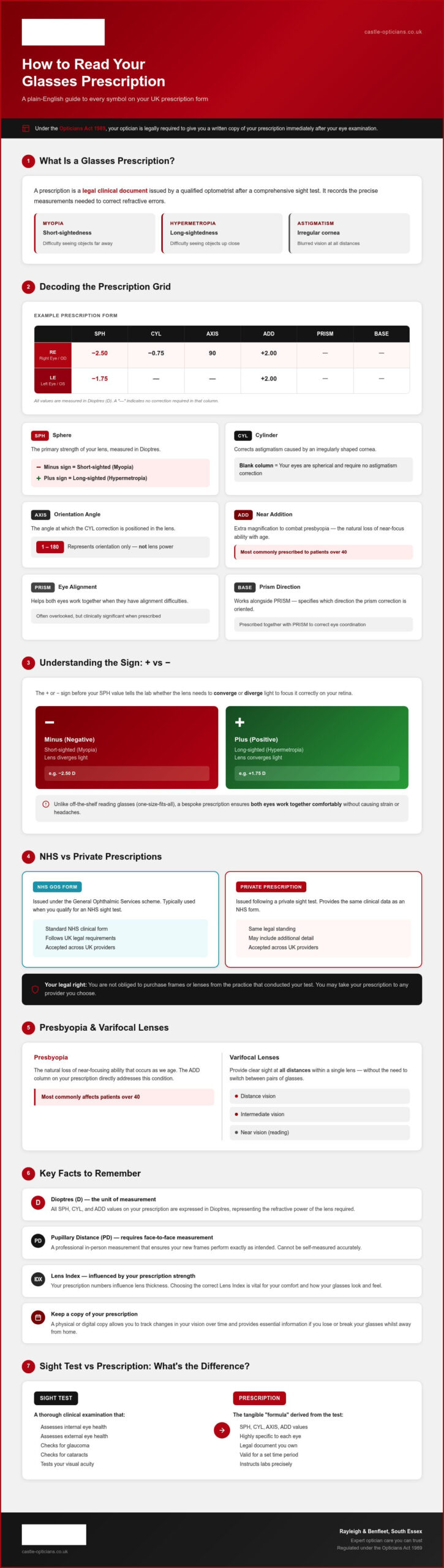
At its core, a glasses prescription is a legal document issued by a qualified optometrist following a comprehensive sight test. It provides the precise measurements required to correct refractive errors, such as myopia (short-sightedness) or hypermetropia (long-sightedness). In the United Kingdom, this isn’t just a courtesy; the Opticians Act 1989 mandates that your optician must provide you with a written copy of your prescription immediately after your examination. Truly understanding your glasses prescription UK requirements ensures you’re treated as a patient first and a customer second. Essentially, a prescription is a clinical record of your visual correction needs as of a specific date.
The Difference Between a Sight Test and a Prescription
Many people use these terms interchangeably, but they represent different stages of your eye care journey. A sight test is a thorough clinical examination. It assesses the internal and external health of your eyes, checking for conditions like glaucoma or cataracts, alongside testing your vision. The prescription is the tangible “formula” derived from these findings. It uses specific eyeglass prescription terminology to tell a lab exactly how to craft your lenses. Because your eyes are unique, these numbers are highly specific. Unlike off-the-shelf reading glasses, which use a “one-size-fits-all” approach, a bespoke prescription ensures both eyes work together comfortably without causing strain or headaches.
Your Legal Rights as a Patient in the UK
Gaining a clear sense of your ocular needs empowers you as a consumer. Once your test is complete, you have the legal right to take that document to any provider you choose. You aren’t under any obligation to purchase frames or lenses from the practice that conducted the test. While we pride ourselves on the personalised care offered at Castle Opticians in Rayleigh and Benfleet, we believe every patient should feel in control of their choices. Understanding your glasses prescription UK standards helps you navigate these options with confidence. Keeping a physical or digital copy of your prescription is vital for your records. It allows you to track changes in your vision over time and ensures you have the necessary information if you lose or break your glasses whilst away from home.
Decoding the Grid: SPH, CYL, AXIS, and ADD Explained
Understanding your glasses prescription UK standards often starts with looking at the technical grid your optometrist hands you. This table usually features rows for your Right eye (often marked as RE or OD) and your Left eye (LE or OS). The numbers within these rows are measured in Dioptres (D), which signify the refractive power of the lens required for your vision. The “+” or “-” sign before the number is the most critical part of the data, as it tells the lab whether the lens needs to converge or diverge light to focus it correctly on your retina.
These values combine to create a bespoke lens profile that is entirely unique to your eyes. Whilst high-street chains might provide the numbers, our team in Rayleigh and Benfleet takes the time to explain how each one affects your daily life. This level of detail ensures you feel confident in your choice of frames and lens technology.
Sphere (SPH) and Cylinder (CYL)
The SPH column indicates the primary strength of your lens. A minus sign (-) means you’re short-sighted (myopia), whilst a plus sign (+) means you’re long-sighted (hypermetropia). If you have an irregularly shaped cornea, the CYL column will contain a value to correct this astigmatism. If this column is blank, it simply means your eyes are spherical and don’t require that specific correction. Following the College of Optometrists clinical guidelines, these measurements must be precise to ensure your lenses provide the sharpest possible image.
Axis and Near Addition (ADD)
The Axis is a number between 1 and 180. It doesn’t represent power, but rather the orientation or angle at which the CYL correction sits. For patients over 40, the ADD column becomes particularly important. This represents the extra magnification needed to combat presbyopia, which is the natural loss of near-focusing ability as we age. Depending on the strength of this addition, you might find that varifocal lenses Essex specialists provide are the most convenient way to enjoy clear sight at all distances without constantly switching frames.
Prism and Base: Correcting Eye Alignment
One area often overlooked in standard guides is the Prism and Base columns. These are prescribed to help the eyes work together as a team, especially if you’ve experienced ghosting or double vision. The Prism value indicates the displacement needed, whilst the Base (In, Out, Up, or Down) tells us the direction light must be shifted. Because Prism correction is highly sensitive, it requires the precise, expert fitting that independent opticians specialise in. If you’re unsure about your current numbers, you can always book an eye test with our friendly local experts to ensure your prescription is perfectly up to date.
NHS vs Private Prescriptions: Understanding the UK System
In the United Kingdom, the way your optical data is recorded depends on whether you qualify for state-funded care. The NHS uses General Optical Services (GOS) forms, which are multi-functional documents. They act as a clinical record of your vision and a formal claim for funding. If you don’t qualify for NHS support, you’ll receive a private prescription instead. Whilst the layout of the paperwork might look different, the vision data is clinically identical. Whether you’re paying privately or using an NHS voucher, the SPH and CYL values remain the same. Understanding your glasses prescription UK paperwork helps you recognise which system you’re in and what benefits you can access. You can check your eligibility for an NHS eye test Rayleigh by visiting our local practice, where our team can guide you through the latest criteria for free examinations.
The distinction between the two systems is purely administrative. A private prescription doesn’t mean the test was more thorough, nor does an NHS prescription imply a “basic” service. At Castle Opticians, every patient receives the same level of unhurried, expert care from our qualified optometrists. We believe that professional standards should never vary, regardless of how the examination is funded.
NHS Optical Vouchers and Supplements
NHS optical vouchers are categorised from A to H. Each letter represents a specific monetary value based on the strength and complexity of the lenses you require. For example, a higher prescription typically triggers a higher voucher value to help cover the cost of specialised lens materials. There are also supplements available for specific clinical needs, such as complex lenses or medically necessary tints. As an independent practice, we take the time to organise these NHS claims on your behalf. We ensure the process is seamless, so you can focus on choosing the frames that suit your style whilst we handle the technical paperwork with the health authority.
Prescription Validity and Re-test Dates
A common point of confusion is how long a prescription remains legally valid. For most adults in the UK, a prescription is valid for two years. However, this is a clinical recommendation rather than a rigid rule for everyone. If your optometrist identifies a specific health reason, such as the presence of diabetes or glaucoma, they may set the re-test date at one year to monitor your eye health more closely. It’s vital to respect these expiry dates. Using an out-of-date prescription to buy glasses, especially from online retailers, is a significant risk. Your vision can change subtly over twelve months, and using an old “formula” can lead to headaches, eye strain, or poor focus. Our unhurried consultations ensure that your re-test date is based strictly on your personal ocular health needs.
How Your Prescription Influences Your Choice of Lenses
The numbers on your document don’t just determine how well you see; they dictate the physical characteristics of your eyewear. If you have higher SPH or CYL values, your lenses will naturally be thicker and heavier if produced using standard materials. This is where understanding your glasses prescription UK standards becomes practical. It allows you to anticipate the weight and aesthetic of your finished spectacles before you even pick a frame. At our Rayleigh and Benfleet branches, we guide you through these choices to ensure your glasses are as comfortable as they are clear.
For those with high ADD values, the transition between near and far vision needs to be smooth. Patients in this category often benefit from specialised lenses in Benfleet that use digital surfacing to widen the field of view. However, the lens material is only half the story. Your frame choice is equally vital. A large frame with a high minus prescription will result in thick, visible edges, whilst a smaller, more rounded shape can significantly reduce this effect through better centration. We take the time to match your prescription to a frame that complements both your face and your lens profile.
Index Matching for High Prescriptions
The “Lens Index” is a measurement of how efficiently a material bends light. A higher index means the material is more efficient, allowing the lens to be thinner and lighter. We generally recommend a 1.6 index lens for prescriptions over +/- 3.00 to keep the profile sleek. Once you reach +/- 5.00, moving to a 1.67 or 1.74 index becomes essential for both aesthetics and all-day comfort. Reducing “lens bulge” and weight prevents the glasses from slipping down your nose and eliminates the “bottle-top” look. Aspheric lenses can further thin the profile for farsighted patients by using a flatter curvature that reduces magnification of the eyes.
Coatings and Enhancements
High-index lenses are more reflective than standard plastic, making Anti-reflective (AR) coatings a necessity rather than an optional extra. These coatings allow more light to pass through the lens, reducing distracting reflections and improving the clarity of your vision, especially whilst driving at night. We also offer blue light filters, which can be beneficial if your lifestyle involves heavy screen use, as they help reduce digital eye strain. Finally, scratch-resistant treatments are a wise investment to protect your precision optics from daily wear. If you’re ready to find the perfect match for your vision, book a consultation with our expert dispensing team today.
Why Expert Interpretation at Castle Opticians Matters
Having the document is one thing, but interpreting it correctly is where the real value lies. An independent optician takes the time to explain the clinical reasoning behind each value. We believe that understanding your glasses prescription UK requirements shouldn’t be a solo effort. It’s a collaborative process where we match the data to your specific lifestyle, whether that involves intensive computer work, long-distance driving, or intricate hobbies. We don’t just see numbers; we see how those numbers affect your daily comfort and clarity.
Since 1989, our group has prioritised long-term relationships over quick transactions. Visiting our Rayleigh or Benfleet branches means you’ll often see the same familiar face. This continuity allows us to track your visual health over decades, offering a level of personal consideration that corporate entities struggle to replicate. It’s the difference between being a patient and being a customer. We take pride in being a seasoned professional you can trust for honest, unhurried advice.
The Importance of Accurate Measurements
Precision dispensing is what sets a professional consultation apart. Key measurements like Pupillary Distance (PD) and Seg Heights are vital for the performance of spectacle frames Rayleigh residents select. If these aren’t measured by a qualified professional, the optical centre of the lens won’t align with your pupil. This misalignment often results in distorted vision or persistent headaches. This level of technical accuracy is a fundamental part of understanding your glasses prescription UK protocols and ensuring your eyewear works as intended. We use our expertise to ensure every pair of glasses is perfectly centred for your unique facial anatomy.
Book Your Next Consultation in Essex
If your current prescription is nearing its expiry or you simply want a second opinion on your lens options, we’re here to help. Our unhurried approach ensures you leave with total clarity about your ocular health. Whether you have a prescription from another optician or need a fresh examination, our doors are open. We invite you to visit our Rayleigh or South Benfleet branches for a warm, professional chat about your vision needs. Book your comprehensive eye test at Castle Opticians today and experience the difference that local, independent expertise makes to your sight.
Take Control of Your Vision Today
Deciphering the grid of numbers on your optical form is the first step toward better eye health. By learning to decode values like SPH and CYL, you can better appreciate how your lenses correct your unique sight profile. We’ve explored your legal rights under the Opticians Act and the vital role that precise, face-to-face measurements play in your daily comfort. Truly understanding your glasses prescription UK standards ensures you never feel overwhelmed by technical jargon or uncertain about your lens choices again.
At Castle Opticians, we’ve been serving the South Essex community as independent eyecare specialists since 1989. Whether you’re an NHS or private patient, our qualified optometrists in Rayleigh and Benfleet are here to provide unhurried, expert advice. We specialise in expertly fitted varifocals and high-index lenses that match your lifestyle perfectly. If you’re ready for a personalised consultation that prioritises your care over corporate targets, we invite you to visit us soon. Book Your Comprehensive Eye Test at Castle Opticians today to ensure your vision remains sharp and comfortable. We look forward to welcoming you into our practice and helping you see the world with complete clarity.
Frequently Asked Questions
How long is a glasses prescription valid in the UK?
Most glasses prescriptions in the United Kingdom are valid for two years. However, your optometrist might recommend a re-test every year if you have specific clinical needs, such as diabetes or a family history of glaucoma. It’s essential to check the expiry date on your document before ordering new lenses. Staying up to date ensures your ocular health is monitored and your vision correction remains accurate for your daily activities in Rayleigh.
Can I use my glasses prescription to buy contact lenses?
You cannot use a standard glasses prescription to purchase contact lenses. A contact lens fitting requires additional measurements, such as the base curve and diameter of your cornea, which aren’t included on a spectacle form. Because contact lenses sit directly on your eye, the power often differs from your glasses. If you’re interested in contact lenses, our Benfleet and Rayleigh teams can provide a separate assessment to ensure a safe and comfortable fit.
What does “Plano” or “Infinity” mean on my prescription?
“Plano” (or sometimes “0.00” or “Infinity”) indicates that you don’t require any vision correction for that specific part of your prescription. It means the eye has no refractive error in that category. For example, if your SPH is Plano but you have a CYL value, you only need correction for astigmatism. Our independent experts in Rayleigh often see this in patients who only require help with one eye or a specific visual distance.
What is Pupillary Distance (PD) and why is it not on my prescription?
Pupillary Distance (PD) is the measurement of the space between your pupils. In the UK, this is considered a dispensing measurement rather than a clinical part of your prescription. Whilst understanding your glasses prescription UK rules helps you know your vision needs, the PD is usually measured when you select frames. This ensures the lenses are perfectly centred. At Castle Opticians, we take this measurement face-to-face to guarantee the highest level of visual precision.
My prescription has a “DS” after the SPH-what does this mean?
The abbreviation “DS” stands for “Dioptre Sphere”. If this appears in the CYL column of your prescription, it simply means you don’t have astigmatism in that eye. It confirms that the eye’s refractive error is purely spherical. This is a common term our optometrists explain during consultations in South Benfleet. It provides peace of mind that your lens requirement is straightforward, needing only the primary SPH power for clear focus.
Can I use an old prescription if my vision feels the same?
It’s unwise to use an expired prescription, even if you feel your vision hasn’t changed. A comprehensive eye test at our South Essex practices does more than just update your numbers; it’s a vital health check for conditions like hypertension and retinal changes. Using an old “formula” can lead to unnecessary eye strain or headaches. We recommend sticking to the re-test date provided by your optometrist to maintain optimal ocular health and comfort.
What happens if my prescription is wrong?
If you feel your new vision correction isn’t quite right, we recommend visiting us for a re-check. Sometimes your brain needs a short adaptation period, especially with new varifocal lenses. However, if discomfort persists, our Rayleigh and Benfleet teams will verify the measurements and lens accuracy. As a trusted local expert since 1989, we’re committed to ensuring every pair of glasses we dispense provides the clear, comfortable vision you deserve.
Is an NHS eye test prescription different from a private one?
Clinically, there’s no difference between an NHS eye test prescription and a private one. Both documents provide the same essential data required to craft your lenses. The main difference is administrative; the NHS uses GOS forms which also function as a claim for state funding. Whether you’re an NHS or private patient at Castle Opticians, you’ll receive the same thorough examination and expert interpretation of your results from our qualified clinical team.