
Did you know that nearly 80% of the two million people living with sight loss in the UK are aged 65 or older? It’s a startling statistic, particularly when you consider that much of this vision impairment is preventable through regular, professional screening. If you’re looking for an eye test over 60 Essex provides several choices, yet it’s common to feel confused about NHS entitlements or a bit anxious about the clinical environment. We understand that your eyesight is the key to your independence, whether that’s driving to see friends or simply enjoying a favourite book.
This article explains exactly what you’re entitled to under the NHS and how to prepare for your appointment so you feel looked after. We’ll cover the clinical checklist, the benefits of advanced screening, and how to find a local expert you can rely on for years to come. Our goal is to ensure you feel confident, prepared, and fully informed about protecting your vision in later life.
Key Takeaways
- Understand your eligibility for a free NHS sight test, which is available to everyone over 60 to ensure your vision remains protected.
- Learn how to prepare for your appointment by organising your current spectacles and noting any medications for a more thorough clinical review.
- Discover why an eye test over 60 Essex residents book is a vital health screening for conditions like glaucoma and cataracts, rather than just a prescription update.
- Gain insight into how the natural ageing process affects your eyes and why clear vision doesn’t always mean your eyes are perfectly healthy.
- See why choosing an independent local optician offers the extra time and personal attention required for a comprehensive and comfortable examination.
Why Your Eye Health Changes After 60
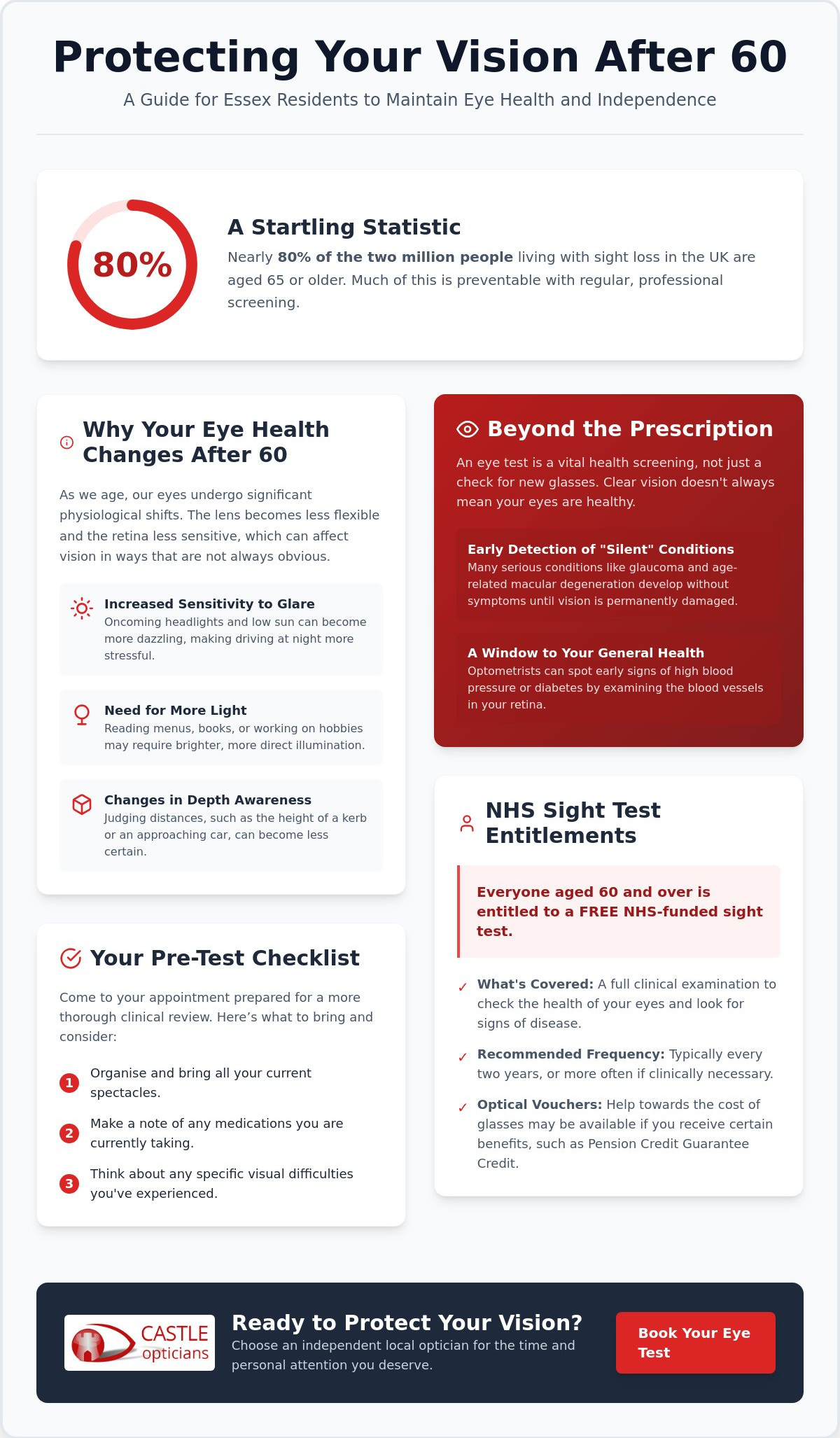
As we reach our sixties, the eyes undergo subtle but significant physiological shifts. The crystalline lens, which was once flexible and clear, begins to stiffen and yellow. This process often leads to age-related farsightedness, making close-up tasks like reading or sewing much more challenging. Meanwhile, the retina at the back of the eye becomes less sensitive to light. You might find yourself reaching for a brighter lamp more often than you used to, or finding it harder to see clearly in dimly lit restaurants.
It is a common misconception that if you can still read a car number plate or the fine print in a newspaper, your eyes are perfectly healthy. Vision is just one part of the story. An eye test over 60 Essex residents attend is designed to look beneath the surface. Many serious conditions, such as glaucoma or age-related macular degeneration, don’t affect your central vision until they are quite advanced. By the time you notice a change in how you see, permanent damage may have already occurred.
Your ocular health is also a window into your general wellbeing. Optometrists often spot early signs of high blood pressure or diabetes during a routine check by examining the delicate blood vessels in the retina. In a county like Essex, where many of us rely on our cars to navigate rural villages or commute along the A127 and A13, maintaining sharp, healthy vision is vital for road safety. Protecting your eyesight isn’t just about a new pair of spectacles; it’s about preserving your ability to drive confidently and live independently for as long as possible.
Common Visual Changes to Expect
Living in Essex often means dealing with varied driving conditions, from bright coastal light to dark country lanes. You may notice specific changes in your visual behaviour:
- Increased sensitivity to glare: Oncoming headlights or low winter sun can feel much more dazzling, making night driving on unlit roads feel more stressful.
- The need for more light: Tasks that once felt easy, such as reading a menu or working on a hobby, now require direct, bright illumination to see detail clearly.
- Changes in depth awareness: Judging the height of a kerb or the distance of an approaching vehicle can become less certain as your depth perception shifts.
The Importance of Early Detection
Many age-related eye conditions are “silent,” meaning they develop without pain or obvious symptoms. Modern diagnostic technology allows us to see microscopic changes in the eye’s structure long before they impact your daily life. Your optometrist acts as a primary health gatekeeper, identifying potential issues when they are at their most manageable. Booking a regular eye test over 60 Essex ensures that these hidden changes are monitored, providing peace of mind that your vision is being looked after by a professional who understands your history.
NHS Sight Test Entitlements for Essex Residents Over 60
Reaching sixty brings many changes, but one of the most positive is the increased support available for your health. In the UK, the government acknowledges that our eyes require more frequent and detailed care as we age. This is why NHS sight test entitlements include everyone aged 60 and over, regardless of their financial background or current vision quality.
The NHS fee covers the cost of a thorough clinical examination. This isn’t just about finding out if you need new spectacles; it’s a vital health check. While the clinical side is covered, the cost of frames or lenses is generally a private matter. However, some residents may qualify for optical vouchers. These are typically available to those receiving Pension Credit Guarantee Credit or those on a low income who qualify for the NHS Low Income Scheme. If you’re unsure about your status, our team is always happy to help you book your next clinical appointment and explain the latest guidance.
Standard practice suggests an eye test over 60 Essex residents should take place every two years. This interval allows your optometrist to track small changes in your ocular health over time. If you have specific medical conditions, this timeframe might be shortened to ensure you’re receiving the right level of care.
How to Claim Your Free NHS Eye Test
Accessing your entitlement is a straightforward process designed to be as stress-free as possible. You don’t need a referral from your GP; you simply need to follow these steps:
- Step 1: Locate an NHS-registered optician in your local area, such as our welcoming practices in Rayleigh or South Benfleet.
- Step 2: Mention your age and NHS eligibility whilst booking your appointment over the phone or in person.
- Step 3: Bring proof of your age, such as a driving licence or passport, or any relevant health cards to your appointment.
- Step 4: Complete the GOS1 application form provided at the practice. This is a simple document that confirms your eligibility to the NHS.
When You Might Need More Frequent Tests
While the two-year rule is standard, clinical necessity often dictates a more regular schedule. Your optometrist will advise you if an annual check is more appropriate for your circumstances. Common reasons for more frequent monitoring include:
- Family history: If you have a close relative with glaucoma, regular screening is essential for early detection.
- Diabetes: Residents living with diabetes require annual checks to monitor for diabetic retinopathy, a condition that can affect the blood vessels in the retina. Understanding the full scope of an eye test for diabetics in Essex can help you see why a comprehensive examination works alongside NHS diabetic screening to protect your sight.
- Sudden changes: If you notice new floaters, flashes of light, or a sudden blur in your vision, don’t wait for your next scheduled appointment.
The Ultimate Pre-Test Checklist: How to Prepare
Preparing for your clinical examination is the most effective way to ensure you receive the highest standard of care. While our optometrists use advanced technology to assess your ocular health, the personal details you provide offer the essential context we need. When you attend an eye test over 60 Essex experts recommend arriving with a clear picture of your recent visual history and daily requirements. It’s not just about reading letters on a chart; it’s about how you interact with the world around you.
Start by organising your current eyewear. It is incredibly helpful if you bring every pair of spectacles you use, including those for reading, distance, and computer work. We often find that patients have different prescriptions for different tasks, and seeing how you currently use your lenses allows us to make more precise adjustments. If you’re new to our practice, bringing your most recent prescription helps us track any subtle changes that have occurred since your last visit.
Your general health plays a significant role in your vision. Compile a simple list of any medications or supplements you take regularly. Conditions such as diabetes or high blood pressure can have a direct impact on your retinas, and some treatments may cause side effects like dry eyes or light sensitivity. Being aware of your full medical background ensures your clinical review is as thorough as possible. It’s also a good time to double-check your NHS sight test entitlements so you feel confident about the administrative side of your visit.
Finally, consider your lifestyle and any specific symptoms you’ve noticed. Have you struggled with glare whilst driving on Essex roads, or do you find your eyes tire quickly when sewing or reading? Whether you enjoy a round of golf or spend hours on a digital tablet, your favourite hobbies dictate your visual needs. Documenting when symptoms occur and what activities they affect helps us provide the best possible advice for your long-term independence. Understanding that a comprehensive eye health check in Essex goes far beyond a simple prescription update can help you approach your appointment with the right expectations and get the most from your time with our clinical team.
Essential Items to Bring to Your Essex Appointment
- Previous records: Bring your most recent prescription or contact lens details if you’re visiting a new practice.
- Current spectacles: All pairs, even if you only wear them for specific tasks like driving or reading.
- Sunglasses: These are useful for the journey home if your pupils need to be dilated, which can make your eyes temporarily sensitive to bright light.
Questions to Ask Your Optometrist
Writing down your questions beforehand ensures that no concern is overlooked. You might want to ask:
- How has my prescription changed since my last visit?
- Are there any early signs of age-related conditions like cataracts or macular degeneration?
- Are there specific lenses or coatings that would make my favourite hobbies more comfortable?
Beyond the Prescription: Screening for Age-Related Conditions
While a prescription update ensures you see clearly today, the most critical part of an eye test over 60 Essex residents attend is the clinical screening for age-related conditions. These assessments focus on the structural health of your eyes, identifying issues that may not yet have caused noticeable symptoms. Our optometrists use a combination of physical examinations and diagnostic tests to build a complete picture of your ocular wellbeing, ensuring that your vision is protected for the long term.
Glaucoma screening is a primary focus during your visit. By measuring the internal pressure of your eye and assessing your peripheral vision, we can detect early signs of damage to the optic nerve. Similarly, a cataract assessment involves checking the clarity of your eye’s natural lens. Whilst cataracts are a common part of the ageing process, monitoring their development allows us to provide timely advice on management or surgical options. We also pay close attention to the health of your central retina to screen for Age-Related Macular Degeneration (AMD). This condition affects your ability to see fine detail, making tasks like reading or recognising faces more difficult. For residents living with high blood sugar, we conduct essential checks for diabetic retinopathy to ensure the delicate blood vessels in your retina remain healthy. If you are managing diabetes, our dedicated eye test for diabetics Essex patients can access explains how a comprehensive examination at an independent practice works alongside the national screening programme to give you the most complete protection for your sight.
Managing Eye Dryness and Comfort
It’s quite common to experience increased irritation or a gritty sensation in your eyes as you get older. This eye dryness occurs amongst the over 60s because tear production naturally decreases or becomes less efficient. You can often manage mild symptoms at home through simple changes, such as using a warm compress or staying hydrated. However, if discomfort persists, we offer professional treatments and specialist advice at our Rayleigh and South Benfleet centres to help restore your comfort and clarity.
Advanced Diagnostic Technology
We believe in using the best tools available to look after your sight. Digital retinal photography allows us to capture high-resolution images of the back of your eye, creating a permanent record that we can compare during future visits. This technology is invaluable for tracking long-term health and identifying subtle changes, such as the early appearance of floaters or retinal thinning. Utilising these tools ensures your eye test over 60 Essex provides the most accurate results possible. To understand more about the specific steps we take during your visit, you can read our guide to a comprehensive eye test Essex residents can expect. If you are ready to prioritise your ocular health, book an appointment with our clinical team today for a thorough assessment.
Personalised Local Care: Booking Your Eye Test in Rayleigh or South Benfleet
Choosing where to have your eye test over 60 Essex is a decision that impacts both your health and your daily comfort. Whilst high-street chains often focus on volume, an independent optician like Castle Opticians prioritises the individual. We believe that clinical care should never feel rushed or impersonal. By choosing a local expert, you benefit from a professional environment where the optometrist takes the time to understand your specific concerns, from the nuances of your medical history to the visual demands of your favourite activities.
Our practices in Rayleigh, South Benfleet, and Canvey Island are designed to be welcoming spaces that avoid the sterile atmosphere often found in larger medical facilities. We have found that when patients feel relaxed, they are more likely to share important details about their vision that might otherwise be overlooked. This community-focused approach allows us to build long-term relationships with our visitors, ensuring that your ocular health is monitored by a familiar face who knows your history and values your independence. A truly thorough eye health check in Essex should always feel like a personal and unhurried experience, which is precisely what our independent practices are built to deliver.
Expert Guidance on Frames and Lenses
Once your clinical examination is complete, our team provides expert guidance to help you find the best solution for your vision. Selecting the right lenses is a personalised process; we look at everything from your driving habits on Essex roads to how much time you spend on digital devices. We offer a wide selection of frames that balance style with functional comfort, ensuring you find a pair that feels like a natural extension of yourself. Our professional fitting service ensures your new glasses are correctly aligned, preventing the headaches or discomfort that can arise from poorly adjusted frames.
A Trusted Part of the Essex Community
Castle Opticians has been a proud part of the local fabric since 1989. Over the decades, we have had the pleasure of looking after local families across multiple generations, maintaining a consistent commitment to high standards of personal consideration. We understand the local area and the specific needs of our neighbours, which is why we strive to make every visit as straightforward and helpful as possible. Whether you need advice on a sudden change in your vision or it’s simply time for your biennial NHS check, we are here to provide the authoritative guidance you deserve.
Taking the next step is simple. You can get in touch with our friendly team at any of our centres to schedule your eye test over 60 Essex. We look forward to welcoming you and providing the thorough, attentive care that has made us a trusted name in the county for over thirty years. Your vision is your most precious sense; let us help you protect it with the personal attention it requires.
Protecting Your Vision for the Years Ahead
Your vision is the foundation of your independence and your connection to the local Essex community. By understanding your NHS entitlements and preparing for your clinical review, you can ensure that your eyes receive the thorough attention they deserve. Regular screening is not just about updating your prescription; it is a vital safeguard against conditions like glaucoma and macular degeneration that often develop without obvious symptoms. Furthermore, supporting your ocular health involves overall physical recovery; to learn how a better rest can help, read more about sleep routines from Bennetts Bedrooms.
Choosing a local expert ensures you benefit from a patient, unhurried consultation tailored to your specific lifestyle. Whether you are navigating unlit country lanes, enjoying a quiet afternoon with a book, or admiring historic architecture on a luxury excursion with Timescape Tours, clear and healthy vision makes every moment more enjoyable. If you are due for an eye test over 60 Essex, our team is ready to provide the professional authority and warm welcome you expect.
Castle Opticians has been a trusted provider of independent eye care since 1989. We specialise in bespoke clinical examinations for the over 60s at our highly-rated practices in Rayleigh and South Benfleet. Book your comprehensive NHS eye test at Castle Opticians today and let us help you look after your sight for the long term. We look forward to seeing you soon and ensuring you feel both respected and looked after.
Frequently Asked Questions
Am I definitely entitled to a free NHS eye test if I am over 60?
Yes, you are definitely entitled to a free NHS sight test once you reach the age of 60. This is a universal benefit provided by the NHS to ensure that everyone in this age group can have their ocular health monitored regularly. When booking an eye test over 60 Essex residents should know that age is the only requirement for this essential health screening.
How often should I have an eye test once I reach 60?
Most people over 60 should have an eye test every two years. This interval allows your optometrist to track any subtle changes in your vision or the structure of your eyes. If you have a pre-existing condition such as diabetes, or if there is a family history of glaucoma, your clinician may recommend an annual check to ensure any issues are identified as early as possible.
Will the NHS pay for my glasses as well as the eye test?
The NHS generally only covers the cost of the clinical examination for those over 60. Whilst the test itself is free, the cost of frames and lenses is usually a private expense. You may be eligible for an NHS optical voucher to help with these costs if you receive certain benefits, such as Pension Credit Guarantee Credit, or if you are on a low income.
What happens if the optometrist finds a problem during my eye test?
If a potential issue is identified, your optometrist will provide a clear explanation and discuss the best course of action. Depending on the nature of the concern, they may refer you to a hospital specialist or suggest more frequent monitoring at our practice. We aim to ensure you feel supported and fully understand any recommendations made for your long-term vision care.
Can I have an NHS eye test at an independent optician in Essex?
You can certainly have your NHS eye test at an independent optician. Many residents prefer booking an eye test over 60 Essex at an independent practice because it often allows for a more personal, unhurried experience. We are fully registered to provide NHS services, meaning you receive your entitled free check whilst benefiting from our community-focused approach and clinical expertise.
Do I need to bring anything specific to prove I am over 60?
You will need to provide proof of your age when you attend your appointment. A standard driving licence, passport, or birth certificate is perfectly acceptable. When you arrive at the practice, our team will help you complete a simple GOS1 form, which is the official document required by the NHS to process your free sight test entitlement.
What is the difference between a private and an NHS eye test for seniors?
An NHS eye test provides a comprehensive clinical health check and a prescription update. A private examination often includes additional, advanced diagnostic tools that go beyond the standard NHS requirements. For example, many patients choose to pay a small additional fee for an OCT scan, which allows our experts to see deeper layers of the retina for even earlier detection of conditions.
Can I still have an NHS eye test if I am housebound in Essex?
Yes, free NHS mobile sight tests are available for residents who are unable to leave their homes unaccompanied. If a physical or mental illness prevents you from visiting a local practice, an optometrist can bring the necessary equipment to your home or residential care setting. This ensures that even those who are housebound in Essex can still access professional care to protect their vision.